HOMEBlogWhy Do Two Printable Canvases With the Same GSM Have Different Prices?
Blog
Why Do Two Printable Canvases With the Same GSM Have Different Prices?
When professional buyers compare printable canvas quotations, GSM is often one of the first specifications they look at.
A very common question is:
“Both canvases are 300 gsm. Why is one more expensive?”
It is a reasonable question. But GSM alone does not tell you how a printable canvas will actually perform.
Two canvases can have very similar finished weight—and sometimes even a similar base-fabric construction—while still showing clear differences in:
coating formulation;
opacity;
ink absorption;
color density;
tonal reproduction;
surface durability;
scratch resistance;
printer compatibility;
and batch-to-batch consistency.
This is why professional printable canvas should not be evaluated only by GSM + price.
For a broader introduction to printable-canvas materials, coating systems and purchasing criteria, see our Ultimate Printable Canvas Guide .
1. GSM Measures Weight — Not Complete Canvas Performance
GSM means grams per square meter.
It tells us the finished weight of one square meter of canvas.
It does not independently tell us:
which base fabric is underneath the coating;
how much coating has been applied;
which coating chemistry is used;
how opaque the finished canvas is;
how the surface interacts with ink;
how strong the printed colors will be;
or how durable the printed surface will be.
GSM is one specification. It is not a complete printable-canvas quality standard.
Professional buyers should therefore evaluate GSM together with fabric construction, coating system, printer technology, application and required performance.
For more background on printable-canvas materials and applications, see our Inkjet Canvas Guide .
2. One Good Print Sample Does Not Prove Long-Term Consistency
A supplier may be able to produce one very good sample.
For professional B2B buyers, the more important question is:
Can that printing performance be reproduced across future production batches?
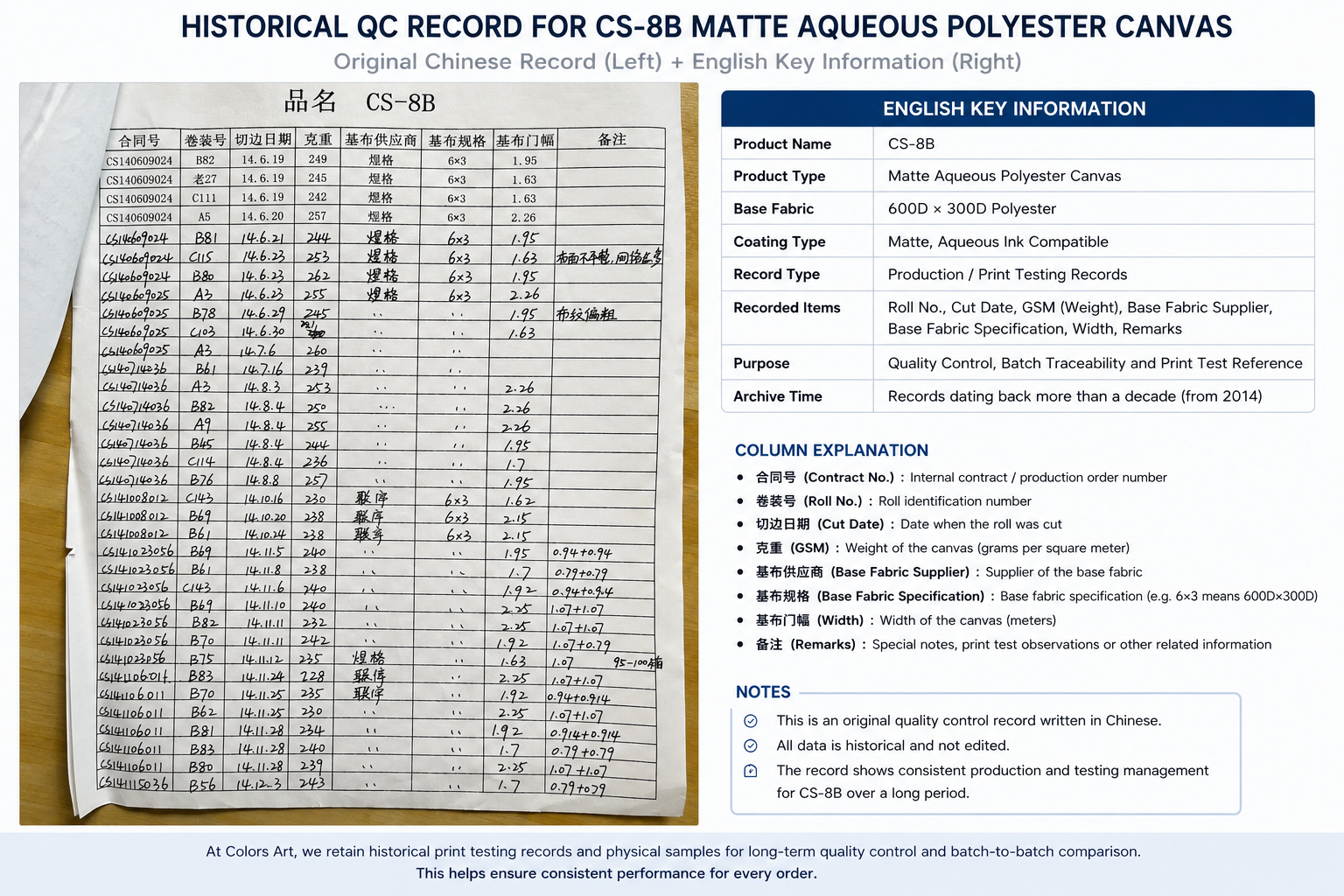
Our archived CS-8B test samples provide a useful real-world example.
CS-8B is a 600D × 300D matte aqueous polyester canvas.
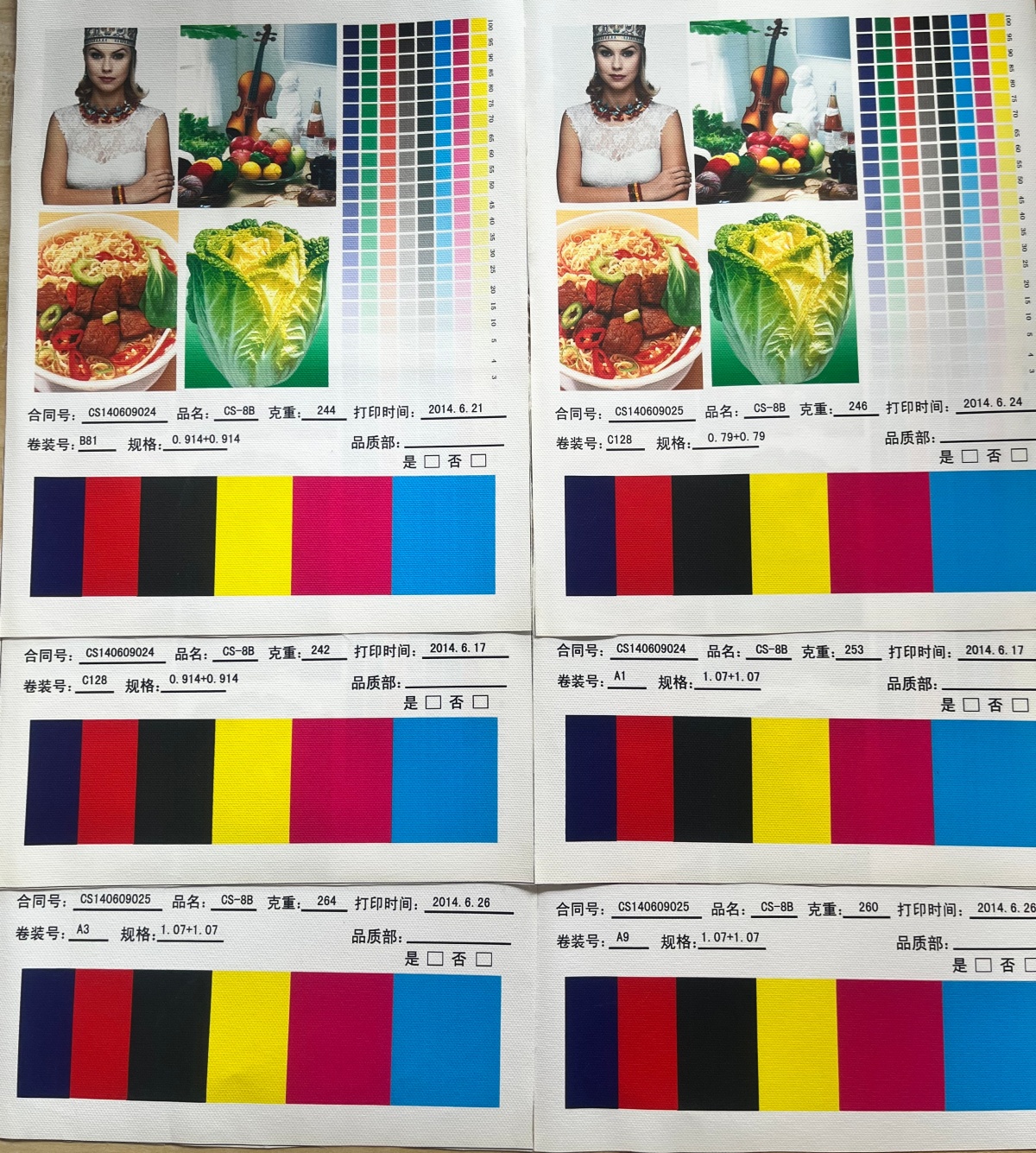
The physical printed samples shown below date back to 2014 and were retained for historical batch and print-performance comparison.
Archived CS-8B matte aqueous polyester canvas print samples from 2014, retained for historical batch and print-performance comparison.
Retaining physical print samples allows our QC team to look back at:
overall color response;
solid-color appearance;
tonal behavior;
canvas surface after printing;
and visible differences between production records.
The objective is not to claim that every textile production sample is mathematically identical.
The objective is to maintain the approved product characteristics and identify meaningful changes when they occur.
3. Different Ink Systems Require Different Canvas Coatings
Printable canvas performance is strongly influenced by the ink-receptive coating.
Different ink systems place different requirements on the canvas surface.
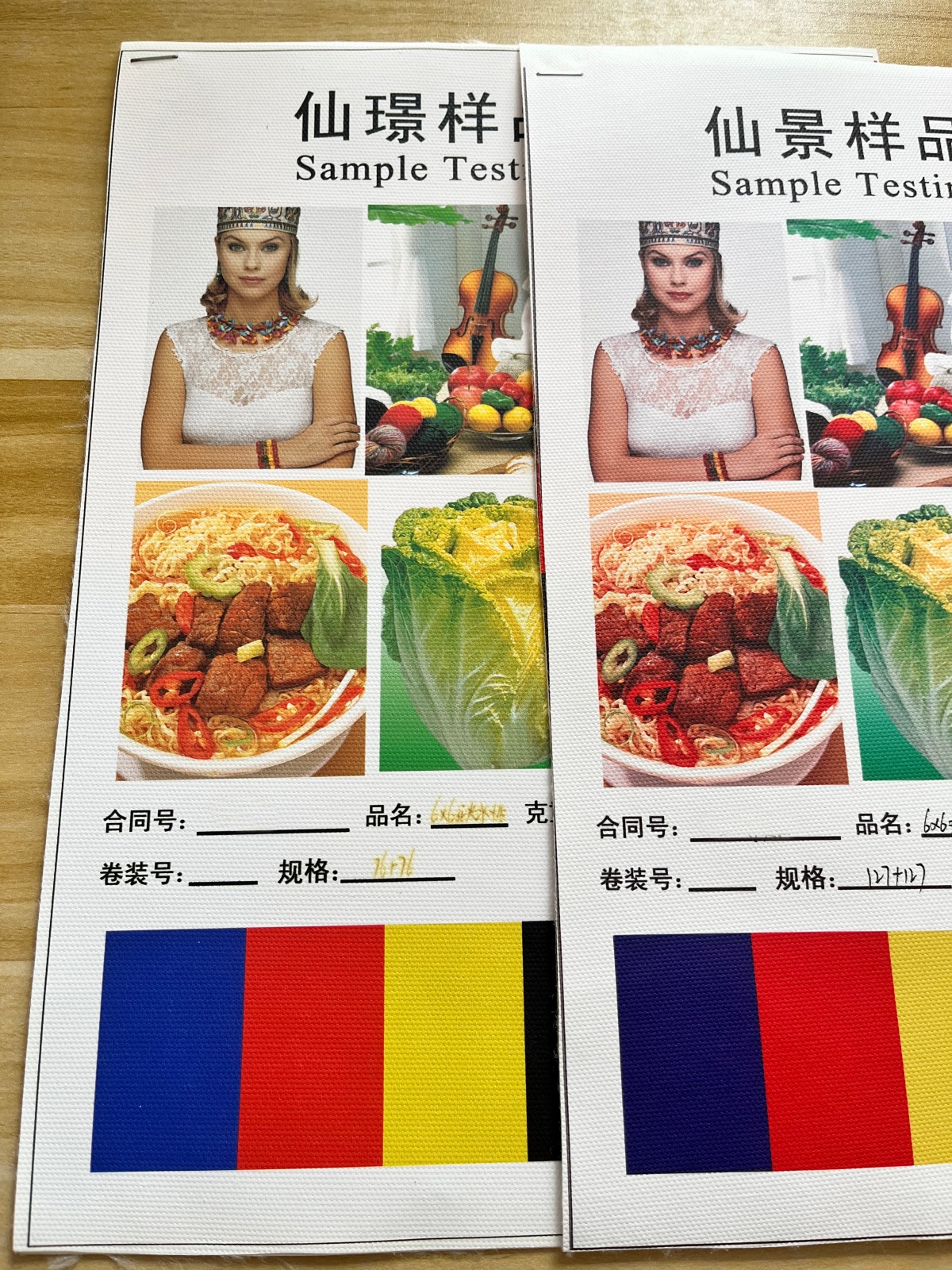
The comparison below shows two actual printed canvas samples:
Left: Matte Aqueous Canvas
Right: Matte Eco-Solvent Canvas
Although both products have a matte appearance, their coatings are designed for different printing technologies.
Side-by-side comparison of matte aqueous canvas on the left and matte eco-solvent canvas on the right, showing differences between two ink-receptive coating systems.
This is why printable canvas should not be classified only by material, GSM or finish.
The intended ink technology + coating chemistry are equally important.
Different coating systems can produce differences in:
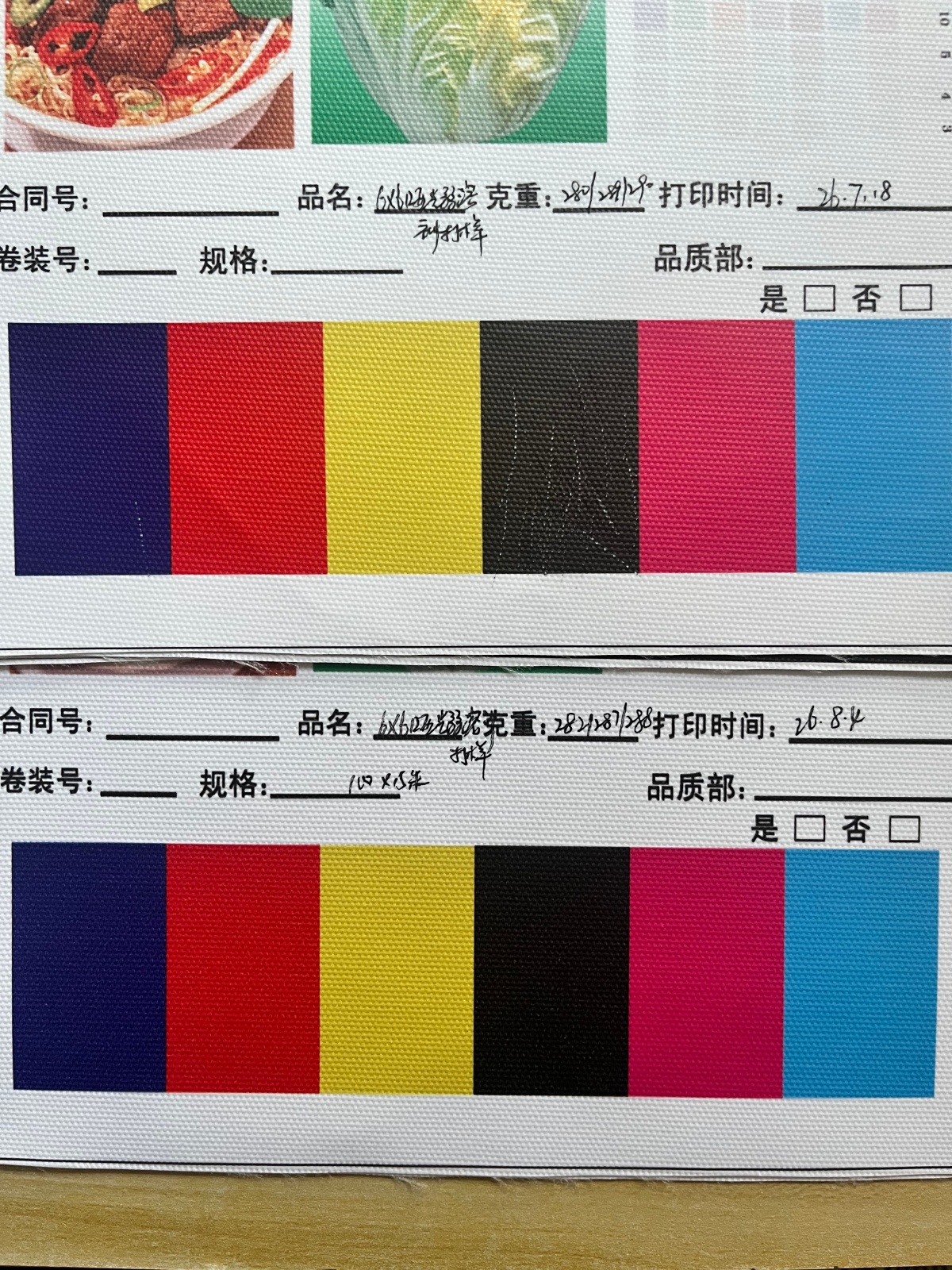
5. Color Gradients Reveal More Than Solid Color Blocks
Solid colors are useful for checking color density and obvious coating problems, but they do not tell the whole story.
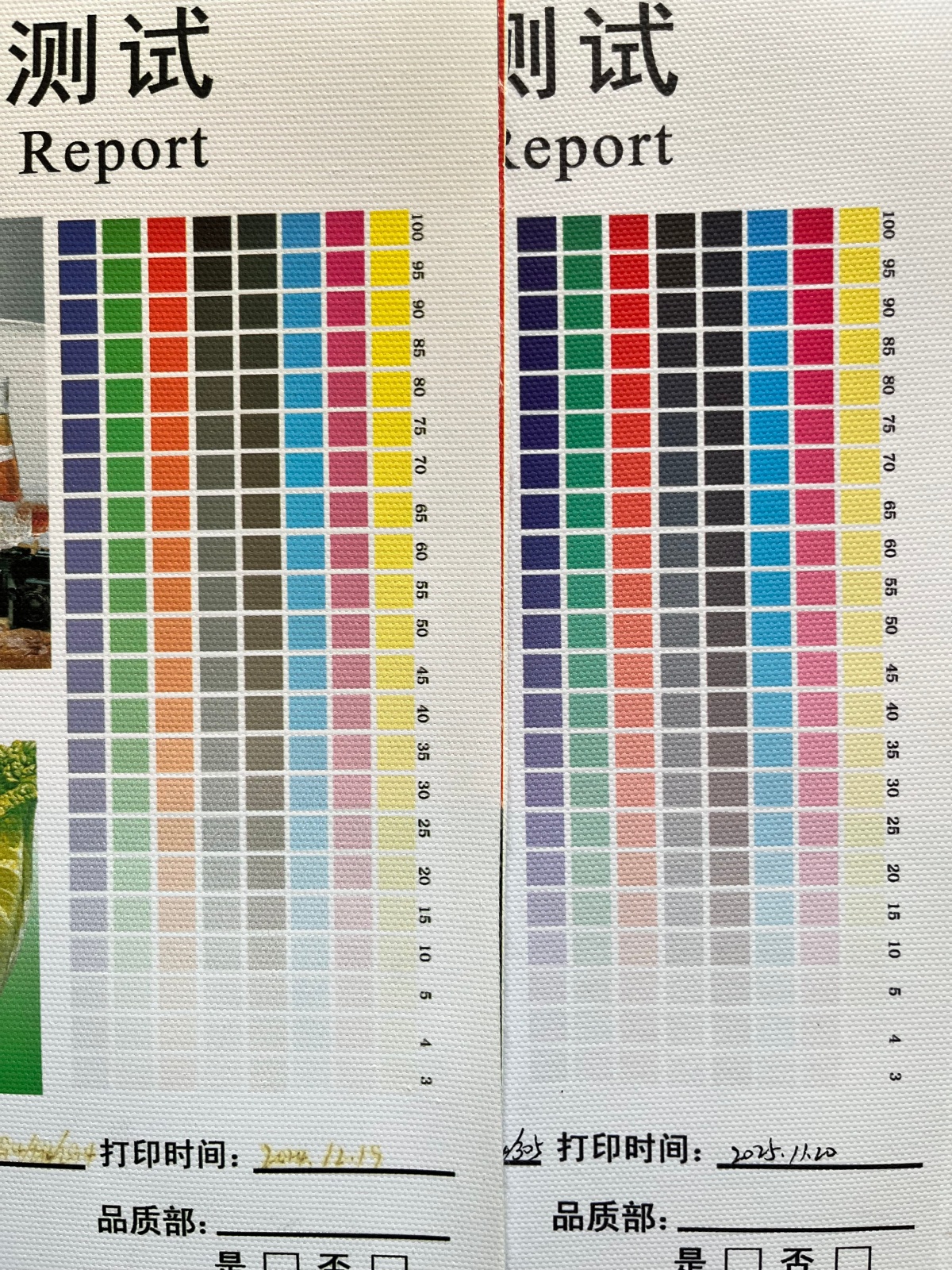
Gradient patterns help reveal more subtle differences in how the coating receives and controls ink.
Color-gradient print samples used to compare tonal transitions, ink response and coating performance on printable canvas.
During this type of test, our team can observe:
light-to-dark tonal transitions;
color build-up;
ink response;
solid-color density;
shadow behavior;
and visible coating differences.
A canvas that looks acceptable when printing a large solid red or blue block may behave differently when reproducing:
skin tones;
fine gradients;
deep shadows;
highlights;
neutral tones;
and subtle color transitions.
A real printing test reveals information that GSM alone cannot show.
6. Scratch Resistance Depends on the Canvas Coating System
Scratch resistance is another performance characteristic that should be evaluated independently.
Not every printable canvas is designed to provide the same level of surface durability.
The samples below show a side-by-side comparison between scratch-resistant and non-scratch-resistant printable canvas coatings.
Side-by-side print samples comparing scratch-resistant and non-scratch-resistant printable canvas coatings as part of coating performance evaluation.
This type of physical comparison helps evaluate how different coating formulations respond to surface abrasion after printing.
Importantly:
Waterproof performance and scratch resistance are not the same property.
Our matte aqueous printable canvas products are waterproof, but matte aqueous canvas is not classified as scratch resistant.
Scratch-resistant performance requires a suitable coating formulation and should be selected according to the printing technology, handling conditions and final application.
This becomes particularly important when printed canvas will go through:
cutting;
stretching;
framing;
packing;
shipping;
and repeated production handling.
7. Compatible Does Not Always Mean Optimized
Another common misunderstanding appears when one canvas can technically accept more than one ink technology.
For example, some solvent-compatible coating systems may also be printable using Latex ink.
But successful ink acceptance does not automatically mean that the same coating is optimized for Latex in terms of:
color response;
surface condition;
ink adhesion;
scratch resistance;
and final print appearance.
Compatible does not always mean optimized.
This is why actual printer testing is important.
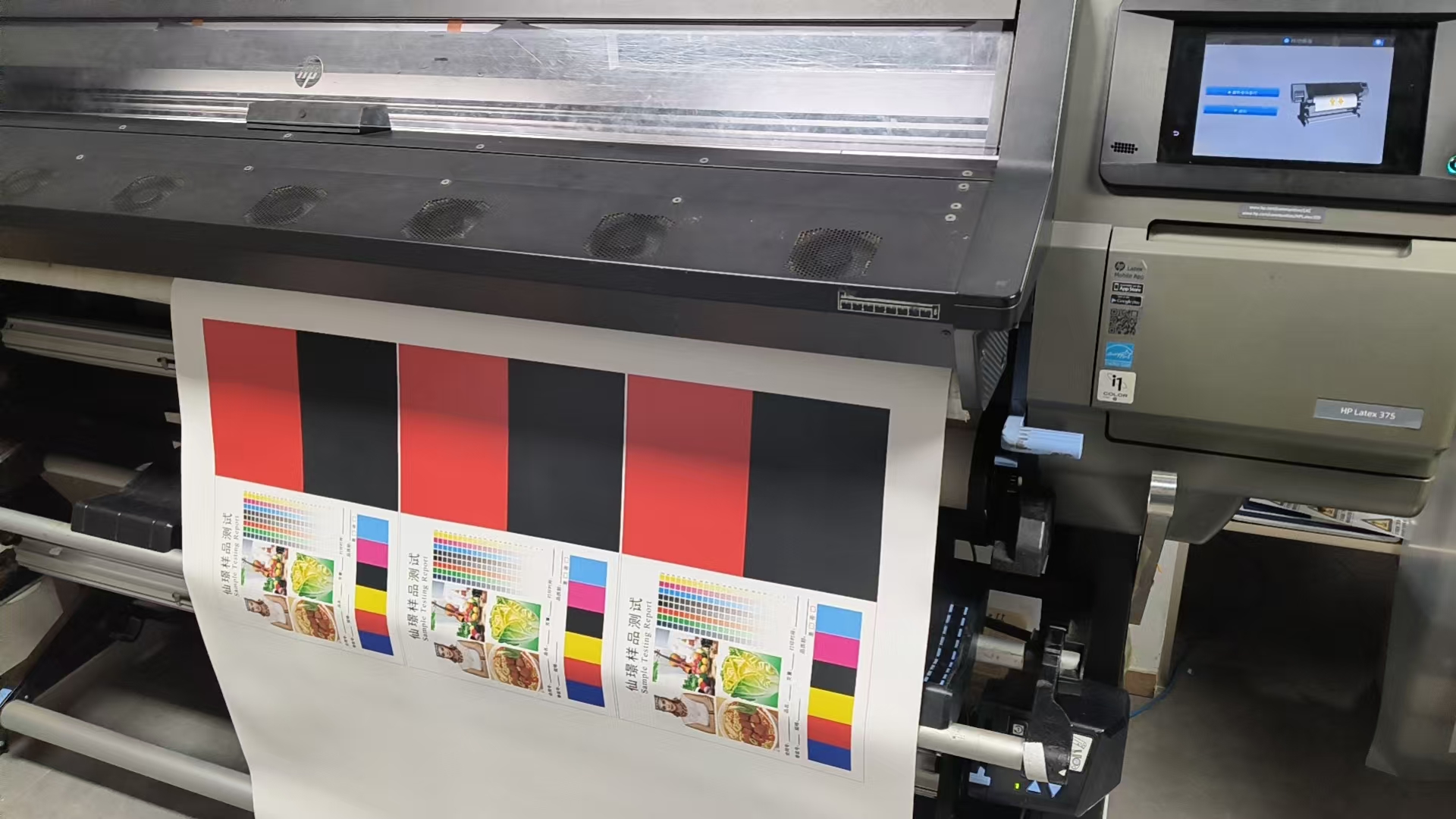
8. Actual Printer Testing Is Part of Printable Canvas Evaluation
Laboratory inspection can identify many coating and fabric issues, but printable media ultimately has to perform on a printer.
Colors Art therefore uses actual printers as part of product development and quality evaluation.
Printable canvas undergoing an actual print test on an HP Latex 375 at the Colors Art factory.
A specification sheet can tell us:
GSM;
material;
width;
fabric construction;
and basic product specifications.
But it cannot completely show how a particular coating will interact with a specific printer and ink system.
Actual print testing provides a much more practical reference for:
color reproduction;
ink response;
surface behavior;
tonal reproduction;
and printing compatibility.
HP also publishes technical guidance for its Latex printing systems. Buyers using HP Latex printers can refer to HP's official technical resources for printer-specific information.
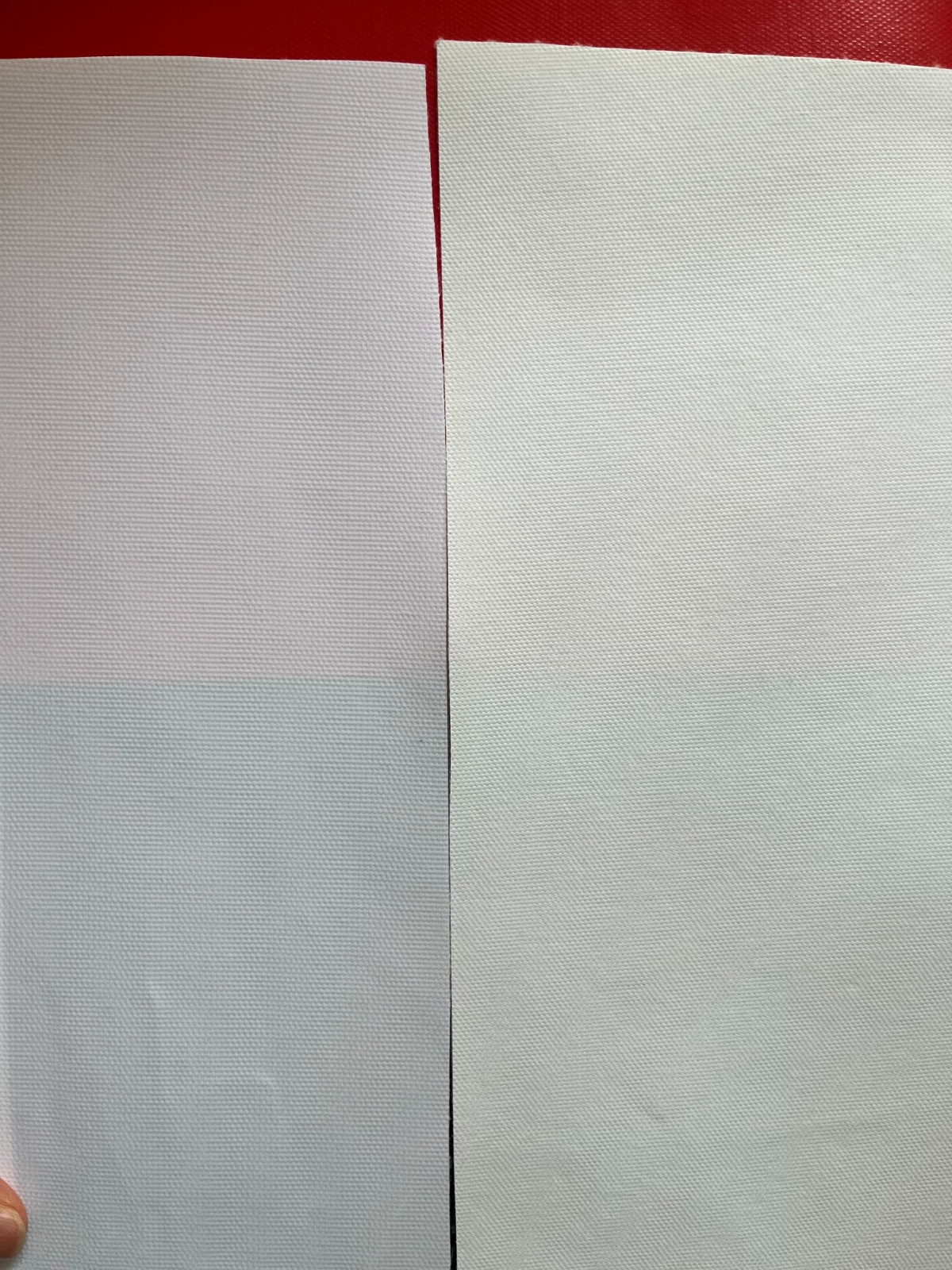
9. Surface Appearance and Opacity Should Be Evaluated Separately
Print performance is not the only characteristic that can differ between printable canvases.
The unprinted surface can also show differences in:
whiteness;
surface uniformity;
texture;
coating coverage;
and opacity.
Side-by-side printable canvas samples used to compare surface appearance, whiteness and opacity.
Opacity is especially important for wall-art and stretched-canvas applications because insufficient hiding power can allow the background or stretcher structure to affect the finished visual result.
This is another reason why buyers should not assume:
Higher GSM = automatically higher opacity.
Professional media manufacturers normally list opacity separately from GSM.
For example, Fujifilm provides independent specifications for weight, opacity, caliper and surface characteristics on its professional canvas media.