Standard Wooden Stretcher Bars
Standard Wooden Stretcher Bars for Professional Canvas Production
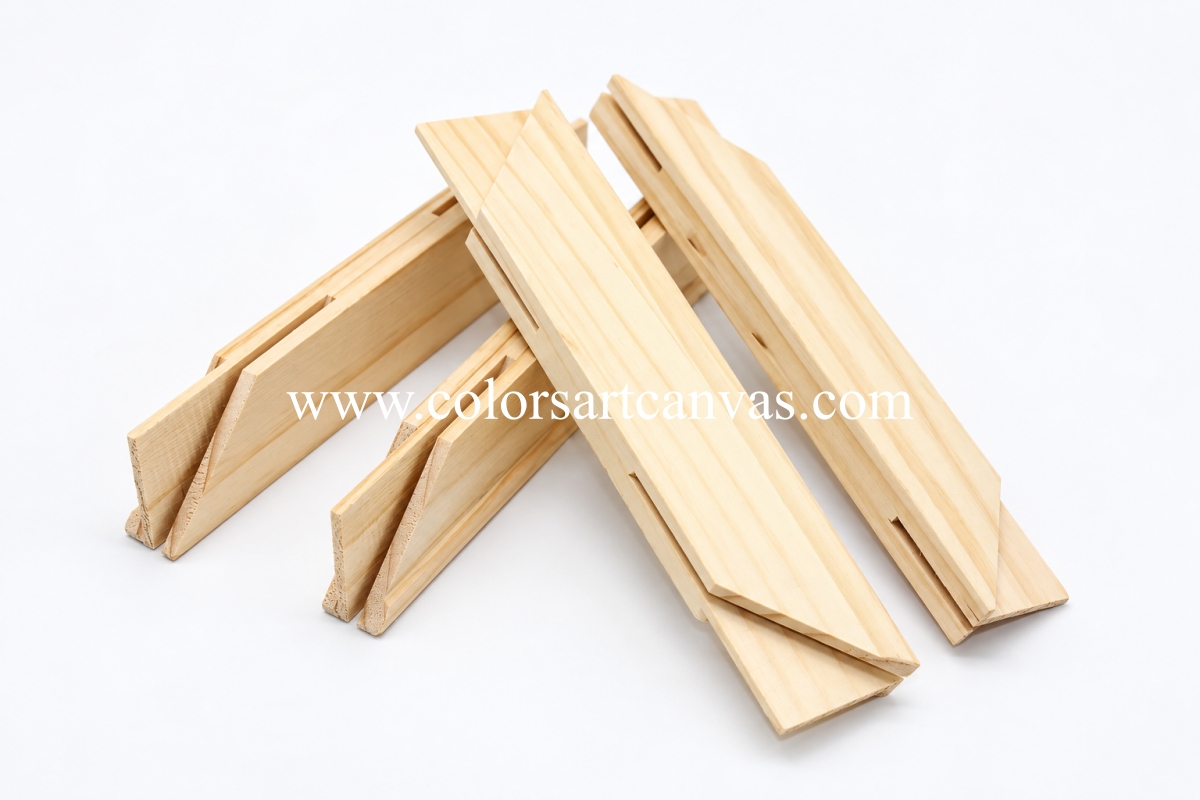
Standard wooden stretcher bars form the internal supporting structure behind stretched canvas, artist canvas, printed canvas and framed wall art. They are commonly selected when the finished canvas requires a moderate frame depth and does not need the deeper visible side profile of a gallery wrap frame or the larger wooden section normally associated with heavy-duty stretcher bars.
Colors Art manufactures wooden canvas stretcher bars for professional B2B production. Our standard-profile range is supplied to canvas printing factories, artist canvas manufacturers, framing companies, wall-art producers, art supply distributors, wholesalers and OEM/private-label canvas programs.
Rather than selecting a stretcher bar only by price or nominal size, professional buyers should compare the actual profile width and depth, canvas-contact edge, joint structure, wood grade, moisture condition, straightness and support configuration. These factors directly influence frame assembly, canvas tension and repeat production consistency.
Quick Specification Overview
The following table summarizes the main purchasing points for Colors Art standard wooden stretcher bars. Exact specifications should still be confirmed on the individual product page or during OEM sample approval.
| Purchase Checkpoint | Colors Art Standard Stretcher Bar Capability |
|---|---|
| Product Type | Standard wooden canvas stretcher bars |
| Main Material | Kiln-dried pine / fir depending on individual profile and product specification |
| Wood Selection | Selected knot-free pine and selected small-knot wood options depending on product requirement |
| Finished Moisture Requirement | ≤12% |
| Confirmed Standard Profile Examples | 16 × 30 mm, 17 × 30 mm, 17 × 38 mm, 18 × 37 mm, 18 × 38 mm, 18 × 40 mm |
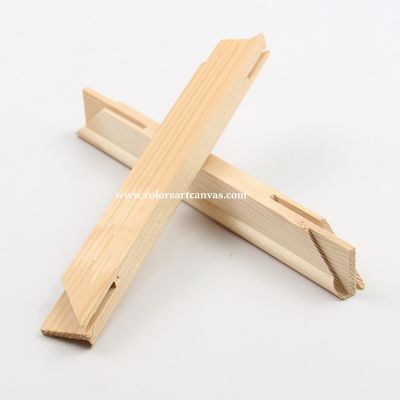
| Joint Options | Tongue-and-groove, tenoned and other confirmed joint structures depending on the individual product |
| Supporting Components | Cross bars, supporting bars and wooden wedges available according to frame size and construction |
| Supply Form | Loose stretcher bars or assembled wooden canvas frames |
| Customization | Profile dimensions, lengths, joints, wood grade, support configuration, packing and private-label programs |
| Main Applications | Stretched canvas, artist canvas, printed canvas, framed canvas and wall-art production |
| Factory QC | Moisture, profile dimensions, length, straightness, machining, joint fit, surface condition and packing |
When Is a Standard Stretcher Bar the Right Choice?
A deeper or heavier stretcher bar is not automatically better. The correct profile is the one that provides sufficient stiffness, appropriate canvas clearance and efficient assembly for the finished canvas product.
Standard profiles are commonly used for regular stretched canvas, artist canvas, framed canvas and volume printed-canvas production where a moderate overall depth is preferred. If the canvas will later sit inside a decorative outer frame, a standard profile can also help control the total finished thickness.
For products where the wrapped canvas edge itself is part of the visual presentation, a deeper gallery-wrap profile may be more suitable. For oversized frames or long unsupported spans, a larger wooden section and suitable supporting bars should be evaluated.
See the complete Colors Art wooden stretcher bar range for standard, gallery-wrap, heavy-duty and supporting-bar solutions.
Standard Stretcher Bar Profiles and Actual Dimensions
Standard stretcher bars are not defined by one universal cross-section. Different markets and canvas-production systems use different widths, depths, edge shapes and joint structures. Colors Art currently manufactures multiple standard-profile sizes.
| Profile Size | Known Product / Positioning | Important Buying Point |
|---|---|---|
| 16 × 30 mm | Economy / compact standard stretcher bar profile | Suitable for applications where a relatively compact wooden section meets the finished-frame requirement |
| 17 × 30 mm | Standard tenoned stretcher bar profile | Joint structure and actual cross-section should be confirmed before matching an existing frame system |
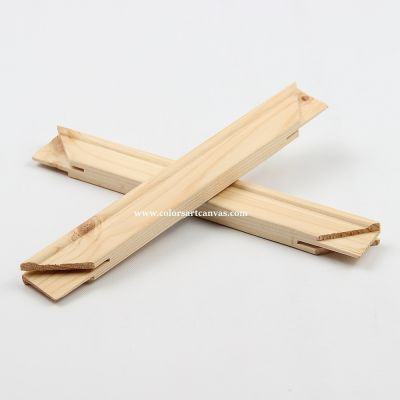
| 17 × 38 mm | Knot-free pine tenoned stretcher bar | Available with machined tenon construction and raised rounded canvas-contact edge on the confirmed product version |
| 18 × 37 mm | Standard wooden stretcher bar profile | Actual profile dimensions should be used for OEM matching rather than relying only on nominal trade descriptions |
| 18 × 38 mm | Knot-free pine standard stretcher bar | Confirmed Colors Art version uses double rounded edges and tongue-and-groove corner joints |
| 18 × 40 mm | Standard deeper-profile wooden stretcher bar | Provides slightly greater overall profile depth than 18 × 38 mm; exact geometry should still be checked separately |
Similar overall dimensions do not necessarily mean the profiles are interchangeable. Two stretcher bars may have comparable width and depth while using different slopes, rounded edges, raised lips, joints, slots or back structures.
For OEM matching, buyers should therefore confirm the actual cross-section, profile width, profile depth and joint geometry rather than sourcing only by a nominal size description.
For detailed examples, see our 18 mm × 38 mm Knot-Free Pine Stretcher Bars and 17 mm × 38 mm Knot-Free Pine Tenoned Stretcher Bars .
Kiln-Dried Timber and Wood Grade Selection
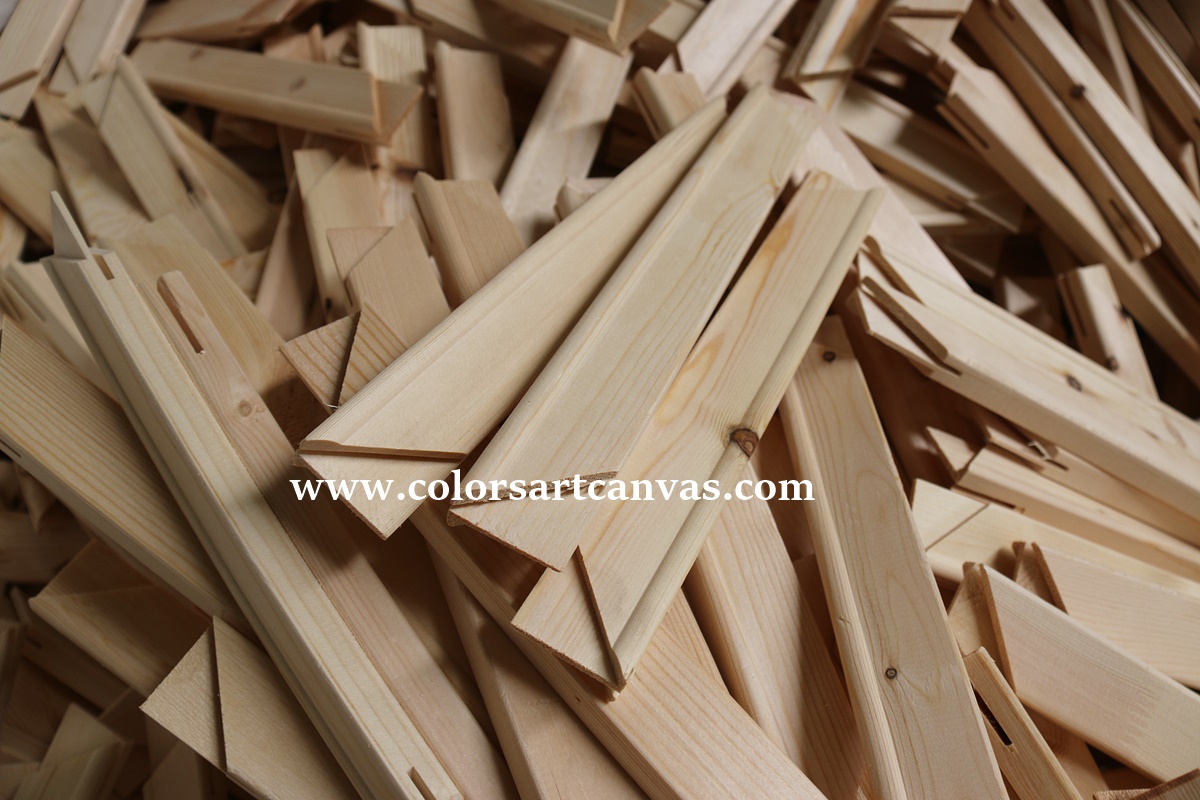
Wood condition is one of the most important variables in wooden stretcher-bar production. Timber naturally responds to changes in moisture and humidity, so inappropriate moisture condition can increase the risk of movement, bowing, twisting, joint opening or changes in canvas tension.
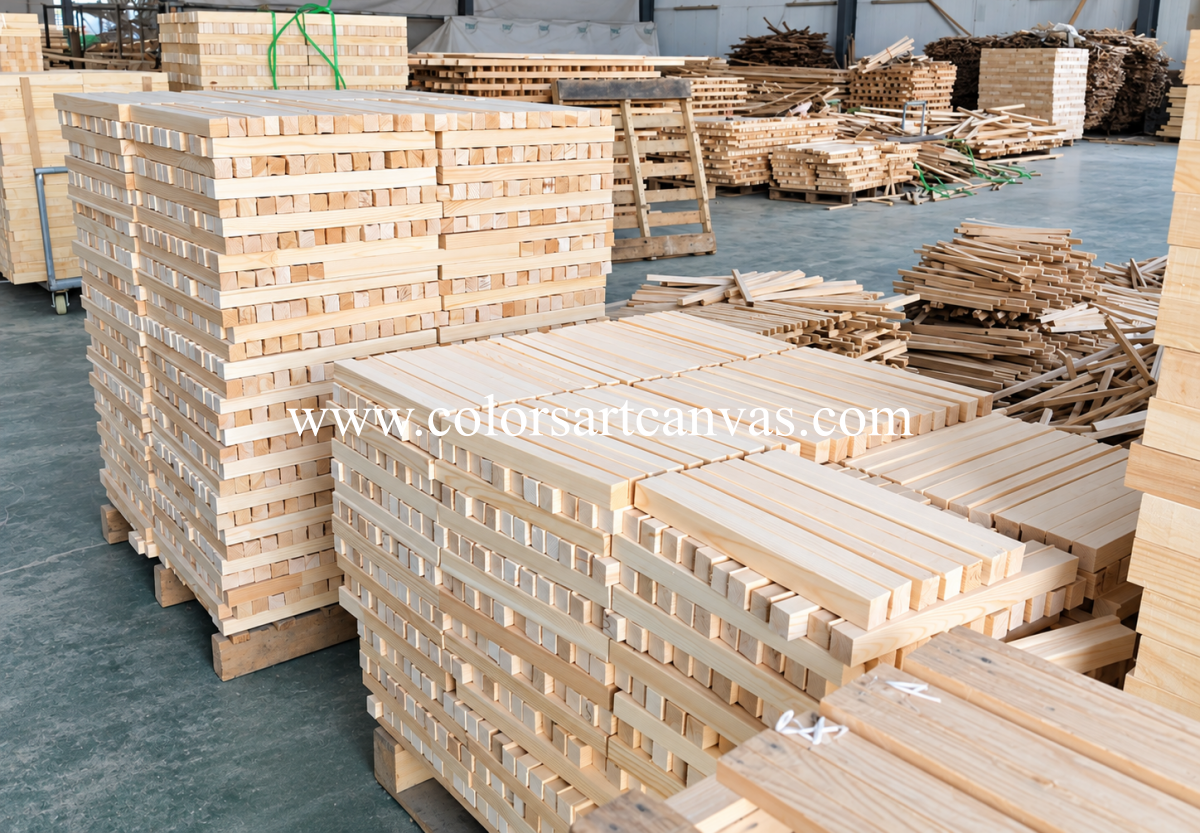
Colors Art uses kiln-dried timber for wooden stretcher-bar production and controls finished stretcher-bar moisture to ≤12% under our current production requirement.
Different wood grades can be selected according to the finished product and target market. Selected knot-free pine is suitable when customers require cleaner appearance and more uniform visual quality. Selected small-knot wood can be considered for suitable programs where controlled sound knots are acceptable and material cost is also an important purchasing factor.
Wood grade should therefore be confirmed together with the profile, frame size, appearance requirement and target market rather than treated only as a cosmetic specification.
Canvas-Contact Edge and Profile Geometry
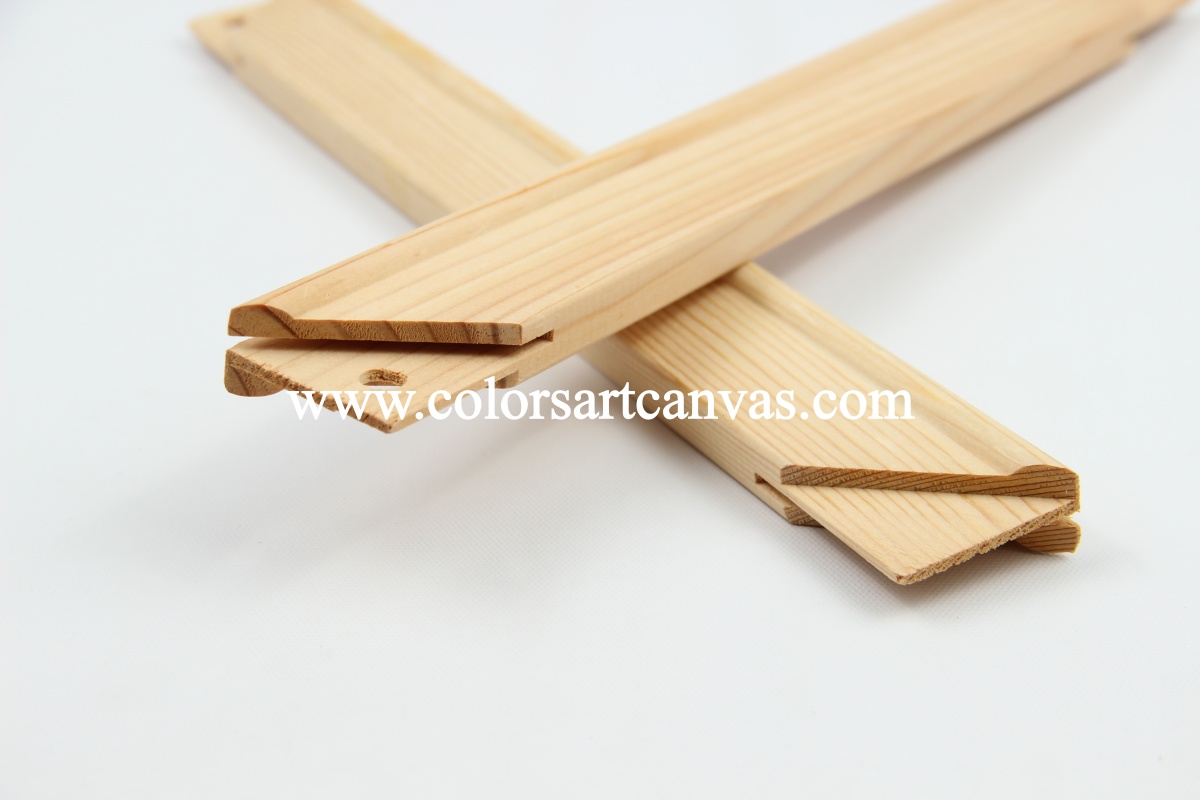
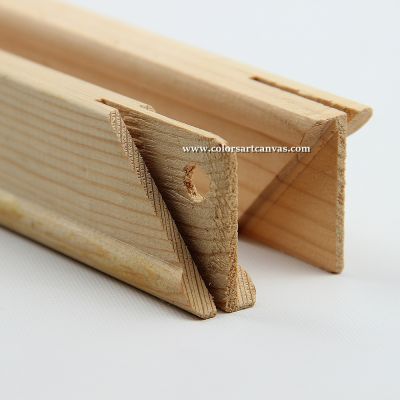
A stretcher bar is not simply a rectangular piece of timber. The front working profile is designed so the stretched canvas is supported mainly around the outer edge of the frame rather than resting flat against the full inner wooden surface.
Depending on the product, Colors Art stretcher bars may use raised, rounded, sloped or other shaped canvas-contact edges. The exact geometry differs by profile and should not be inferred only from the overall width and depth.
For example, the current 18 mm × 38 mm knot-free pine stretcher bar uses a double rounded edge, while the 17 mm × 38 mm tenoned profile uses a raised outer edge with a rounded canvas-contact surface.
Jackson’s Art also explains the general stretcher-bar principle: traditional wooden bars use a raised or sloping front so that the canvas contacts the outer rim rather than the full face of the timber. See the independent Jackson’s Art guide to stretcher bars .
Joint Design and Repeatable Frame Assembly
For canvas manufacturers assembling hundreds or thousands of frames, joint consistency becomes much more important than it is for a single handmade canvas.
Differences in machining can affect how easily the bars assemble, whether the corners close correctly and whether the finished rectangle maintains the intended dimensions.
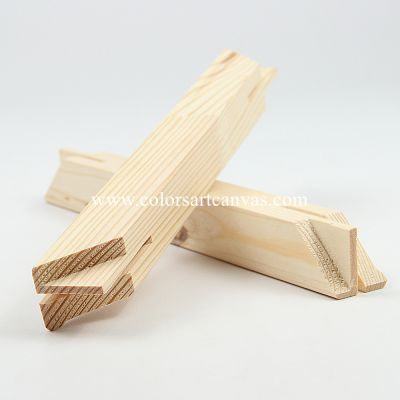
Colors Art produces different joint structures according to the individual product design. Confirmed examples in the current standard range include:
- 18 × 38 mm: precision-machined tongue-and-groove corner joint
- 17 × 38 mm: machined tenon joint with pre-notched construction
- Other profiles: joint type should be confirmed according to the individual product specification
For OEM production, customers can also provide an existing sample or technical drawing so that profile geometry, joint structure and assembly fit can be evaluated before repeat production.
When Should Cross Bars or Supporting Bars Be Used?
As frame dimensions increase, canvas tension produces greater force on the wooden structure. Additional support may therefore be required to reduce bowing, twisting and unwanted movement.
The need for a supporting bar should not be determined by one universal canvas dimension. Important factors include:
- finished frame width and height
- longest unsupported span
- stretcher bar width and depth
- wood condition and profile rigidity
- canvas material and stretching tension
- frame aspect ratio
- handling and export-shipping requirements
Colors Art can supply cross bars and supporting bars according to the frame size and construction. For some frame systems, larger sizes may use one or multiple braces, but the final arrangement should be confirmed against the actual profile and finished frame dimensions.
This is also why cross-bracing rules should not simply be copied from another manufacturer's catalogue. Different bar depths and constructions can require different support thresholds. Jackson’s Art, for example, uses different center-bar recommendations for different stretcher-bar ranges and depths. Read the independent center-bar and crossbar guide .
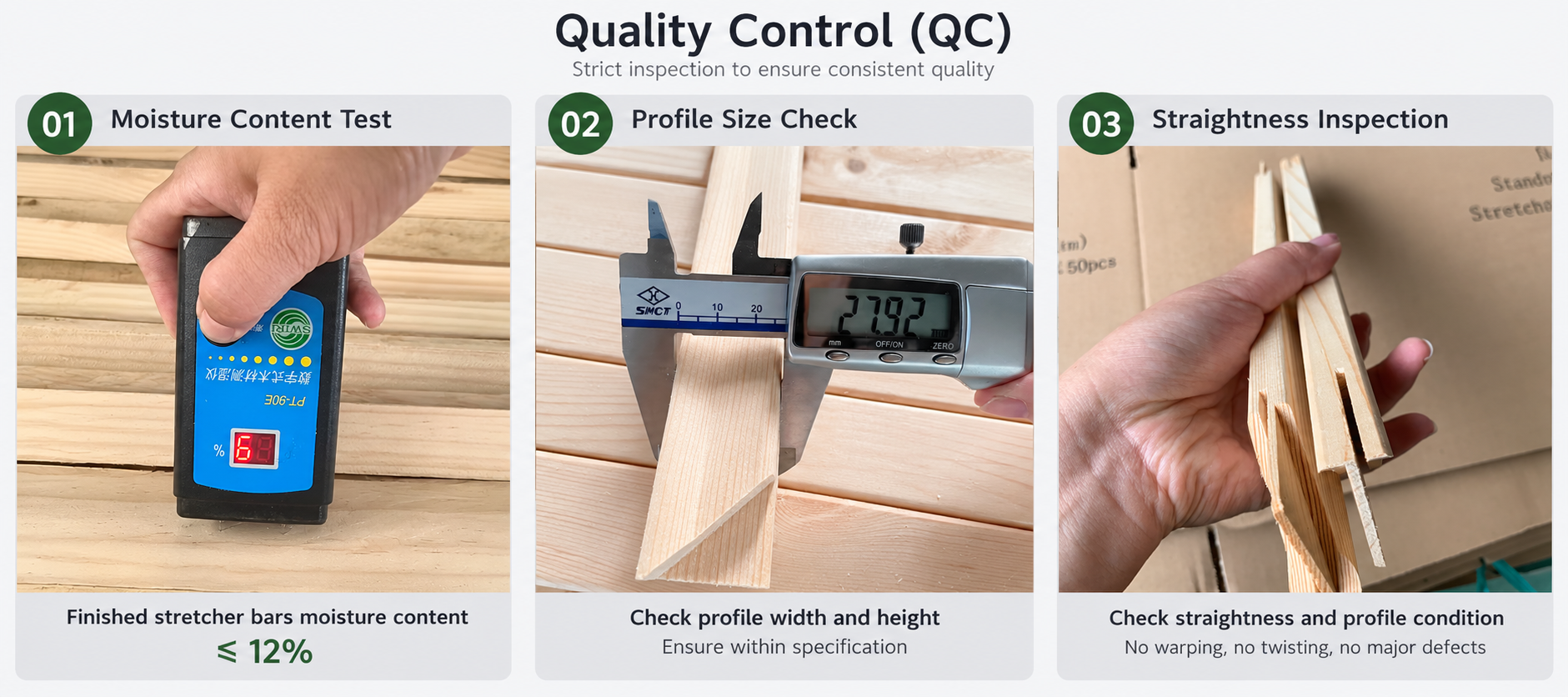
Factory Quality Control for Finished Stretcher Bars
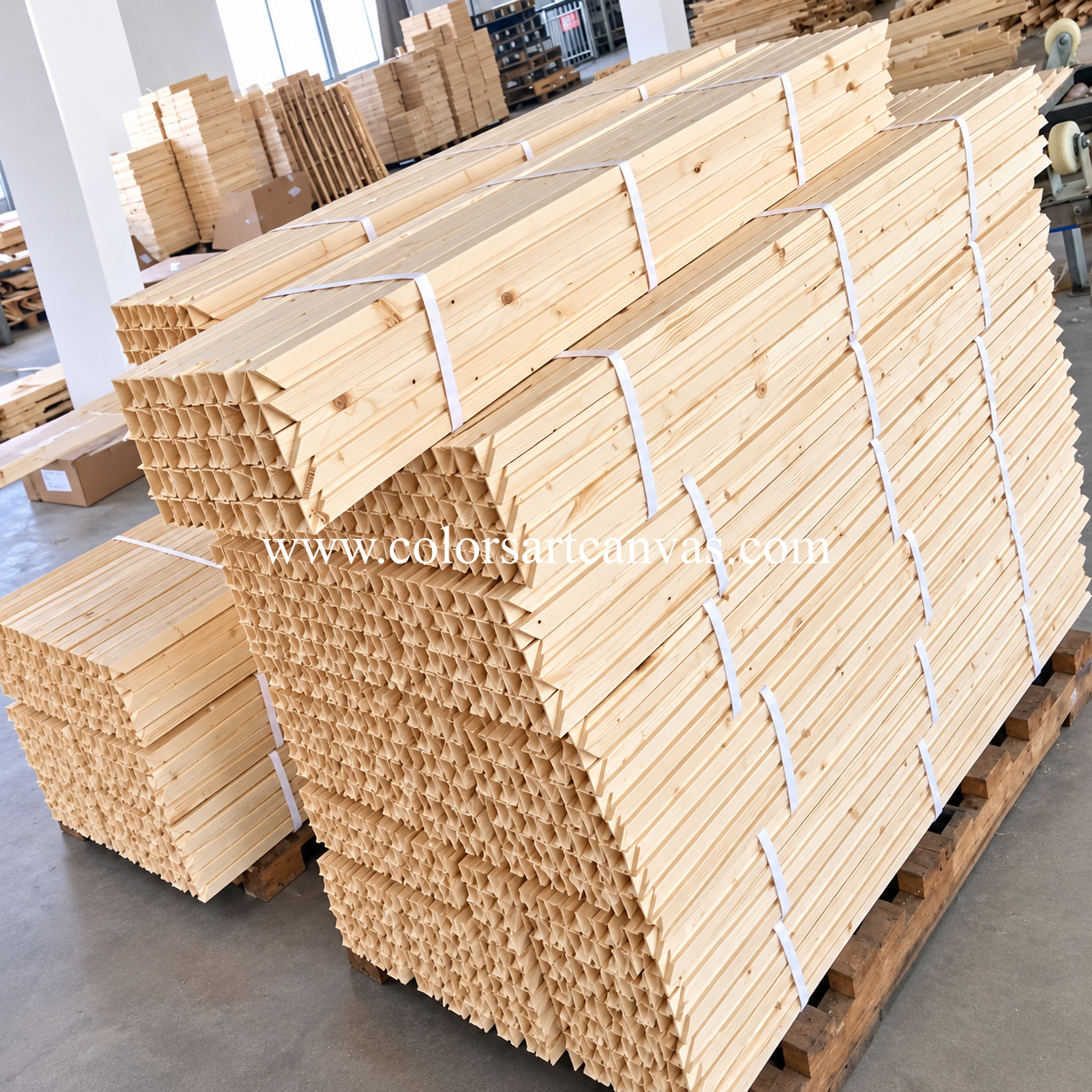
For bulk canvas-frame production, approving one visually good sample is not enough. Repeat-order quality depends on whether moisture, dimensions, machining and straightness remain within the confirmed specification across production batches.
Our finished stretcher-bar quality-control process focuses on practical characteristics that directly affect downstream frame assembly.
1. Finished Wood Moisture Inspection
A moisture meter is used to check finished wooden stretcher bars. Our current finished stretcher-bar moisture requirement is ≤12%.
2. Profile Width and Depth Measurement
Digital calipers are used to verify the profile width and depth against the confirmed specification. This is particularly important when customers are matching an existing frame system or require repeat production from an approved sample.
3. Straightness Inspection
Long wooden bars are checked for visible bowing, twisting and deformation that could interfere with assembly or cause an assembled frame to sit unevenly.
Additional Inspection Points
- bar length
- visible wood defects
- surface machining and sanding
- joint machining
- corner fit
- cross-bar slot or support preparation when required
- packing condition before shipment
How to Select a Standard Stretcher Bar Profile
| Buyer Requirement | What Should Be Checked |
|---|---|
| Regular stretched canvas | Profile depth, finished canvas dimensions and canvas tension |
| Canvas inside a decorative frame | Overall finished depth and clearance inside the outer frame |
| High-volume canvas production | Profile consistency, joint fit, assembly efficiency and packing |
| Larger canvas sizes | Profile rigidity, longest unsupported span and brace configuration |
| Premium clean wood appearance | Knot-free or stricter selected wood grade |
| Cost-sensitive wholesale program | Suitable profile, acceptable wood grade and optimized packing |
| Existing customer frame system | Actual cross-section, joint, dimensions and sample assembly fit |
Standard vs. Gallery Wrap vs. Heavy-Duty Stretcher Bars
Stretcher-bar category should be selected according to the finished canvas structure, not simply by choosing the largest available profile.
| Type | Typical Use | When to Choose It |
|---|---|---|
| Standard Wooden Stretcher Bars | Regular stretched canvas, artist canvas, framed canvas and volume canvas production | Choose when moderate frame depth and efficient material use meet the finished product requirement |
| Gallery Wrap Stretcher Bars | Photo canvas, frameless wall art and deep-edge wrapped canvas | Choose when the visible side depth is part of the finished wall-art appearance |
| Heavy-Duty Stretcher Bars | Large-format and oversized canvas frames | Choose when longer spans, frame size or tension require greater structural rigidity |
A standard profile can therefore be the more efficient option when the side of the canvas will be hidden by an outer frame or when a deep gallery-wrap appearance is unnecessary. This same decision logic is now commonly used by specialist stretcher-bar manufacturers when helping buyers compare standard, gallery-wrap and heavy-duty profiles.
OEM and Custom Standard Stretcher Bar Development
Colors Art supports OEM production for buyers who already have an established stretcher-bar system or require a market-specific profile.
For an accurate technical evaluation, buyers should provide as many of the following details as possible:
- actual profile width and depth
- cross-section drawing or clear profile photograph
- bar lengths or finished frame sizes
- wood species or wood-grade requirement
- corner joint type
- required assembly fit
- cross-bar or supporting-bar layout
- wooden wedge requirement
- packing method
- estimated purchasing quantity
If the requested profile already exists in the customer's current supply chain, a physical sample can also be evaluated together with confirmed dimensions. This is particularly useful when the overall size looks similar to an existing Colors Art profile but the actual cross-section or joint geometry is different.
Who Buys Standard Wooden Stretcher Bars?
Standard wooden stretcher bars are mainly supplied into professional canvas and framing production rather than only individual artist use.
- canvas printing factories
- stretched canvas manufacturers
- artist canvas manufacturers
- picture framing companies
- photo canvas and wall-art producers
- art supply distributors
- framing wholesalers
- OEM and private-label canvas brands
For these buyers, repeatability is especially important because even small differences in profile geometry or joint fit can become significant when thousands of frame components are assembled in continuous production.
What Information Should You Provide for a Quotation?
Providing the correct technical information at the beginning reduces unnecessary sampling and makes it easier to compare equivalent stretcher-bar specifications.
For a new inquiry, please provide:
- profile width and depth
- bar length range or finished frame sizes
- wood species and appearance-grade requirement
- corner or joint configuration
- cross-bar requirements
- estimated quantity
- packing requirement
- drawing, cross-section image or reference sample when available
If the current stretcher bar is already in production, sending an actual profile drawing or physical sample can be more useful than supplying only a trade name such as “standard”, “3/4 inch” or “gallery profile”.
Related Stretcher Bar Products and Technical Resources
- Wooden Canvas Stretcher Bars — Browse the complete Colors Art stretcher bar range including standard, gallery-wrap, heavy-duty and supporting-bar solutions.
- 18 mm × 38 mm Knot-Free Pine Stretcher Bars — Standard 18 mm × 38 mm profile with selected knot-free pine, double rounded edges and tongue-and-groove joints.
- 17 mm × 38 mm Knot-Free Pine Tenoned Stretcher Bars — Tenoned standard profile with pre-notched construction and a raised, rounded canvas-contact edge.
- Canvas Stretcher Bars: Wood, Profiles, Sizes and Buyer’s Guide — Technical guidance covering wood selection, profile design, canvas-contact edges, bracing and bulk purchasing considerations.
Frequently Asked Questions About Standard Wooden Stretcher Bars
What is a standard wooden canvas stretcher bar?
A standard wooden stretcher bar is a structural frame component used behind stretched canvas. Compared with deeper gallery-wrap profiles, standard stretcher bars generally use a more moderate profile depth suitable for regular stretched canvas, framed canvas and volume canvas production.
Which standard profile sizes does Colors Art manufacture?
Colors Art manufactures multiple standard-profile sizes. Confirmed examples include 16 × 30 mm, 17 × 30 mm, 17 × 38 mm, 18 × 37 mm, 18 × 38 mm and 18 × 40 mm. Exact cross-section geometry and joint design should be checked on the individual product.
Are 18 × 38 mm and 18 × 40 mm stretcher bars the same?
No. Their overall dimensions are different, and the actual profile geometry may also differ. Even profiles with similar dimensions should not be treated as interchangeable without checking the cross-section, canvas-contact edge and joint structure.
What wood is used for Colors Art standard stretcher bars?
The material depends on the individual product. Colors Art manufactures wooden stretcher bars from kiln-dried pine and fir profiles, with selected knot-free and selected small-knot options available according to the required product specification.
What is the finished moisture requirement?
Our current finished stretcher-bar moisture requirement is ≤12%. Moisture testing forms part of factory quality control.
How are profile dimensions checked?
Profile width and depth can be checked using digital calipers against the confirmed product specification. This is especially important for repeat OEM production and for matching an existing frame system.
How do you inspect stretcher-bar straightness?
Finished wooden bars are checked for visible bowing, twisting and other deformation that could affect assembly or the flatness of the finished canvas frame.
What joint types are available?
Joint structure depends on the individual profile. Confirmed Colors Art standard products include tongue-and-groove and machined tenon configurations. Other structures should be confirmed against the relevant product or OEM specification.
When are supporting bars required?
Supporting bars should be considered as frame dimensions and unsupported spans increase. The final brace configuration depends on profile size, canvas tension, frame geometry and the complete structure rather than one universal size rule.
Can Colors Art reproduce an existing stretcher-bar profile?
Existing profiles can be evaluated from confirmed dimensions, cross-section drawings, clear photographs or physical samples. The profile geometry, joint design and assembly requirements should be approved before repeat OEM production.
Do you supply loose bars and assembled frames?
Yes. Depending on the product and project requirement, Colors Art can supply loose wooden stretcher bars, supporting components or assembled canvas frames.
Can the packing be customized for wholesale or private-label orders?
Yes. Packing, labels and private-label requirements can be evaluated as part of an OEM stretcher-bar program.
Request a Quote for Standard Wooden Stretcher Bars
Send us your required profile dimensions, bar lengths or finished frame sizes, wood requirement, joint type, supporting-bar requirement, quantity and packing details.
For an existing frame system, a cross-section drawing, technical drawing or physical sample can also be provided for profile and assembly evaluation.
Contact Colors Art for standard, custom and OEM wooden stretcher bars for professional canvas manufacturing, framing and wholesale supply.
Technical reference: For an independent explanation of stretcher-bar profile geometry, canvas-contact edges and center/cross-bar functions, see Jackson’s Art — A Guide to Stretcher Bars .
- 1/1