Blog
Canvas Stretcher Bars: A Complete Guide to Wood, Profiles, Sizes and Quality
A high-quality canvas print depends on more than the canvas fabric and printing ink. The wooden frame behind the canvas also affects its tension, shape, appearance and long-term stability.
This wooden structure is made from canvas stretcher bars.
For artists, stretcher bars provide a firm surface for painting. For canvas printing companies, they help produce flat and professional gallery wraps. For wholesalers and distributors, consistent stretcher bar quality reduces assembly problems, damaged products and customer complaints.
This guide explains how to choose the right stretcher bar material, profile, corner joint and cross-brace system. It also provides a practical quality checklist for companies purchasing stretcher bars in bulk.
What Are Canvas Stretcher Bars?
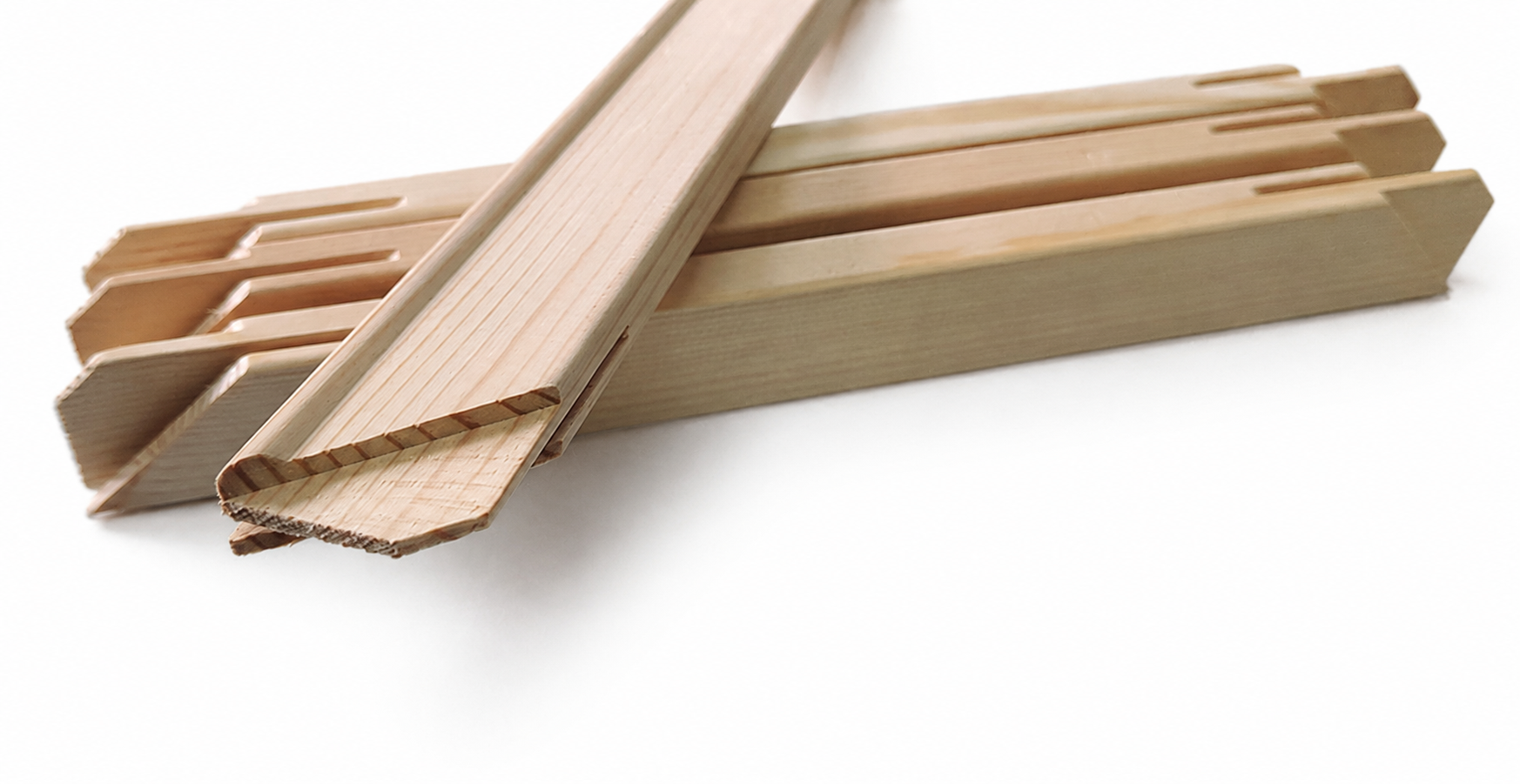
Canvas stretcher bars are wooden sections used to build the internal frame over which canvas is stretched.
A standard rectangular frame normally uses four bars:
- Two bars for the width
- Two bars for the length
The bars are joined at the corners. Canvas is then pulled around the frame and secured at the back with staples or tacks.
Stretcher bars can be supplied in several formats:
- Pre-cut loose stretcher bars
- Long-length stretcher bar moulding
- Tongue-and-groove stretcher bars
- Mitre-cut wooden bars
- Ready-assembled stretcher frames
- Frames with centre bars or cross braces
- Stretcher bars supplied with wooden wedges
The individual wooden sections are called stretcher bars. Once assembled, the complete structure is normally called a canvas stretcher frame.
For additional background, Jackson’s Art provides a useful industry introduction in its guide to canvas stretcher bars.
What Makes a Good Stretcher Bar?
A well-made stretcher bar should be:
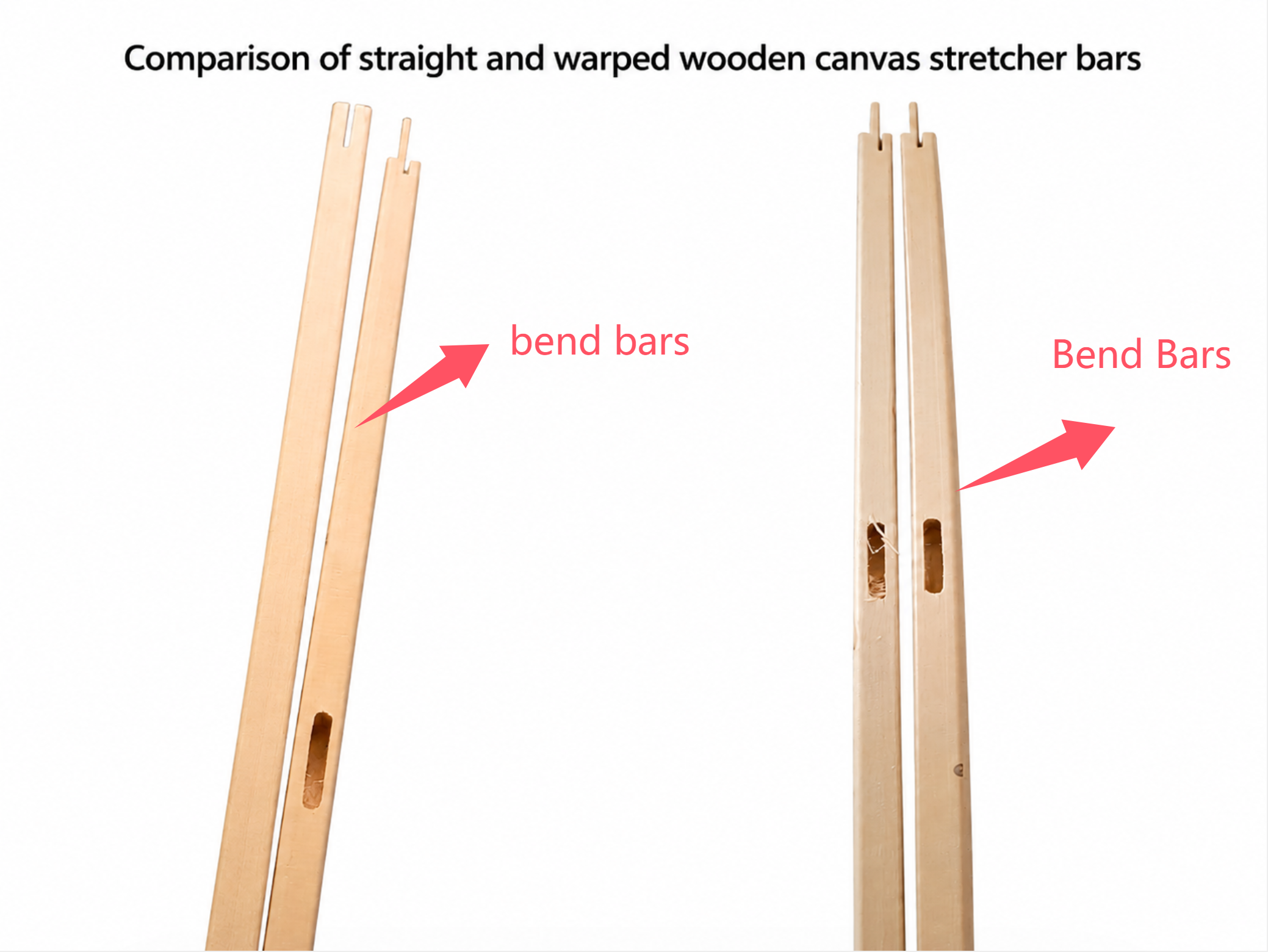
- Straight and properly dried
- Accurately cut to length
- Consistent in width and depth
- Smooth along the raised edge
- Easy to assemble
- Strong enough for the intended canvas size
- Stable after stretching
- Properly protected during shipping
The lowest-priced bar is not always the most economical option.
Inconsistent dimensions, poorly dried wood or rough machining can increase rejection rates, slow down production and damage printed canvas.
For commercial users, the more important measurement is often the cost per usable frame, rather than the purchase price per metre.
Why Stretcher Bar Quality Matters
The wooden frame is mostly hidden behind the finished artwork. However, defects in the stretcher bars can create visible problems.
Common issues include:
- A frame that does not sit flat against the wall
- Loose or uneven canvas tension
- Corner joints that do not fit correctly
- Long bars that bend inward
- Unequal outside dimensions
- Visible wooden lines through the canvas
- Splinters that damage the fabric
- Warping after storage or transportation
For a canvas printing factory producing hundreds or thousands of frames, small inconsistencies can disrupt the entire production process.
Understanding Stretcher Bar Profiles
The shape and dimensions of a stretcher bar are known as its profile.
The profile influences frame strength, canvas clearance, appearance and shipping volume.
Stretcher Bar Depth
Depth is the distance from the front to the back of the assembled frame.
Shallow profiles are often used for:
- Small paintings
- Economy canvas prints
- Canvases installed inside decorative frames
- Lightweight wall art
Deeper profiles are commonly used for:
- Gallery wrap canvas prints
- Premium home décor
- Large-format wall art
- Frameless canvas displays
- Hotel and commercial decoration
A deeper profile produces a more visible three-dimensional edge. It may also provide more structural support, although the profile width and wood construction must be considered at the same time.
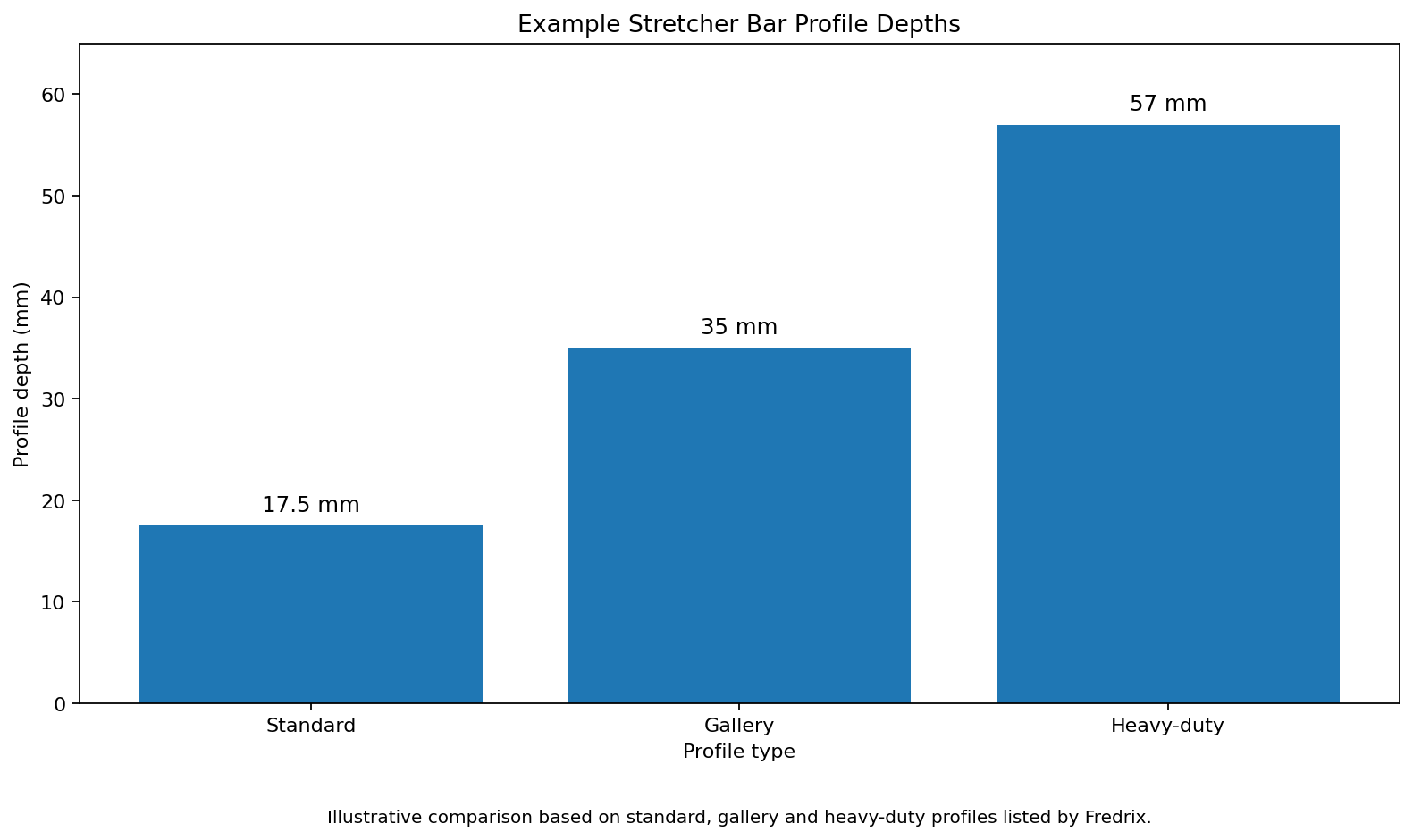
Fredrix, for example, lists standard, gallery and heavy-duty profiles at approximately 17.5 mm, 35 mm and 57 mm deep. These are examples from one established product range rather than universal industry standards.
Stretcher Bar Width
Width affects the strength of the frame and the amount of wood available for attaching the canvas.
A wider profile may provide more support for larger frames. However, it can also increase:
- Product weight
- Wood consumption
- Carton size
- Container volume
- Freight cost
Depth and width should therefore be evaluated together.
Raised or Bevelled Edge
A well-designed stretcher bar normally has a raised, rounded or bevelled outer edge.
This feature keeps most of the canvas away from the flat inner face of the wood. Without enough clearance, the canvas can press against the bar and develop a visible line on the front.
The raised edge should be:
- Smooth
- Consistent
- Free from splinters
- High enough to create canvas clearance
- Rounded enough to avoid damaging the fabric
Both Jackson’s and Fredrix emphasize the role of profile design, tapered edges and canvas clearance in professional stretcher bars.
How to Choose a Stretcher Bar Profile
The following table provides a general selection guide. Final specifications should always be confirmed through physical testing.
| Application | Suggested profile type | Main priority |
|---|---|---|
| Small artist canvas | Shallow or lightweight | Low weight and easy assembly |
| Canvas inside a decorative frame | Standard profile | Controlled overall depth |
| Photo canvas print | Standard or gallery profile | Clean wrapping and stable corners |
| Gallery wrap canvas | Deep-edge profile | Visible side depth and presentation |
| Large wall art | Heavy-duty profile | Strength and resistance to bowing |
| Automated canvas production | Machine-compatible profile | Dimensional consistency |
| Export DIY canvas kits | Loose tongue-and-groove bars | Compact packing and easy assembly |
Colors Art supplies multiple standard and customised profiles, including 18 × 38 mm artist stretcher bars and 34 × 37 mm heavy-duty gallery wrap stretcher bars.
Which Wood Is Best for Stretcher Bars?
The main wood options include pine, fir and paulownia.
Pine Stretcher Bars
Pine is widely used because it offers a practical balance of:
- Strength
- Weight
- Machinability
- Availability
- Cost
- Suitability for custom profiles
Properly selected and dried pine can be used for standard artist canvases, printed canvas and deep-edge gallery wraps.
Explore Colors Art’s pine stretcher bars with tongue-and-groove joints.
Fir Stretcher Bars
Fir is another option for wooden canvas frames.
Its performance depends on the species, timber grade, drying process and profile dimensions. Buyers should evaluate the finished product rather than relying only on the name of the wood.
Paulownia Stretcher Bars
Paulownia is considerably lighter than many conventional softwoods.
It may help reduce:
- Finished frame weight
- Carton weight
- International freight cost
- Handling pressure
- Wall loading
It can be suitable for small and medium wall-art products where lightweight construction is important. For larger sizes, the profile and bracing system should be carefully tested.
Wood Comparison Table
| Wood material | Main advantage | Suitable applications | Main point to check |
|---|---|---|---|
| Pine | Good strength-to-cost balance | Standard and gallery wrap frames | Moisture and knot selection |
| Fir | Flexible material option | Standard canvas products | Species and wood density |
| Paulownia | Very lightweight | Small and medium wall art | Strength on longer sizes |
There is no single best wood for every canvas frame. The right material depends on frame size, profile design, freight requirements and target price.
Solid Wood vs Finger-Jointed Stretcher Bars
Stretcher bars can be made from continuous solid wood or finger-jointed sections.
Solid Wood
Solid wood bars are cut from continuous pieces of timber.
Potential benefits include:
- Simple construction
- Natural appearance
- No visible finger joints
However, longer pieces must be carefully selected. Grain direction, knots and uneven moisture can increase the risk of twisting or bowing.
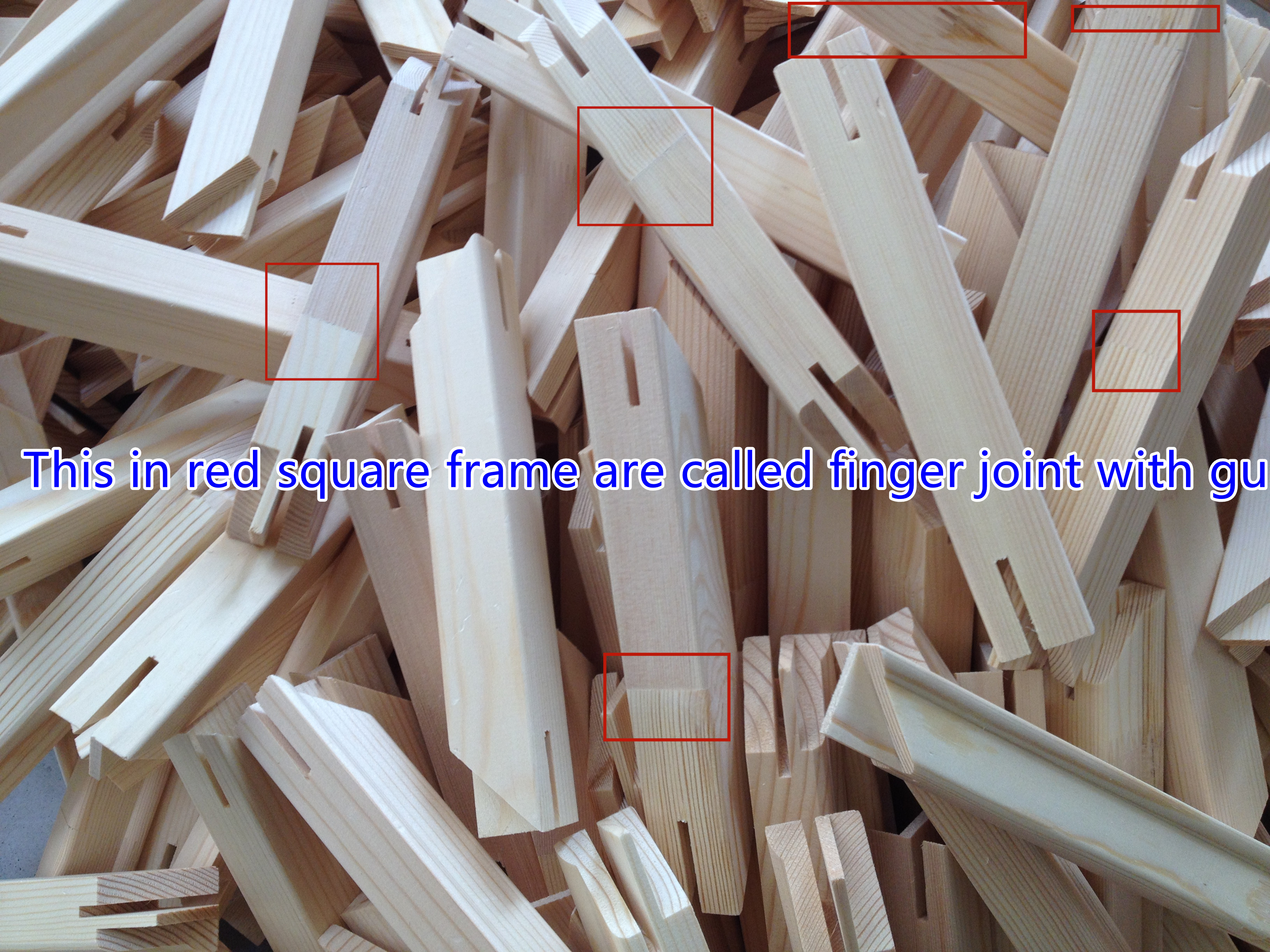
Finger-Jointed Wood
Finger-jointed bars are produced by joining shorter selected wood sections before moulding.
Potential benefits include:
- Removal of defective wood sections
- Better raw-material utilisation
- Consistency in longer lengths
- Suitability for mass production
- Flexible custom-profile production
The final quality depends on joint accuracy, adhesive performance, wood preparation and moisture control.
Fredrix states that it uses finger joints to reduce waste and improve stability in several stretcher-bar ranges.
Colors Art also supplies finger-jointed pine stretcher bars in customised profiles.
Why Moisture Content Matters
Wood reacts naturally to changes in humidity.
If it is not dried and stored correctly, it may:
- Expand
- Shrink
- Bend
- Twist
- Open at the joints
- Change the tension of the canvas
For commercial production, moisture control should be part of the complete manufacturing process rather than a single test performed before shipping.
Wholesale buyers should ask:
- Is the timber kiln-dried?
- When is moisture measured?
- How many pieces are tested from each batch?
- How is the timber stored after drying?
- Is the finished product checked before packing?
- What moisture range appears on the approved specification?
Colors Art product pages list moisture specifications below 12% for several pine, fir and paulownia profiles. The exact requirement should still be confirmed for each customer, destination climate and order.
Standard vs Gallery Wrap Stretcher Bars
Standard stretcher bars are generally used for:
- Small and medium canvases
- Economical canvas prints
- Canvases placed inside decorative frames
- Products requiring a shallow edge
Gallery wrap stretcher bars are normally deeper. The printed canvas wraps around the visible sides and is secured at the back.
They are commonly used for:
- Photo canvas prints
- Fine-art reproductions
- Personalised wall art
- Hotel decoration
- Home décor
- Frameless canvas products
The profile must be deep enough to create the desired visual effect and strong enough to withstand stretching tension.
View Colors Art’s custom-made gallery wrap stretcher frames.
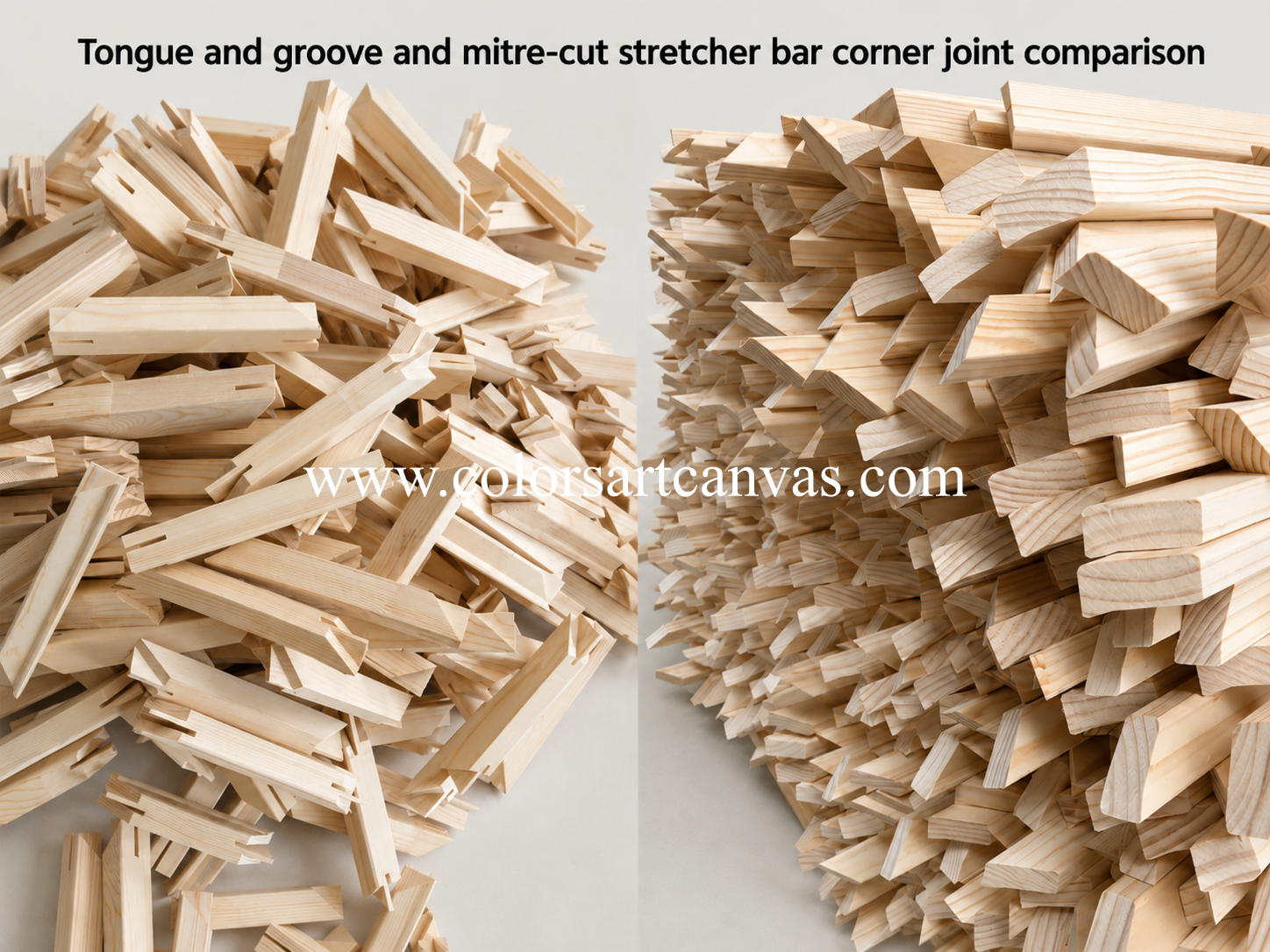
Tongue-and-Groove vs Mitre-Cut Corners
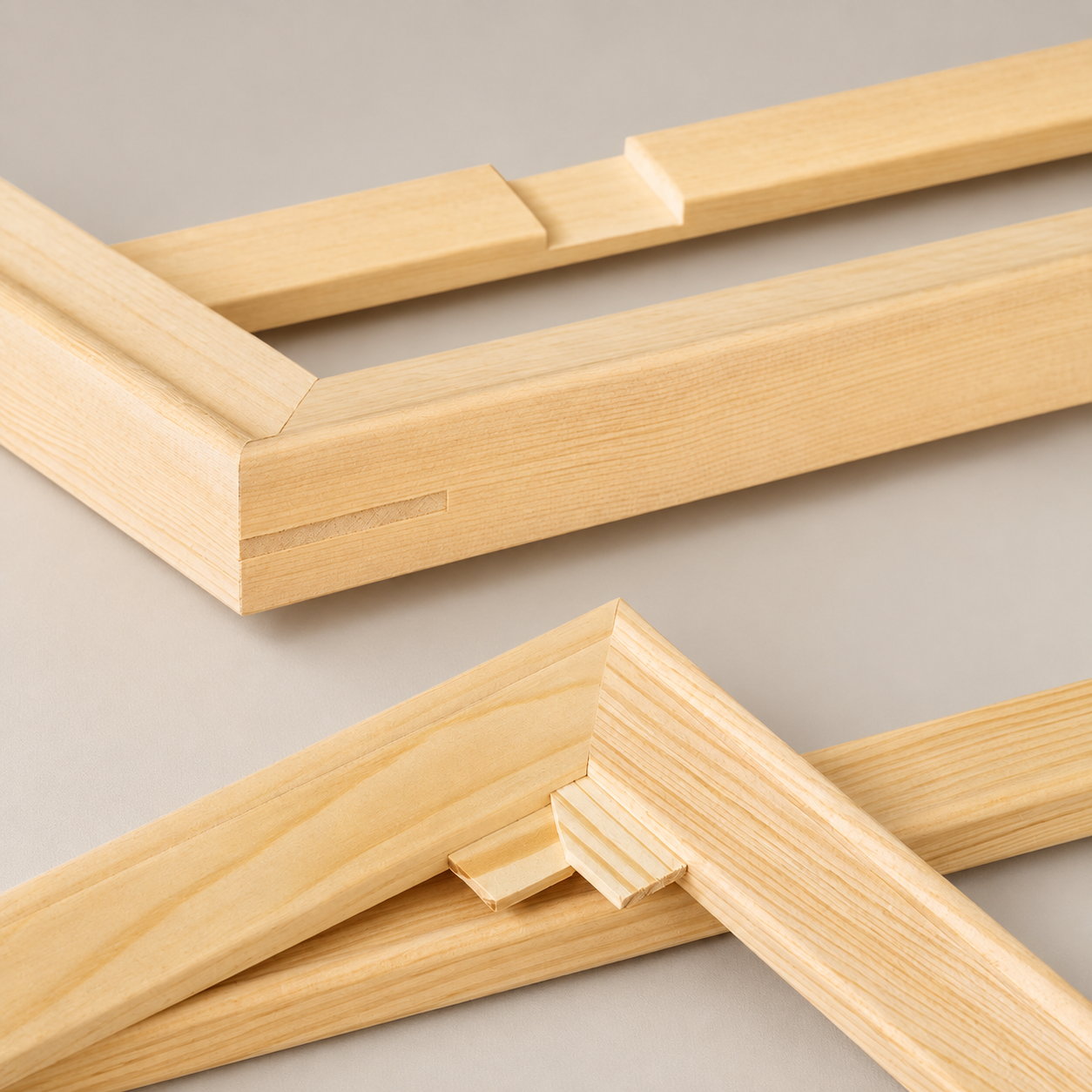
Tongue-and-Groove Corners
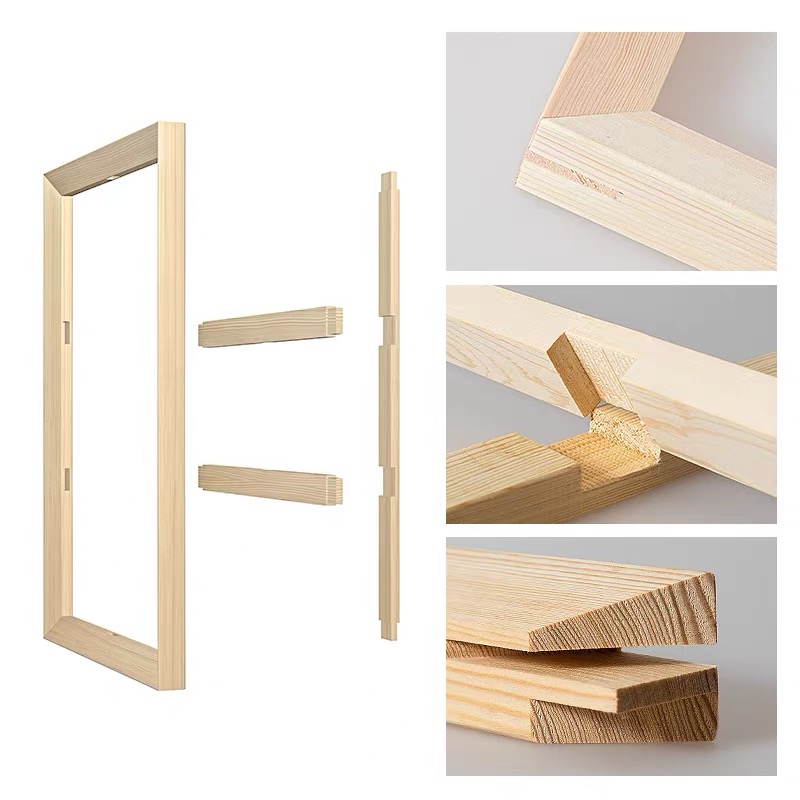
Interlocking tongue-and-groove bars are suitable for:
- DIY canvas kits
- Art-material distributors
- Manual frame assembly
- Compact export packing
- Frames that use wooden wedges
The joints should fit firmly without requiring excessive force.
Mitre-Cut Corners
Mitre-cut bars usually have 45-degree ends and can be joined with:
- V-nails
- Staples
- Glue
- Frame-joining machines
They are often selected by canvas printing factories and picture-frame manufacturers that already have assembly equipment.
When Are Cross Braces Needed?
Cross braces strengthen larger stretcher frames.
Canvas tension pulls the outside bars toward the centre. As the frame becomes longer, the bars may bow inward or twist.
Cross braces can help:
- Keep the frame square
- Reduce inward bending
- Support long bars
- Improve transport stability
- Maintain more consistent dimensions
There is no universal size at which every frame needs a brace. The decision depends on:
- Profile depth and width
- Frame dimensions
- Wood species
- Canvas weight
- Stretching tension
- Production method
- Transportation conditions
Jackson’s recommendations vary by profile. For example, some 18 mm and 21 mm profiles use centre bars when a side exceeds about 30 inches, while deeper profiles can have different limits. This demonstrates why bracing requirements should be based on the actual profile rather than one universal frame size.
Loose Bars, Long Moulding or Assembled Frames?
| Supply format | Advantages | Points to consider |
|---|---|---|
| Pre-cut loose bars | Compact packing and lower freight volume | Buyer needs assembly capacity |
| Long-length moulding | Flexible local cutting | Requires cutting and joining equipment |
| Assembled frames | Less local labour | Higher packing and freight volume |
| Stretcher bar kits | Easy retail or online sale | More individual parts and packaging |
| Machine-compatible profiles | Fast industrial production | Tight tolerances are essential |
Buyers should compare total landed cost rather than unit price alone.
Colors Art offers wholesale canvas stretcher bars, long moulding, loose kits and assembled frames.
How to Check Stretcher Bar Quality
Before approving a bulk order, test samples under real production conditions.
Quality-Control Checklist
| Inspection item | How to check | Possible problem |
|---|---|---|
| Straightness | Place bars on a flat surface | Bowing or twisting |
| Length | Measure several bars from one batch | Frames not square |
| Width and depth | Compare against drawing | Uneven frame surface |
| Corner fit | Assemble a complete frame | Loose or overly tight joints |
| Diagonals | Measure both diagonals | Out-of-square frame |
| Surface | Check by hand and visually | Splinters or rough joints |
| Canvas clearance | Stretch real canvas | Visible bar impressions |
| Cross-brace fit | Assemble full support system | Brace movement or pressure |
| Packing | Review cartons and edge protection | Transit damage |
The most important test is to build a complete frame and stretch the customer’s real canvas material over it.
An individual wooden bar may look acceptable but perform poorly after assembly.
Sustainable Wood and Certification
For customers with responsible-sourcing requirements, buyers may ask for FSC- or PEFC-certified material.
The Forest Stewardship Council describes its system as verifying responsible sourcing through the forest-product value chain. The Programme for the Endorsement of Forest Certification is an international alliance of national forest-certification systems.
Certification claims should only be made when the relevant company, material and chain of custody are properly covered.
Buyers should confirm:
- Certificate owner
- Certificate number
- Scope of certification
- Wood claim shown on invoices
- Whether chain-of-custody documents are required
- Whether printed FSC or PEFC marks are permitted
Questions to Ask a Stretcher Bar Supplier
Before placing an order, ask:
- Which wood species are available?
- Is the wood solid or finger-jointed?
- How is moisture content controlled?
- Which standard profiles are available?
- Can custom profiles be produced?
- What dimensional tolerances can be maintained?
- Are tongue-and-groove joints available?
- Can bars be supplied with mitre-cut ends?
- Are wooden wedges and cross braces available?
- Can assembled frames be fixed with staples or V-nails?
- How are long bars protected during shipping?
- What is the quantity per carton and container?
- Are OEM cartons and private labels available?
- Can the profile work with automated stretching equipment?
- Can production samples be tested before bulk manufacturing?
Custom Stretcher Bars from Colors Art
Standard profiles work for many applications, but established canvas printers and distributors often need products designed around their own manufacturing process.
Colors Art can supply:
- Pine, fir and paulownia stretcher bars
- Solid and finger-jointed wood
- Tongue-and-groove profiles
- Mitre-cut bars
- Cross braces and wooden wedges
- Pre-cut loose bars
- Long-length moulding
- Stapled or V-nailed assembled frames
- Deep-edge gallery wrap profiles
- OEM cartons and private labels
- Custom profiles based on drawings or samples
View the complete Colors Art stretcher bar range.
For a custom quotation, provide:
- Profile drawing or physical sample
- Wood material
- Width and depth
- Bevel shape
- Corner structure
- Required lengths
- Dimensional tolerance
- Moisture requirement
- Packing method
- Estimated order quantity
Frequently Asked Questions
What are canvas stretcher bars used for?
They are used to build the wooden support frame over which painting canvas or printed canvas is stretched.
How many bars are needed for one canvas frame?
A rectangular or square frame normally requires four bars. Larger frames may also require centre bars or cross braces.
What is the best wood for stretcher bars?
Pine is a common choice because it offers a practical balance of strength, weight and cost. Fir and paulownia may also be suitable depending on the required profile and frame size.
Are finger-jointed stretcher bars strong?
Properly manufactured finger-jointed bars can provide good consistency. Their performance depends on wood selection, adhesive quality, joint accuracy and moisture control.
What depth is suitable for gallery wrap canvas?
Gallery wrap profiles are generally deeper than standard profiles. The right depth depends on the finished appearance, canvas size and local market preference.
When does a frame need a cross brace?
A brace should be considered when the selected profile cannot remain square and stable under the tension of the canvas. Larger and shallower frames usually require support earlier.
Can stretcher bar profiles be customised?
Yes. Wood material, width, depth, bevel, joint structure, length, cross braces and packaging can all be customised.
Should I buy loose bars or assembled frames?
Loose bars usually reduce freight volume. Assembled frames reduce local labour. The better option depends on production equipment, shipping cost and available workers.
Conclusion
Canvas stretcher bars may be hidden behind the finished artwork, but they have a major effect on frame stability, canvas tension and final presentation.
The right bars should be straight, properly dried, accurately machined and strong enough for the intended canvas size.
Wholesale buyers should evaluate the complete production system, including:
- Wood selection
- Moisture control
- Profile design
- Corner accuracy
- Cross braces
- Dimensional tolerance
- Export packaging
Colors Art manufactures custom wooden stretcher bars and assembled canvas frames for canvas printing companies, art-material distributors, framers and wall-art manufacturers.
Contact Colors Art with your profile, dimensions, wood material, packing requirements and estimated quantity to receive a customised stretcher bar solution.