HOMEBlogCotton vs Polyester vs Poly-Cotton Inkjet Canvas: Which Is Best for Printing?
Blog
Cotton vs Polyester vs Poly-Cotton Inkjet Canvas: Which Is Best for Printing?
Cotton, poly-cotton and polyester are three of the most widely used base fabrics for professional inkjet printable canvas. But choosing between them is no longer as simple as saying cotton is premium, polyester is economical and poly-cotton sits somewhere in between.
Modern printable canvas has changed.
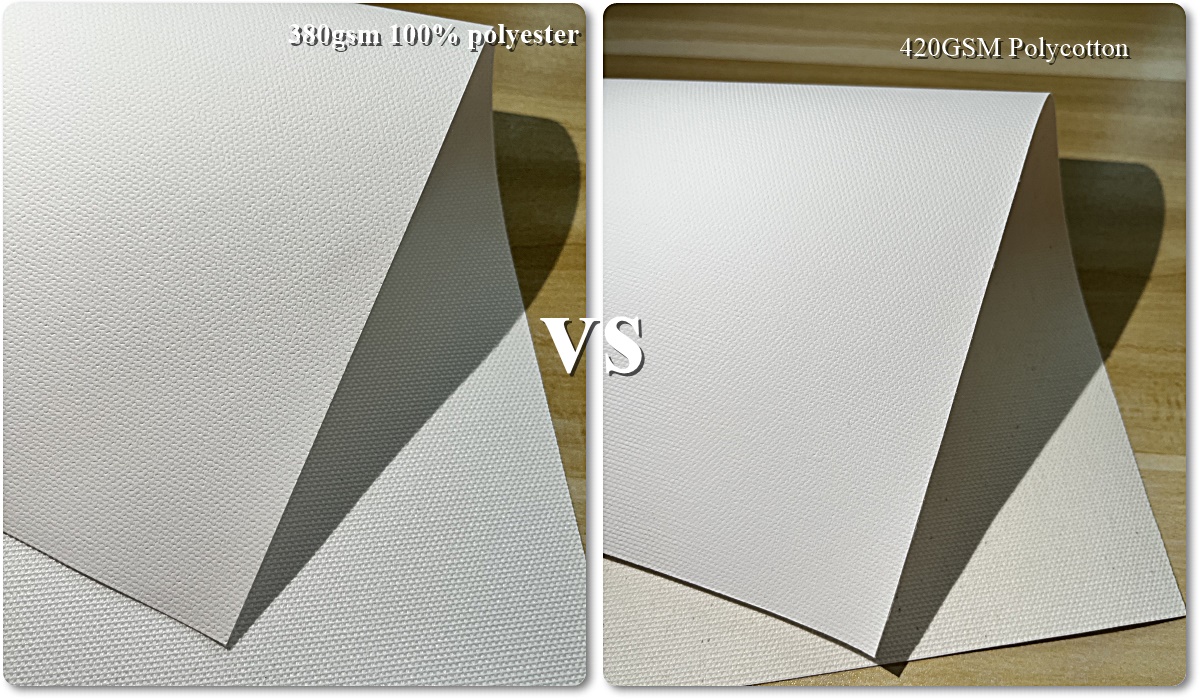
Advances in yarn construction, weaving and coating technology now allow some 100% polyester canvas to achieve a natural woven texture very similar to traditional poly-cotton canvas.
After the printable coating is applied, it may even be difficult to identify the fiber composition simply by looking at the front surface.
At the same time, professional print performance depends on much more than fiber composition. Surface texture, weave construction, coating formulation, white point, ink absorption, dimensional stability and batch consistency can all influence the finished print.
Quick Answer: There is no single best canvas material for every printing application. Cotton is often preferred when natural fiber content and traditional fine-art character are important. Poly-cotton combines a natural textile appearance with good dimensional stability. Polyester offers excellent stability and production consistency, while newer 100% polyester fabrics can also reproduce a natural poly-cotton-like texture.
Does Fiber Composition Determine Inkjet Canvas Quality?
No. Fiber composition matters, but it does not determine printable canvas quality by itself.
Two products can both be labeled “100% cotton canvas” and still produce noticeably different printing results.
The same applies to polyester and poly-cotton.
Professional inkjet canvas is a complete material system. Its performance depends on the interaction between:
Fiber composition
Yarn construction
Weave structure
Surface texture
Base-fabric treatment
Printable coating formulation
Coating weight and uniformity
Ink compatibility
Dimensional stability
Batch-to-batch consistency
This is why professional buyers should evaluate the complete construction rather than choosing a canvas only because it is described as cotton, poly-cotton or polyester.
What Is Cotton Inkjet Canvas?
Cotton inkjet canvas uses cotton fiber as the main component of the woven base fabric.
Because cotton is a natural fiber, its yarns create subtle variations in the weave. These characteristics give cotton canvas the traditional textile appearance associated with artist canvas and fine-art reproduction.
For premium wall art, photographic reproduction, limited-edition prints and other applications where natural fiber content contributes to the perceived value of the finished product, cotton remains an important choice.
Main Advantages of Cotton Inkjet Canvas
Natural woven texture
Traditional fine-art appearance
Authentic textile character
Premium positioning for natural-fiber products
Excellent printing potential when combined with the correct coating
Why Are There Small Black or Brown Specks in Some Cotton Canvas?
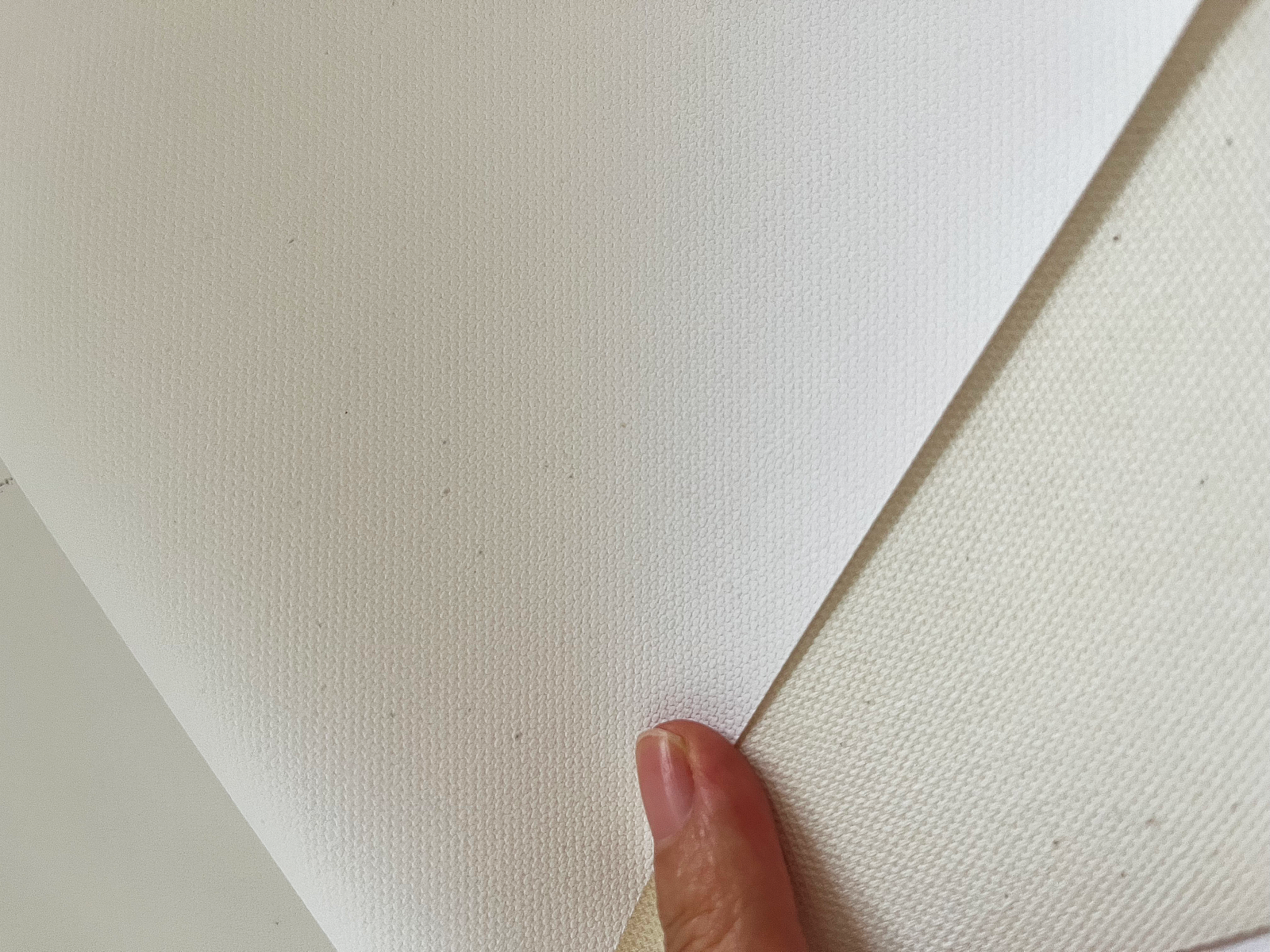
Small dark dots visible in cotton or cotton-containing fabrics do not necessarily indicate dirt or coating contamination.
Cotton is a natural agricultural fiber. Very small pieces of naturally occurring plant material can remain with the fiber during processing.
One possible source is cotton seed-coat fragments, which may remain visible after the cotton has been spun and woven into fabric.
Buyer Insight: A dark speck in cotton-containing canvas can originate from the natural cotton fiber itself. This is different from a black spot caused by contamination during the coating process.
This distinction matters when a buyer requires an extremely clean white printable surface.
Cleaning or filtering the coating system cannot remove a natural seed-coat fragment that is already present in the woven base fabric.
Small dark specks in cotton-containing canvas can originate from natural cotton seed-coat fragments rather than coating contamination.
Why Is Bleaching Used for Cotton and Poly-Cotton Base Fabrics?
When manufacturers need a cleaner and brighter cotton-containing base fabric, additional pretreatment and bleaching may be used before coating.
This can improve fabric cleanliness and whiteness, but it also increases processing cost.
There is another consideration for professional buyers: batch-to-batch shade consistency.
Cotton is a natural fiber, and bleaching introduces additional processing variables. As a result, one batch of treated base fabric may have a slightly warmer or more yellow undertone, while another may appear brighter or cooler white.
The printable coating can reduce some of these visual differences, but the condition and shade of the underlying base fabric still matter when tight production consistency is required.
For High-Volume Printers: Maximum whiteness is not always the most important target. A stable and repeatable white point from batch to batch can be more valuable for repeat production.
What Is Poly-Cotton Inkjet Canvas?
Poly-cotton canvas combines cotton and polyester fibers in the base fabric.
The purpose is generally to retain much of the natural textile character associated with cotton while gaining some of the dimensional stability and production advantages of polyester.
This makes poly-cotton popular for photo canvas, wall décor, gallery wraps and professional commercial printing.
Because poly-cotton still contains cotton, natural cotton-related specks can still occur depending on the raw fiber, blend, fabric construction and pretreatment.
What Is Polyester Inkjet Canvas?
Polyester inkjet canvas uses synthetic polyester fiber as the woven base fabric.
Polyester is widely used in commercial printing because it can provide good dimensional stability, controlled manufacturing characteristics and reliable production consistency.
Traditional polyester canvas is sometimes associated with a smoother or more synthetic-looking surface.
However, this description no longer applies to every polyester canvas.
Can 100% Polyester Canvas Look Like Poly-Cotton?
Yes.
Modern fabric engineering can create 100% polyester canvas with a woven texture that closely resembles traditional poly-cotton.
This is achieved through the construction of the fabric rather than by changing its fiber composition.
Yarn characteristics, yarn thickness, weave pattern, density and finishing can all be adjusted to create a less uniform and more natural-looking textile surface.
After the printable coating is applied, the front surface can become even more difficult to distinguish visually from poly-cotton.
Important: Texture does not prove fiber composition. A canvas that looks like poly-cotton can still be 100% polyester. When fiber composition is important, buyers should rely on material specifications or fiber testing rather than appearance alone.
Modern 100% polyester canvas can be engineered with a natural woven texture similar to traditional poly-cotton canvas.
Why Use Polyester with a Poly-Cotton-Like Texture?
The purpose is not simply to make polyester imitate another material.
For some professional printing applications, this construction can combine several useful characteristics.
Natural-Looking Texture
The specially engineered weave provides more textile character than conventional smooth polyester, making it suitable for wall art and photo canvas where a traditional canvas appearance is desirable.
No Cotton Seed-Coat Specks
Because the base fabric contains no cotton, cotton seed-coat fragments cannot occur as a natural component of the fabric.
This can help manufacturers produce a clean printable surface without relying on cotton bleaching to solve this particular issue.
No Cotton Bleaching Requirement
Because there is no cotton fiber, the fabric does not require cotton bleaching to address natural cotton coloration or cotton-related impurities.
More Controllable Base-Fabric Consistency
Polyester is manufactured under controlled industrial conditions. This can reduce some of the natural raw-material variation associated with cotton and provide a more consistent starting point before coating.
Good Dimensional Stability
Polyester is valued for dimensional stability during printing, drying, cutting and stretching, particularly in high-volume production.
Cost and Production Efficiency
For buyers who want a natural poly-cotton-like appearance but do not specifically require cotton fiber, textured polyester can provide an attractive balance between appearance, consistency and total production cost.
Manufacturer's Perspective: Polyester with a poly-cotton-like texture should still be clearly specified as 100% polyester. Similar appearance is a product advantage, not a reason to misrepresent the actual fiber composition.
Cotton vs Poly-Cotton vs Polyester: Quick Comparison
Factor
100% Cotton
Poly-Cotton
Traditional Polyester
Polyester with Poly-Cotton-Like Texture
Natural-looking texture
Excellent
Excellent
Depends on construction
Very Good to Excellent
Fine-art character
Excellent
Very Good
Varies
Very Good
Cotton seed-coat specks
Possible
Possible
Not from cotton
Not from cotton
Cotton bleaching
May be required
May be required
Not required
Not required
Dimensional stability
Good
Very Good
Excellent
Excellent
Base-fabric consistency
More dependent on natural fiber and processing
Influenced partly by cotton content
Very Good
Very Good
Gallery wrapping
Suitable
Suitable
Suitable
Suitable
Natural texture without cotton
No
No
Depends on weave
Yes
This comparison should be treated as a purchasing guide rather than an absolute quality ranking. Individual products can perform differently depending on fabric construction, coating formulation and manufacturing control.
Does Cotton Produce Better Print Quality Than Polyester?
Not automatically.
On professional inkjet canvas, ink interacts primarily with the printable coating applied to the fabric surface.
The coating strongly influences:
Ink absorption
Color density
Black density
Image sharpness
Drying speed
Ink adhesion
Water resistance
Scratch resistance
A high-quality coated polyester canvas can therefore produce better printing results than a poorly coated cotton canvas.
Likewise, a premium cotton canvas with a carefully developed coating can produce outstanding fine-art results.
Key Principle: Base fabric and coating should be evaluated as one printable system.
Why Can the Same Artwork Look Different on Different Canvas?
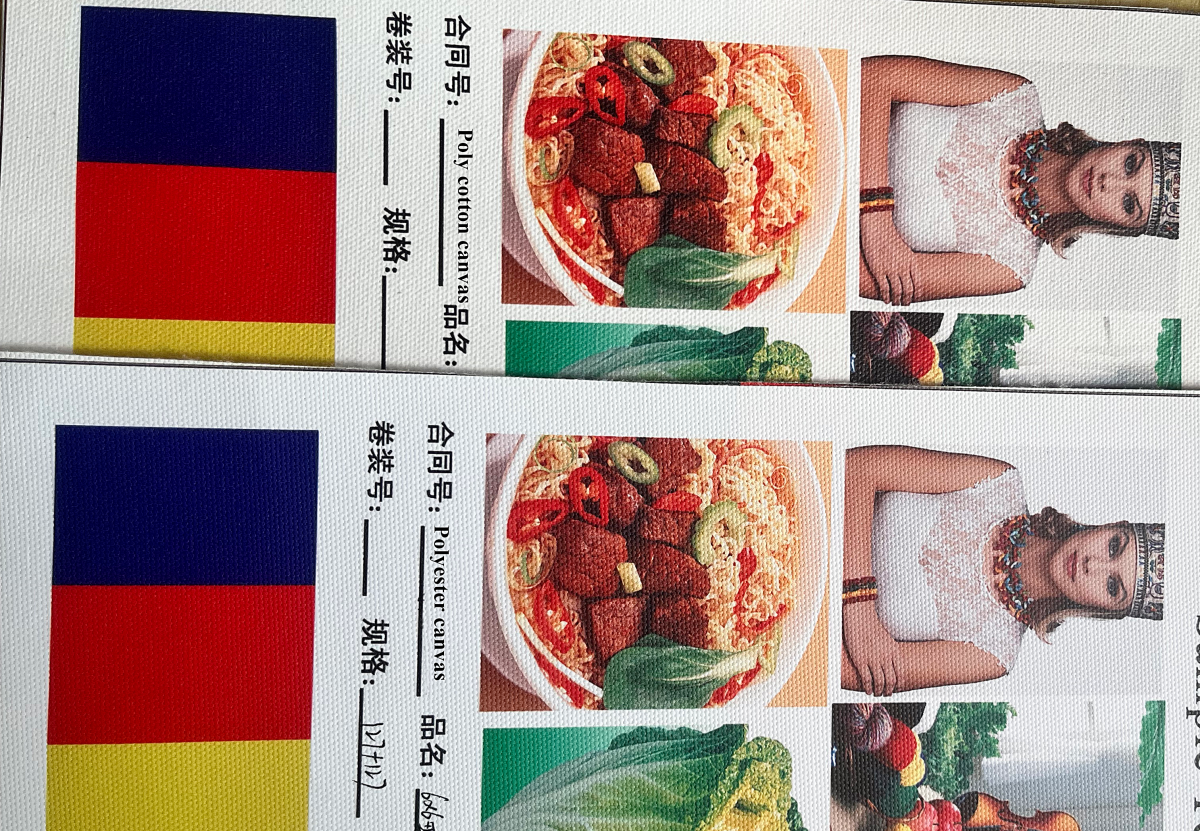
Even when the same printer, ink and artwork are used, different canvases can produce visibly different results.
Important factors include:
Surface white point
Coating absorption
Canvas texture
Gloss level
Ink holdout
Printer settings
ICC profile
For accurate comparisons, buyers should print the same artwork using the same printer, ink, print mode and color-management workflow.
Printing identical artwork under the same conditions helps buyers compare color, texture and coating performance across different canvas constructions.
What GSM Is Best for Inkjet Canvas?
There is no single GSM that is best for every application.
GSM means grams per square meter and describes the total weight of the canvas. It is influenced by the base fabric construction and coating.
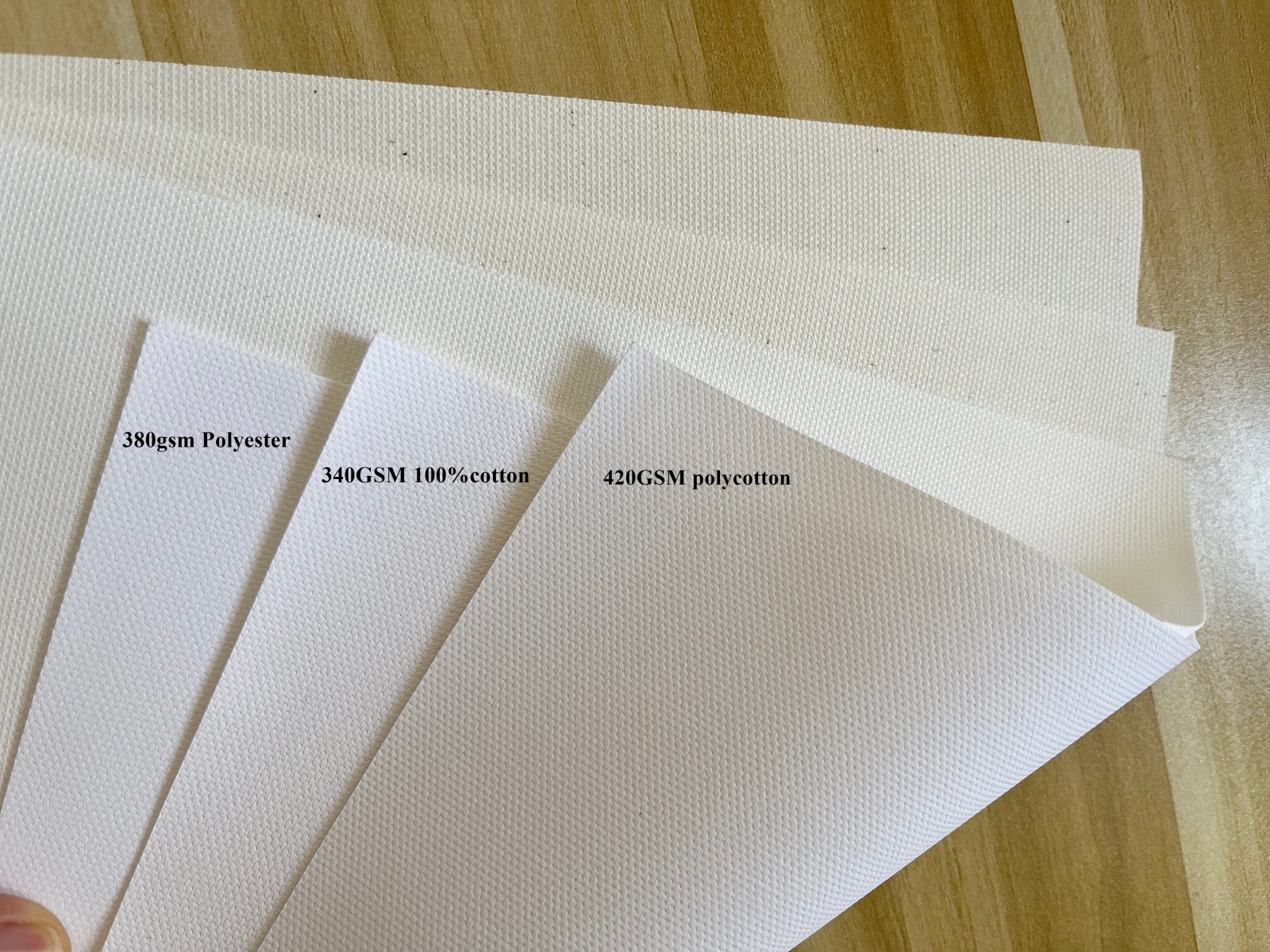
Professional printable canvas may use specifications such as 340 gsm, 380 gsm and 400 gsm, depending on the required fabric structure, texture, hand feel and application.
A well-engineered 340 gsm canvas can provide excellent printing and stretching performance.
A 380 gsm or 400 gsm canvas may be preferred when the customer requires a heavier construction, different texture or specific finished feel.
Moving from 340 gsm to 380 gsm or 400 gsm does not automatically improve image quality.
Quick Answer – Is higher GSM better for canvas printing? No. Higher GSM means heavier canvas, not automatically better canvas. Buyers should compare fabric construction, texture, coating performance, dimensional stability and stretching behavior together with GSM.
340 gsm, 380 gsm and 400 gsm printable canvases can all provide professional results. The correct weight depends on construction, coating and application.
Which Canvas Is Best for Different Ink Systems?
Aqueous Pigment Printing
Cotton, poly-cotton and polyester can all be used for aqueous pigment printing when the coating has been developed for water-based pigment inks.
The coating needs to control ink absorption while maintaining color density, detail and drying performance.
Latex printing introduces heat during printing and curing, so buyers should evaluate coating compatibility, heat response and dimensional stability.
Testing should include both print quality and post-print stretching.
UV Printing
For UV printing, surface adhesion and coating compatibility are especially important.
The actual coated canvas should be tested with the intended UV ink system and production settings.
How Should Professional Buyers Test Inkjet Canvas?
A printable canvas sample should not be approved only because the first printed image looks good.
Professional buyers should test the material under actual production conditions.
1. Print the Same Test Image
Use identical artwork, printer, ink, print mode and color-management settings.
Compare:
Color saturation
Black density
Shadow detail
Fine lines
Skin tones
Neutral grays
Gradients
2. Check White Point
Compare the surface under the same lighting and look for warm, yellow, cool or neutral undertones.
For repeat orders, white-point consistency is particularly important.
3. Test Drying
Check for tack, smearing, blocking and the required time before cutting, stacking or stretching.
4. Test Scratch Resistance
Scratch testing should simulate normal finishing, stretching, packing and handling.
Buyers should distinguish between light surface marking, coating damage and actual ink removal.
5. Test Water Resistance
Check whether exposure to water causes color bleeding, coating softening, ink migration, surface whitening or adhesion failure.
6. Stretch the Printed Canvas
A material can look excellent while flat but behave differently when wrapped around a stretcher frame.
Check:
Edge cracking
Surface whitening
Corner folding
Coating separation
Fabric deformation
Tension retention
7. Check Roll-to-Roll and Batch-to-Batch Consistency
For high-volume production, one good roll is not enough.
Compare multiple rolls and repeat production batches for:
Texture
White point
Gloss level
GSM
Thickness
Coating behavior
Print performance
Professional Buyer Insight: A good sample proves that a supplier can make one good roll. Batch consistency shows whether the supplier can repeatedly manufacture the same product.
Which Canvas Should You Choose?
Choose 100% Cotton When:
Natural fiber content is part of the product specification
Traditional fine-art character is important
The customer specifically requires cotton
The finished print is positioned as a premium natural-fiber product
Choose Poly-Cotton When:
You want a natural-looking canvas texture
You need good dimensional stability
You produce photo canvas or wall décor
You want a balance between appearance and production performance
Choose Polyester When:
Dimensional stability is important
High-volume production consistency matters
Cost and production efficiency are important
Natural cotton fiber is not required by the finished-product specification
Consider Polyester with a Poly-Cotton-Like Texture When:
You want a natural woven appearance without cotton fiber
You want to avoid cotton seed-coat specks
You want to reduce variation related to cotton bleaching
You need good dimensional stability
You prioritize repeat production consistency
Final Buying Principle: The best printable canvas is not necessarily the canvas with the highest cotton percentage, the heaviest GSM or the highest price. It is the canvas that repeatedly delivers the required texture, print quality, finishing performance and production consistency for the intended application.
Frequently Asked Questions
Is cotton canvas better than polyester canvas?
Not always. Cotton provides natural fiber character and is often preferred for premium fine-art applications. Polyester generally provides excellent dimensional stability and production consistency. Final print quality depends heavily on the coating and overall fabric construction.
Is poly-cotton better than polyester canvas?
It depends on the application. Poly-cotton is attractive when buyers want natural textile character combined with good stability. Polyester can be preferable when dimensional stability, consistency and production efficiency are the main priorities.
Can 100% polyester canvas look like poly-cotton?
Yes. Modern yarn and weaving techniques can produce 100% polyester canvas with a natural texture similar to traditional poly-cotton. The coated printable surface may be difficult to distinguish visually from poly-cotton.
Can you identify canvas fiber composition by looking at it?
Not reliably. Modern polyester can closely resemble cotton-blend canvas. When fiber composition matters, request the material specification or use independent fiber testing.
Why are there small black dots in cotton canvas?
Some dark specks can originate from naturally occurring cotton seed-coat fragments or plant residues remaining with the cotton fiber. They are not always caused by coating contamination.
Does polyester canvas have cotton seed-coat specks?
No cotton-related seed-coat specks occur in 100% polyester because the material contains no cotton fiber.
Is higher GSM better for printable canvas?
No. Higher GSM means heavier canvas, not automatically better print quality. 340 gsm, 380 gsm and 400 gsm products can all perform well when their fabric construction and coating are appropriate for the application.
Does coating matter more than fiber composition?
Coating has a major influence on color density, sharpness, drying, ink adhesion, scratch resistance and water resistance. Fiber composition still affects texture and physical behavior, so the coating and base fabric should be evaluated together.
Which canvas is best for high-volume printing?
Polyester and poly-cotton are both commonly considered for high-volume production because they can provide good stability and repeatability. The best choice depends on the required texture, coating, printer, ink system and finished product.
Which canvas is best for fine-art printing?
100% cotton remains a strong choice when natural fiber content and traditional fine-art character are important. Premium poly-cotton can also perform well. Print quality ultimately depends on the complete canvas and coating system.
How Colors Art Develops Printable Canvas
At Colors Art, we evaluate printable canvas as a complete system rather than focusing on base-fabric composition alone.
Our printable canvas range includes cotton, poly-cotton and polyester constructions with different textures, weights and surface finishes for professional digital printing applications.
Product development and production evaluation can include:
Base-fabric inspection
Surface texture evaluation
Coating uniformity
Print testing
Water resistance testing
Scratch resistance testing
Stretching performance
Batch consistency inspection
For customers using different printers, inks or production processes, sample testing under actual printing conditions is the most reliable way to select the right canvas.
Need Help Selecting the Right Printable Canvas?
If you are a canvas print factory, photo lab, print-on-demand company, distributor or wall décor manufacturer, tell us your:
Current canvas material
Preferred GSM
Printer brand and model
Ink type
Preferred matte, semi-matte or glossy finish
Preferred texture
Required roll width
Approximate monthly or annual usage
We can recommend suitable cotton, poly-cotton or polyester canvas constructions for sample testing.
Looking for a Professional Inkjet Canvas Manufacturer?
Colors Art manufactures printable canvas for fine-art reproduction, photo canvas, wall décor and high-volume commercial printing.
Send us your current canvas specification, printer, ink system and application. We can recommend suitable samples for comparison and production testing.