Blog
Canvas GSM Consistency: How We Control Weight Across Bulk Production
For professional printable canvas buyers, seeing the correct GSM on one sample is important.
But for distributors, wall-art manufacturers, photo labs and high-volume printing companies, there is a more important question:
If the approved sample meets the required GSM, will the same weight remain consistent across thousands of finished rolls in bulk production?
This is the difference between checking a single sample and controlling GSM consistency across a production batch.
A supplier can cut one sample, weigh it and obtain the correct result. That proves the weight of that particular sample. It does not automatically prove that all the master rolls used for a large order will remain within the required production range.
For large-volume canvas production, GSM therefore needs to be monitored repeatedly throughout the production batch.
Why One GSM Number Is Not Enough
GSM means grams per square meter and is one of the standard specifications used when purchasing printable canvas.
A customer may approve a 230gsm, 260gsm, 300gsm, 340gsm, 380gsm or 400gsm canvas depending on the product and application.
However, the nominal GSM shown on a specification sheet is only the target product specification.
In real textile and coating production, small manufacturing variations can occur. Base-fabric construction, weaving density and coating pickup can all influence the finished weight.
The objective of professional production control is therefore not to expect every individual sample to produce a mathematically identical number.
The objective is to:
- monitor GSM during production;
- identify abnormal variation;
- keep production within the approved specification;
- and maintain better consistency from roll to roll and batch to batch.
This is particularly important for customers operating multiple printers or consuming large quantities of canvas every month.
For a broader explanation of printable canvas specifications, materials and coating systems, see our Ultimate Printable Canvas Guide .
GSM Consistency Starts With the Actual Canvas Construction
GSM should always be considered together with the actual canvas construction.
For example, polyester printable canvas can use constructions such as 500D × 300D, while other products may use different yarn specifications and weaving densities.
The same general construction can also be manufactured to different finished weights depending on the fabric density and coating build.
This is one reason why professional buyers should not evaluate a supplier only by asking:
“What GSM is your canvas?”
A better evaluation considers whether the approved construction can be reproduced consistently during bulk production.
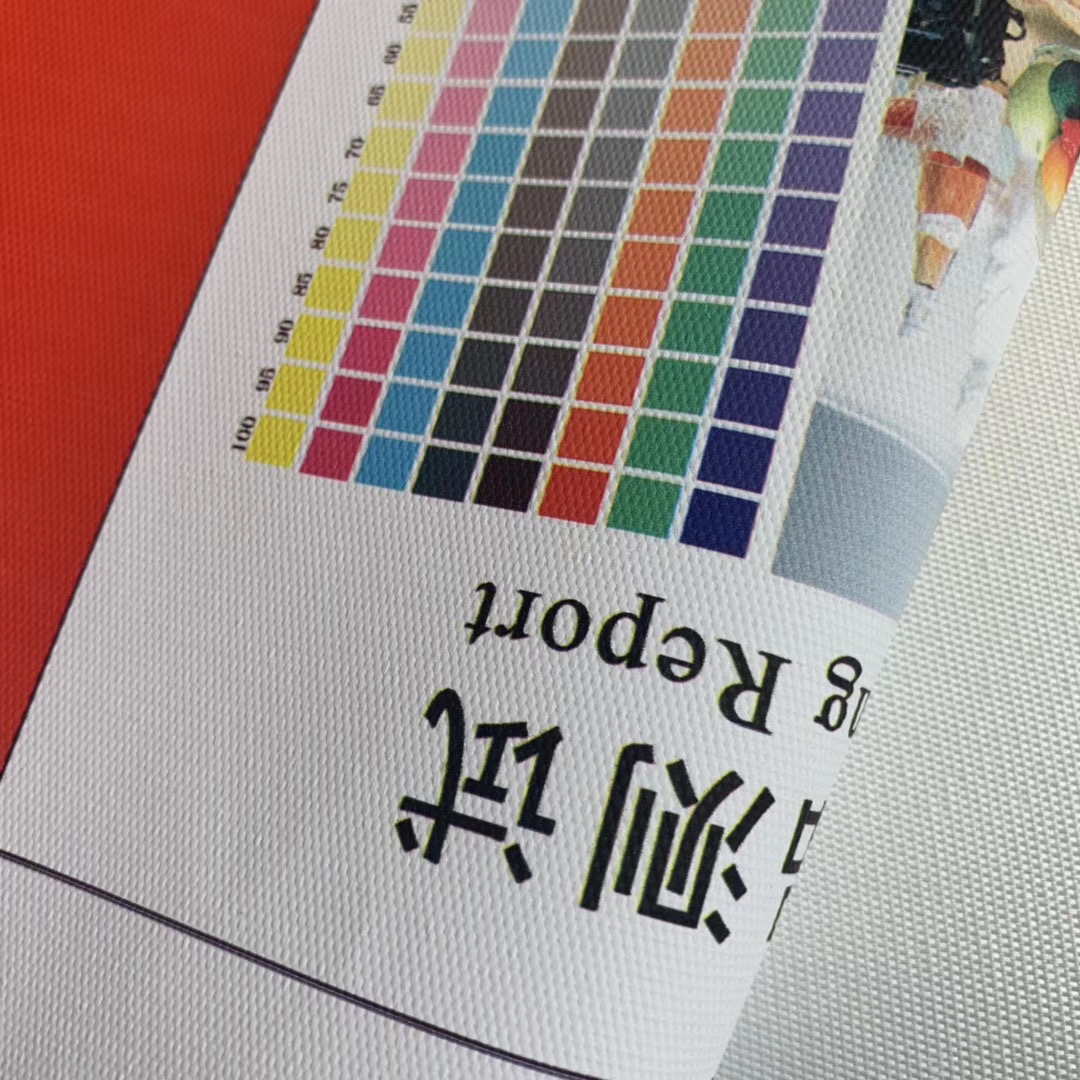
Material selection also affects production characteristics. For more information about cotton, polyester and poly-cotton constructions, see our Cotton vs Polyester vs Poly-Cotton Inkjet Canvas comparison .
Professional Media Specifications Go Beyond GSM
This principle is not unique to Colors Art.
Professional inkjet-media specifications normally include more than weight alone.
For example, Fujifilm's Artist's Canvas 340 is specified as a 340gsm cotton/polyester canvas, but Fujifilm also separately specifies characteristics including caliper, opacity, surface and printer compatibility.
This illustrates an important purchasing principle:
GSM is an important specification, but it is not a complete definition of printable canvas quality or consistency.
External technical reference: Fujifilm Artist's Canvas 340 Specifications .
Why Master Rolls Matter for GSM Consistency
To understand bulk GSM consistency, it is important to understand how commercial canvas rolls are produced.
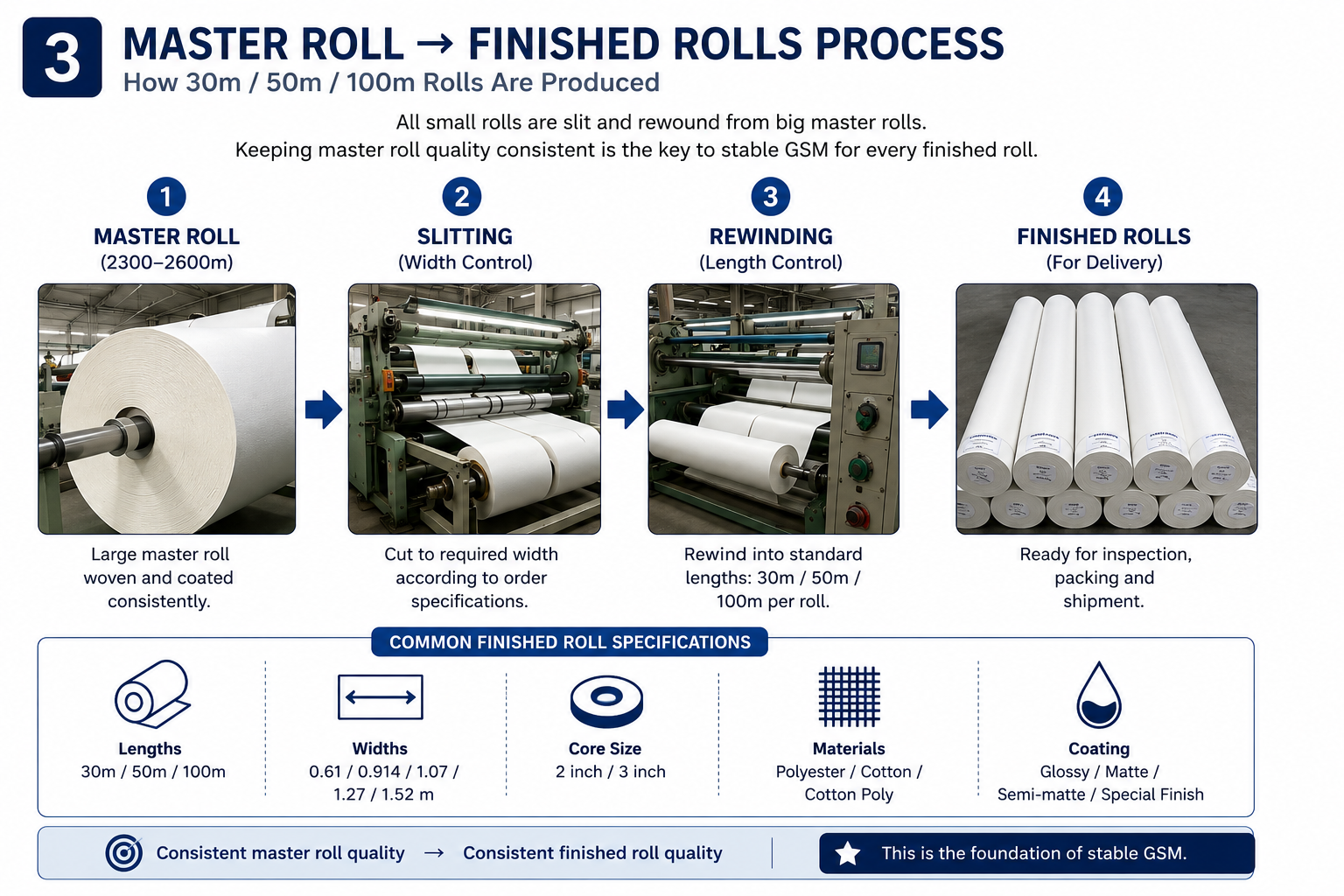
The 30m, 50m or 100m rolls purchased by customers do not normally begin as individual small rolls.
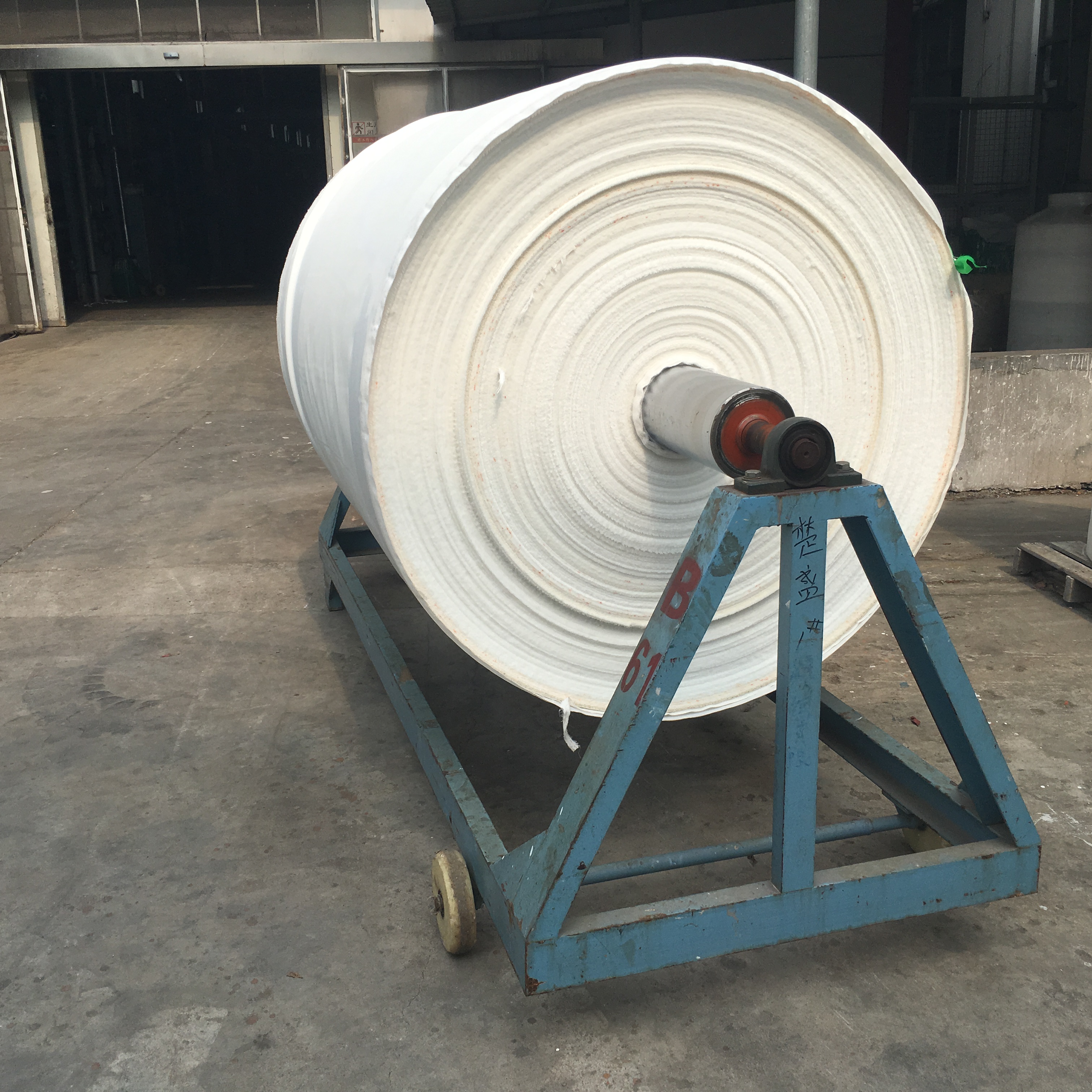
Production starts with much larger master rolls.
When there is no splice, one continuous woven master roll can typically reach approximately:
2,300–2,600 linear meters
depending on the fabric and production conditions.
This means one master roll can eventually supply many finished commercial rolls.
One Master Roll Becomes Many Finished Canvas Rolls
After production, the master roll is converted according to the customer's required specifications.
A simplified production flow is:
Master Roll → Slitting → Rewinding → Finished Rolls → Inspection → Packing
Commercial finished-roll lengths commonly include:
- 30m
- 50m
- 100m
with different widths and core sizes produced according to the customer's order.
This relationship is important for GSM consistency.
If one master roll is significantly different from another, the difference can eventually affect multiple finished rolls.
Therefore, controlling consistency at master-roll level is more meaningful than weighing one finished sample and assuming that the result represents the entire shipment.
Why We Use Multiple GSM Checks During Production
This is the central point of our GSM consistency control.
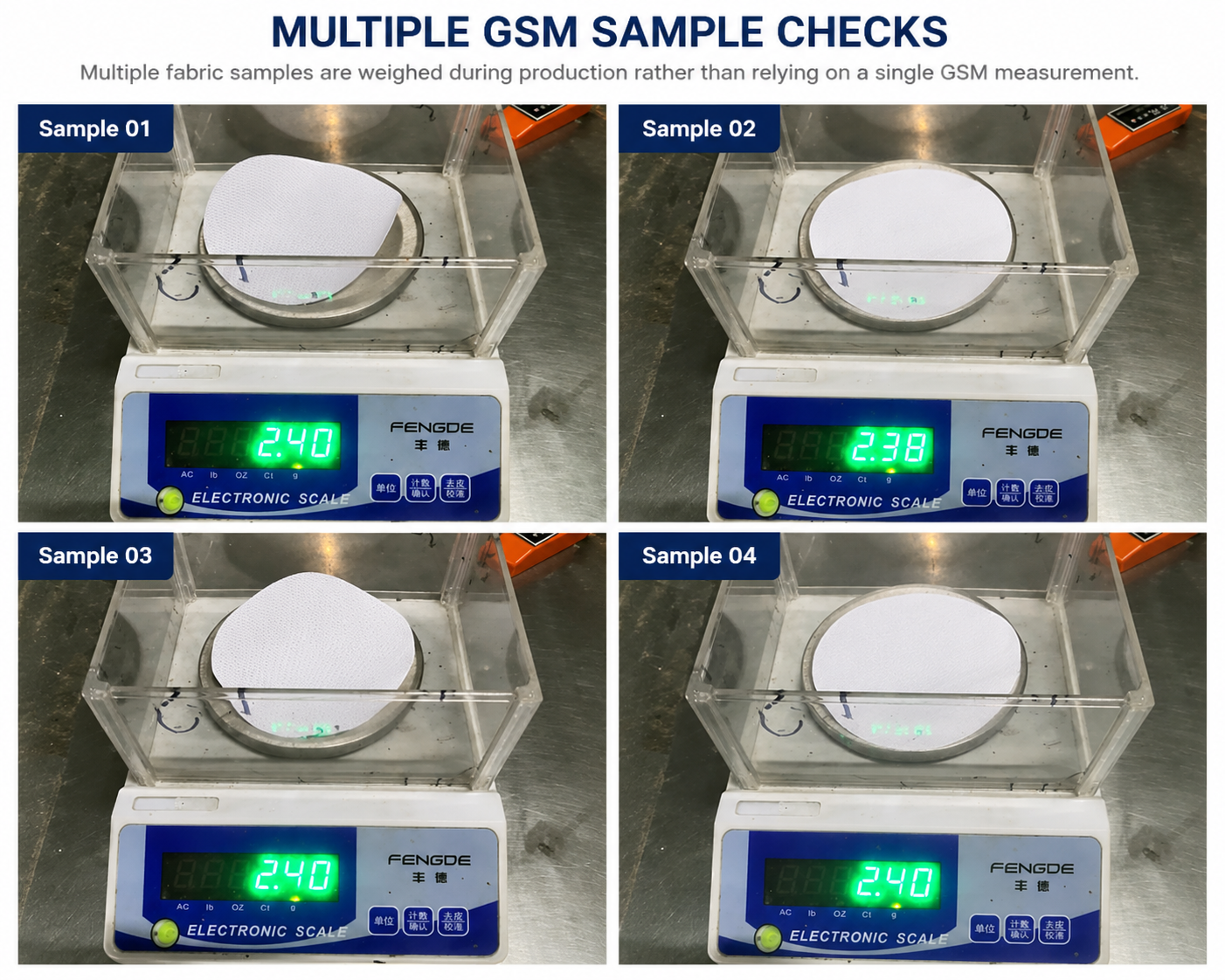
One GSM measurement tells us the weight of one sample.
Multiple measurements provide a much more useful picture of production consistency.
During bulk production, canvas samples are weighed repeatedly rather than relying on one isolated GSM result.
The measurements do not have to display exactly the same number every time. Normal textile and coating manufacturing involves tolerances.
What matters is whether the results remain within the approved production specification and whether any unusual deviation can be identified during production.
For professional buyers, this distinction is important:
One correct measurement proves that one sample meets the target. Repeated measurements provide better evidence of production consistency.
A Real 40HQ Example: Why Multiple GSM Checks Matter
The importance of repeated GSM checking becomes much clearer when we look at the scale of an actual container order.
Consider one production example:
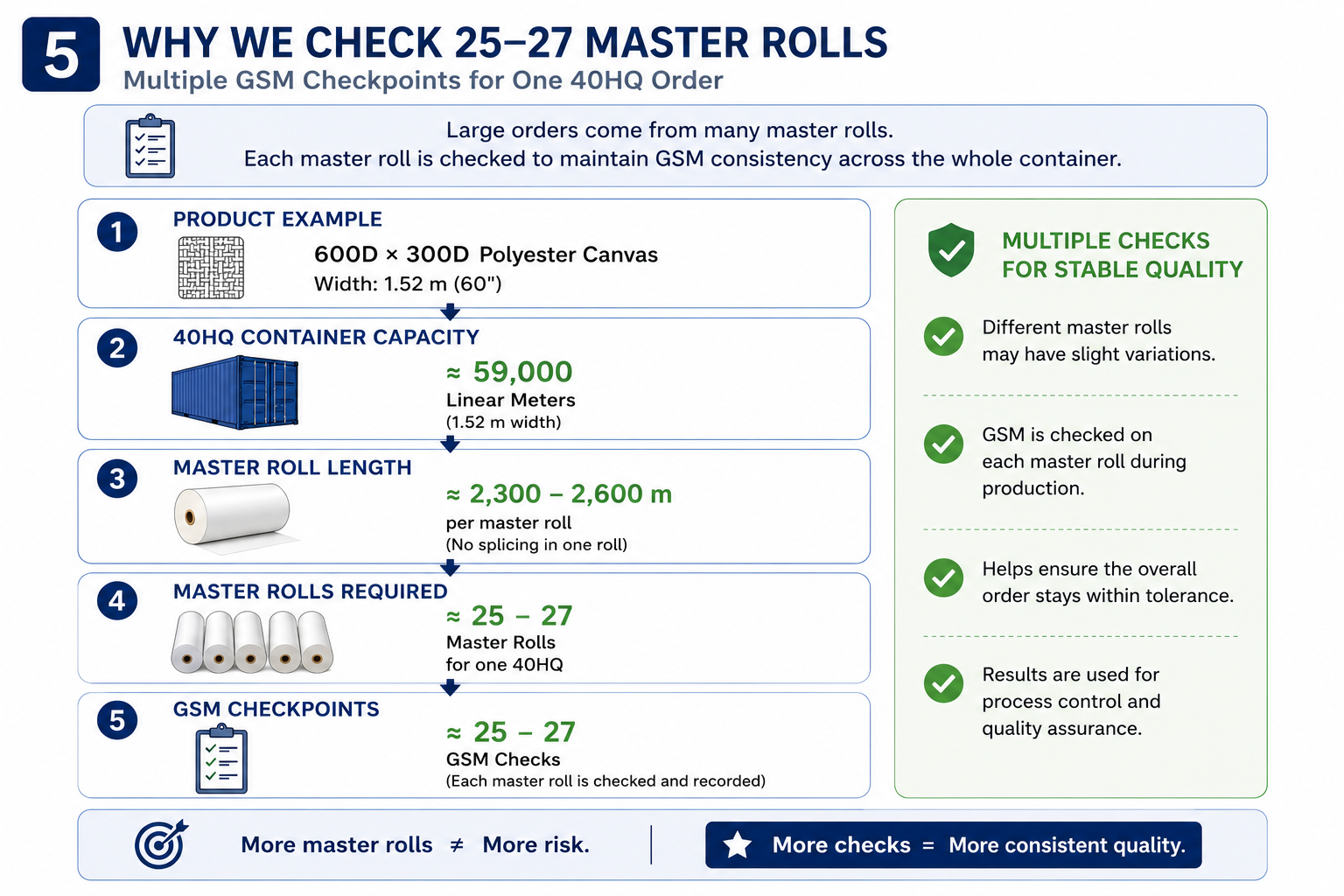
- Fabric construction: 600D × 300D polyester canvas
- Width: 1.52m
- Order quantity: One 40HQ container
For this product, one 40HQ can require approximately:
59,000 linear meters of canvas.
If one continuous master roll contains approximately 2,300–2,600 meters, actual production for the container can involve approximately:
25–27 master rolls.
Now consider what would happen if the supplier measured only one sample from this entire production quantity.
One measurement would represent only a very small portion of approximately 59,000 linear meters.
This is why a large order requires repeated GSM checks across the master rolls used during production.
The logic is straightforward:
≈59,000m of Canvas → ≈25–27 Master Rolls → Multiple GSM Checks → Better Batch Control
Why This Matters to High-Volume Canvas Buyers
For a customer purchasing two or three rolls, a good sample provides useful initial information.
For a wall-art factory, photo lab, canvas distributor or print-on-demand manufacturer consuming hundreds or thousands of rolls, the requirement is different.
The customer needs the media to remain predictable across:
- different master rolls;
- hundreds of finished rolls;
- multiple printing machines;
- repeat production runs;
- and future repeat orders.
A significant change in media weight or construction can affect material handling and production repeatability.
For professional printing, buyers should also evaluate coating and printer compatibility rather than relying on GSM alone. See our guide to choosing inkjet canvas for Aqueous, Solvent, Latex and UV printing .
GSM Control and Final Inspection Are Different QC Steps
GSM monitoring during production should not be confused with final random inspection.
They are different quality-control steps with different purposes.
Production GSM Control
Master Roll → GSM Sample Check → Production Monitoring → Finished Rolls
The purpose is to monitor weight consistency during the production process.
Final Random Inspection
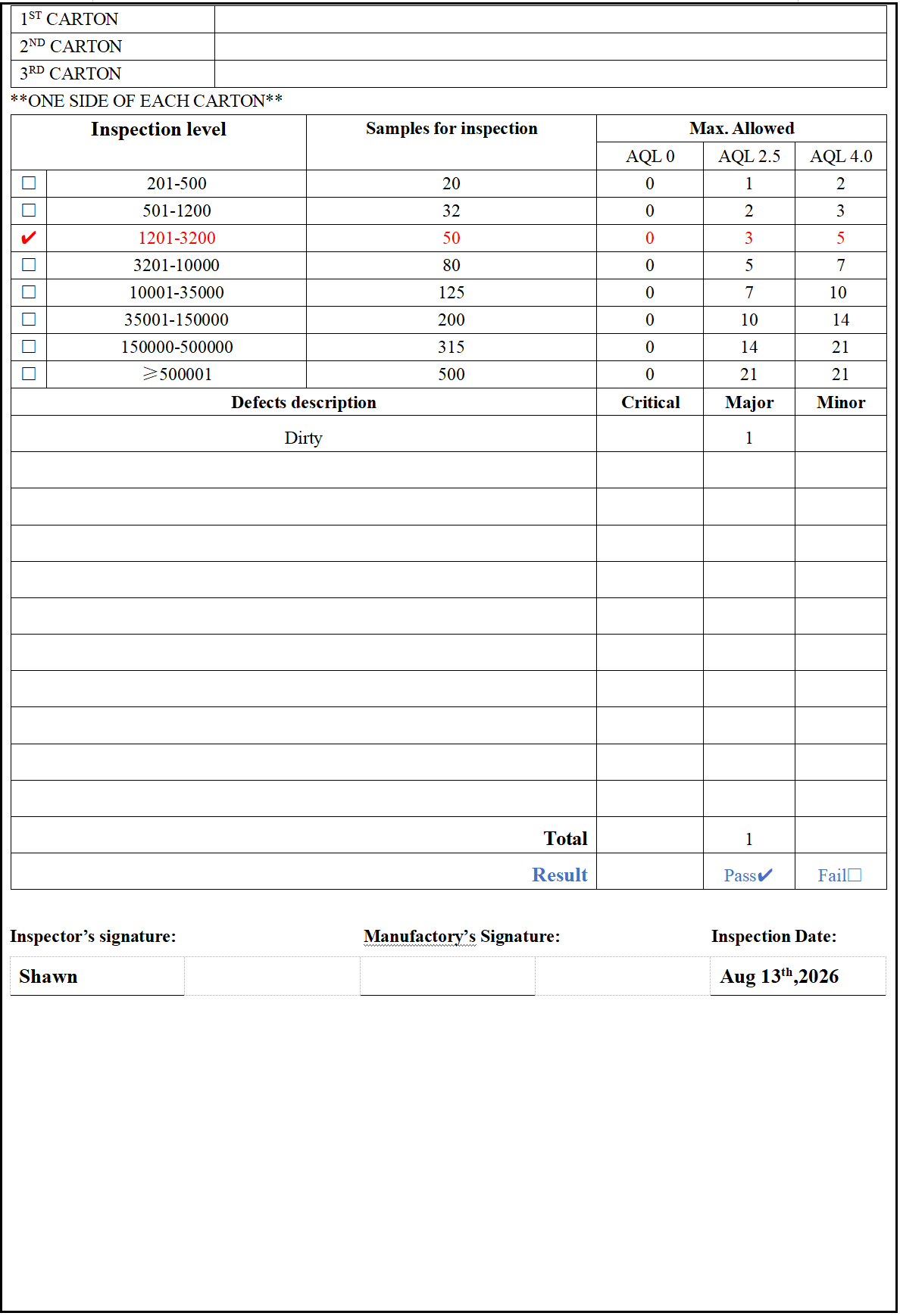
Finished Goods → Random Sampling → Defect Evaluation → Inspection Result
The purpose is to evaluate finished products before shipment according to the applicable inspection criteria.
Our AQL inspection record is therefore shown here as evidence of an additional finished-goods inspection stage. It should not be interpreted as a GSM measurement record.
For a broader look at our coating, printing and production inspection process, see Inkjet Canvas Quality Control: Coating & Printing Tests .
Industry Context: Consistency Matters as Digital Textile Printing Scales
Production consistency becomes increasingly important as digital textile printing continues to expand.
Smithers reports that the global digital textile printing market represented approximately 3.3 billion square meters in 2022 and forecasts approximately 5.5 billion square meters by 2028, with an estimated 8.3% CAGR for 2023–2028.
These figures cover the broader digital textile printing market rather than printable canvas specifically. However, they illustrate the growing scale of digitally printed textile production and why repeatable media performance matters to industrial users.
Industry data source: Smithers — The Future of Digital Textile Printing to 2028 .
What Should Bulk Canvas Buyers Ask Their Supplier?
When comparing suppliers, buyers should not stop after asking:
“Is this canvas 260gsm?”
Useful questions include:
- What is the target GSM?
- What production tolerance is used?
- How frequently is GSM checked during bulk production?
- How many master rolls are normally required for my order?
- Are samples checked across different master rolls?
- How is abnormal GSM variation handled?
- Is the approved sample representative of the planned bulk construction?
- Is there a separate final inspection before shipment?
These questions help distinguish between sample quality and repeatable bulk-production quality.
A good sample is important.
But for a long-term B2B canvas supplier, the ability to reproduce the approved specification across large orders is even more important.
For additional canvas selection criteria, see our Inkjet Canvas Guide: Materials, Coatings & Applications .
From GSM Checks to Bulk Shipment
Ultimately, the purpose of GSM consistency control is not to produce a good laboratory number.
The purpose is to supply more predictable material across an actual commercial shipment.
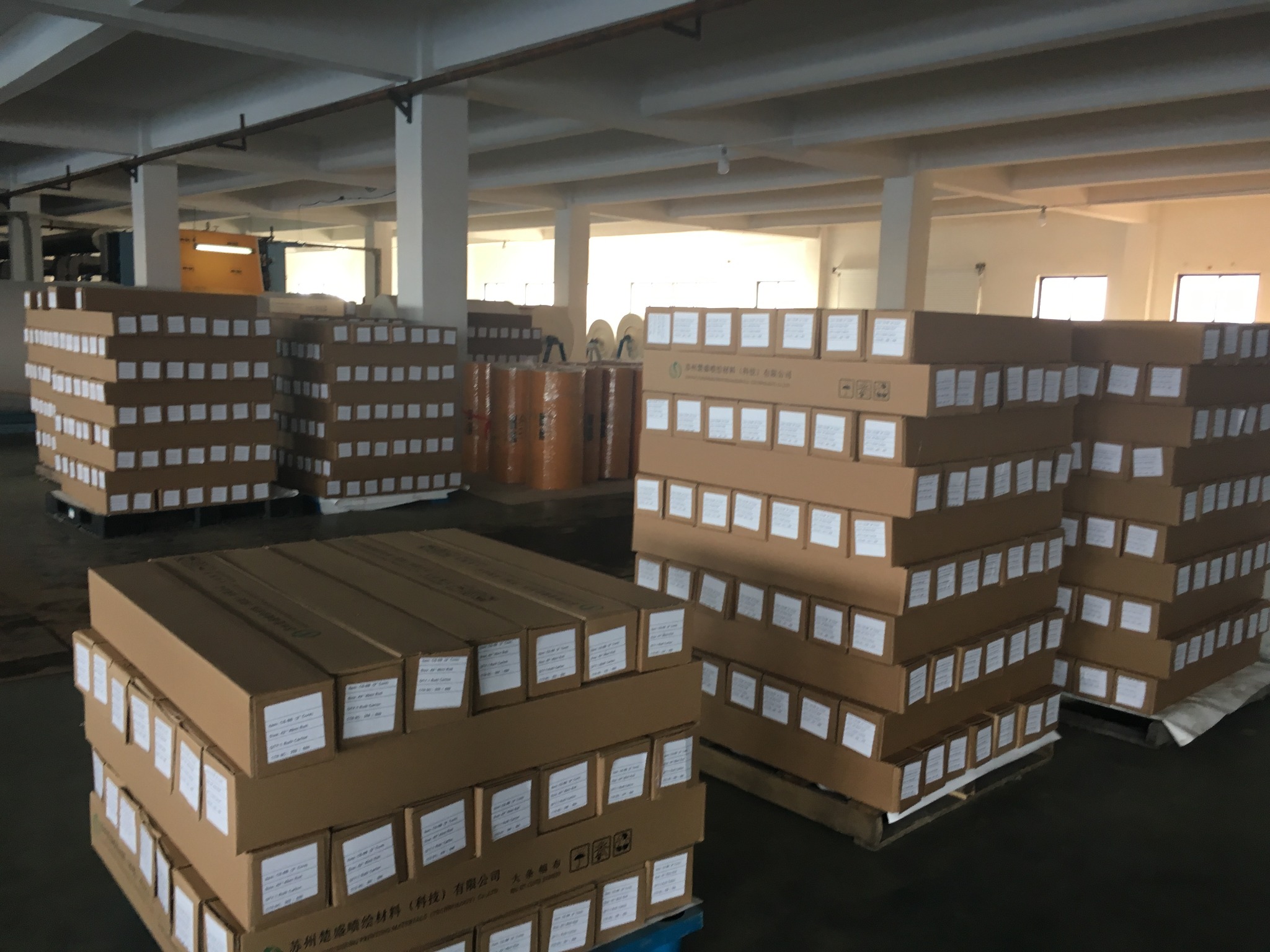
After production and inspection, finished canvas rolls are packed, labeled and organized for bulk shipment.
For high-volume customers, consistency across these finished rolls is what matters in daily production.
Conclusion: Consistency Matters More Than One Perfect Sample
A correct GSM measurement is important, but one perfect measurement does not represent an entire container.
When one 40HQ order can involve approximately 59,000 linear meters of canvas and around 25–27 master rolls, bulk quality depends on repeated production control rather than one isolated sample result.
This is why Colors Art evaluates GSM during production across multiple samples and combines production monitoring with final finished-goods inspection.
A good sample shows that the required GSM can be achieved. Consistent bulk production shows whether it can be reproduced.
For distributors, wall-art manufacturers, photo labs and professional printing companies, this distinction becomes increasingly important as purchasing volume grows.
If you are evaluating a printable canvas for bulk production, send us your current specification or reference sample together with your required GSM, width, roll length, printer and expected order quantity.
Colors Art can evaluate the required construction and prepare samples for production testing before bulk ordering.