HOMEBlogDoes Higher GSM Mean Better Canvas Opacity? A Visual Comparison of 280–420 GSM Printable Canvas
Blog
Does Higher GSM Mean Better Canvas Opacity? A Visual Comparison of 280–420 GSM Printable Canvas
When buyers compare printable canvas, GSM is often one of the first specifications they check. A 420 GSM canvas is heavier than a 280 GSM canvas, so it may seem reasonable to assume that the heavier canvas will automatically have better opacity and less show-through.
In actual printable canvas production, however, the relationship is more complicated.
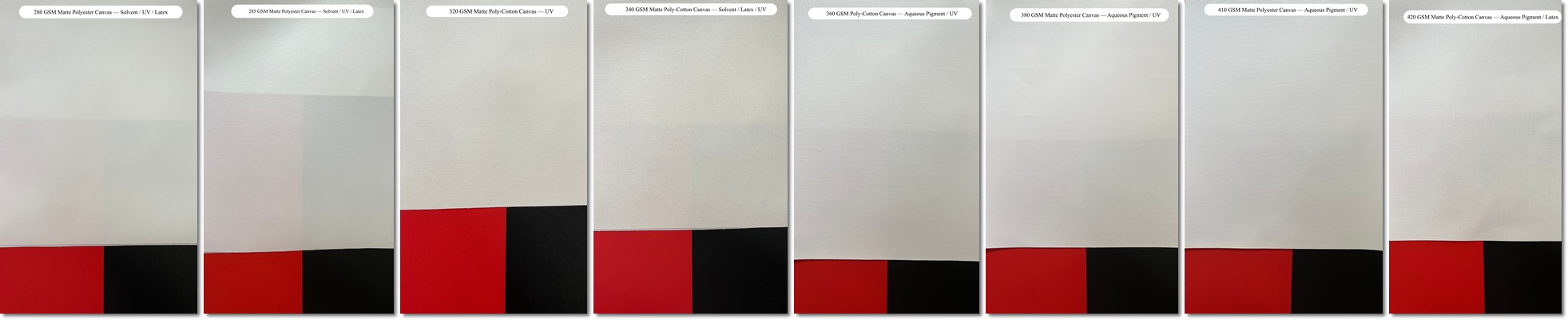
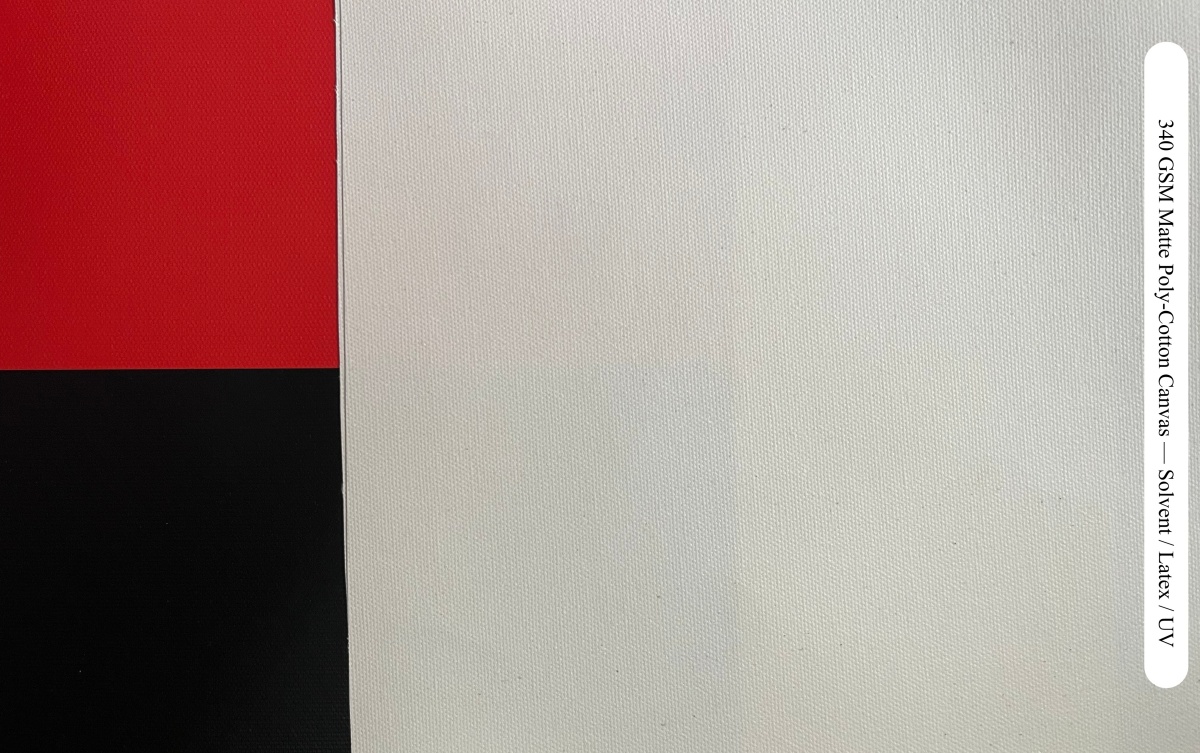
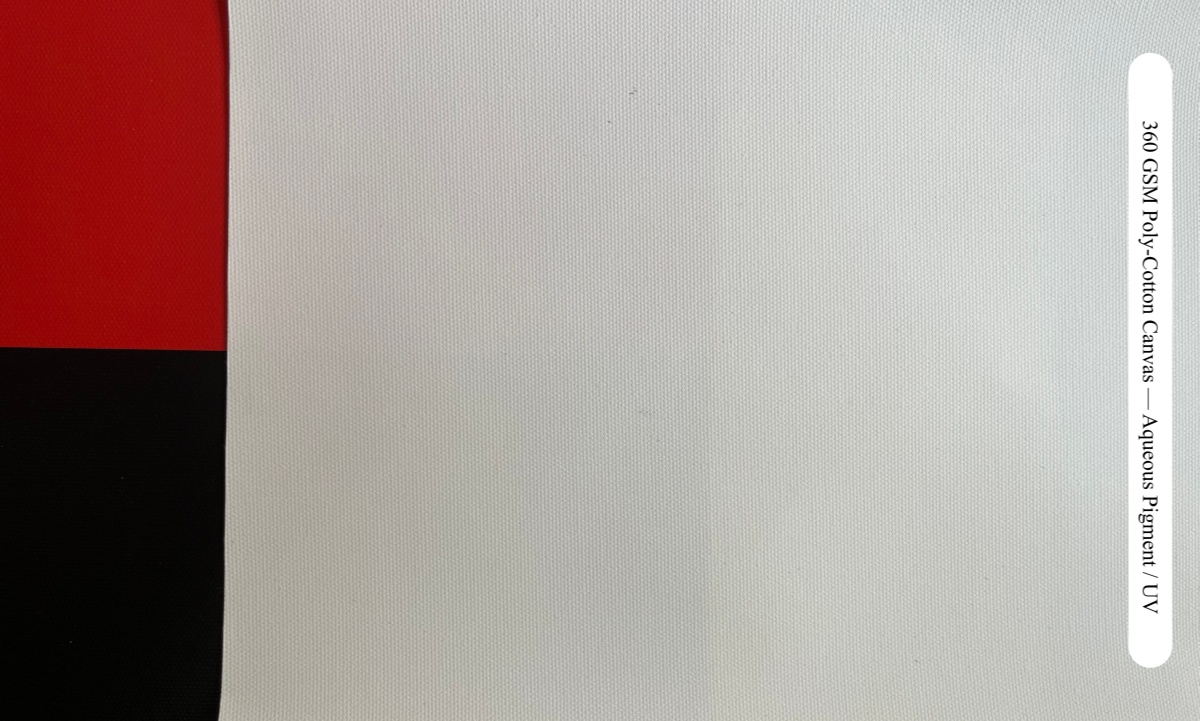
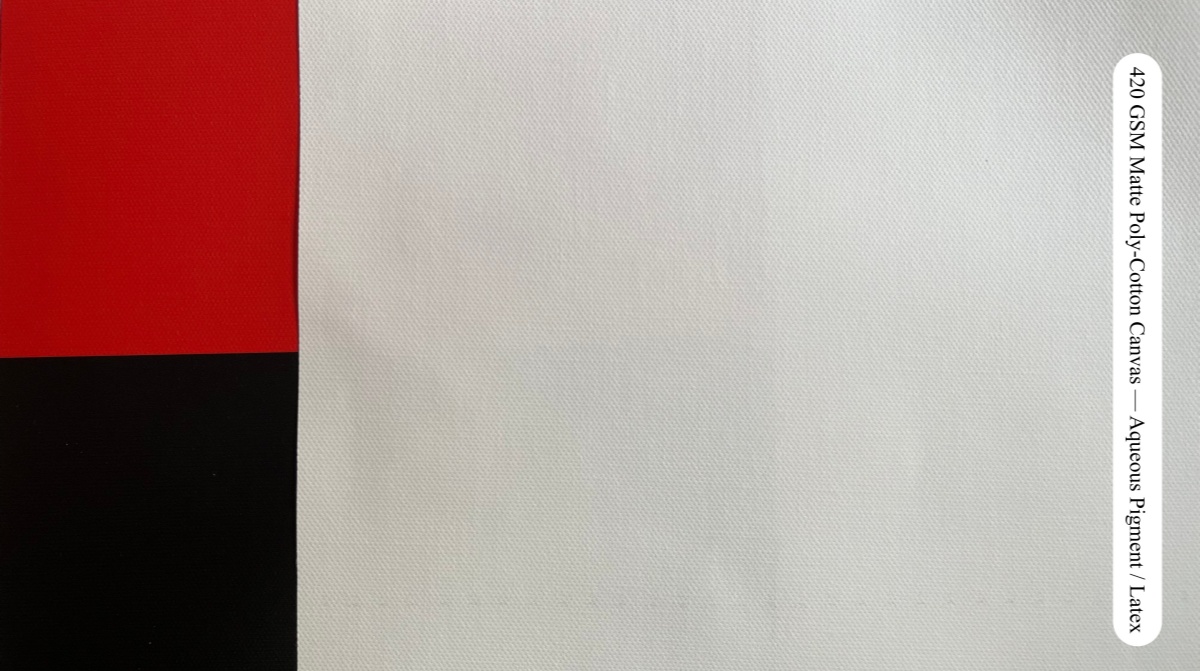
We compared eight printable canvas constructions ranging from 280 GSM to 420 GSM by placing the unprinted canvas over the same red, white and black background and viewing the result from the printable side.
This is a visual opacity comparison, not a laboratory opacity measurement. The purpose is to demonstrate an important purchasing principle:
GSM alone cannot predict the opacity of a printable canvas.
The final result is influenced by the complete canvas construction, including fiber material, yarn construction, weave density, base fabric, priming and printable coating.
Does Higher GSM Mean Better Canvas Opacity? A Visual Comparison of 280–420 GSM Printable Canvas
When buyers compare printable canvas, GSM is often one of the first specifications they check. A 420 GSM canvas is heavier than a 280 GSM canvas, so it may seem reasonable to assume that the heavier canvas will automatically have better opacity and less show-through.
In actual printable canvas production, however, the relationship is more complicated.
We compared eight printable canvas constructions ranging from 280 GSM to 420 GSM by placing the unprinted canvas over the same red, white and black background and viewing the result from the printable side.
Visual comparison of eight 280–420 GSM polyester and poly-cotton printable canvases over the same red, white and black backgrounds.
This is a visual opacity comparison, not a laboratory opacity measurement. The purpose is to demonstrate an important purchasing principle:
GSM alone cannot predict the opacity of a printable canvas.
What Does Opacity Mean in Printable Canvas?
Opacity describes how effectively a canvas prevents the material or color behind it from showing through the printable surface.
For printable canvas, this can matter in applications such as gallery wraps, stretched canvas prints, photographic canvas, fine-art reproduction, wall décor and other applications where the finished canvas is viewed from the printable side.
Opacity should not be confused with whiteness.
A canvas can have a bright white printable surface while still allowing more of the background behind it to show through than another canvas with a different fabric and coating construction.
Similarly, a heavier canvas does not automatically mean a more opaque canvas. GSM is an important specification, but it is only one part of the complete printable canvas construction.
For this comparison, eight unprinted printable canvas samples were placed over the same contrasting red, white and black background.
The black area makes show-through particularly easy to observe, while the red area helps reveal the influence of a colored background. The white area provides a reference for the normal appearance of the printable surface.
The samples include polyester and poly-cotton constructions designed for different ink technologies. They therefore should not be interpreted as eight otherwise identical products in which GSM is the only variable.
That difference is important: in real purchasing decisions, buyers normally compare commercial canvases with different base fabrics, coating systems and intended applications, not laboratory samples that differ only in weight.
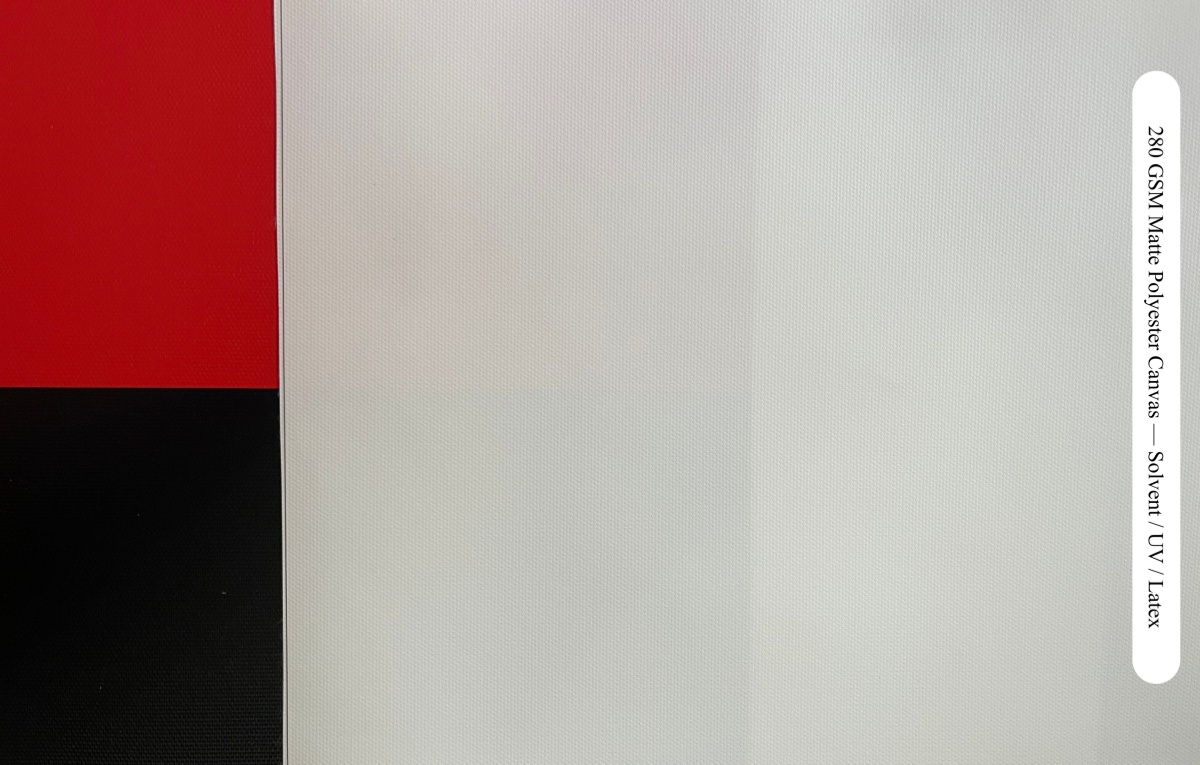
280 GSM matte polyester printable canvas shown over red, white and black backgrounds for visual opacity comparison.
This 280 GSM sample represents a relatively lightweight polyester printable canvas. Instead of judging it simply as a “lighter” canvas, buyers should observe how the base fabric and coating work together to control visible background show-through.
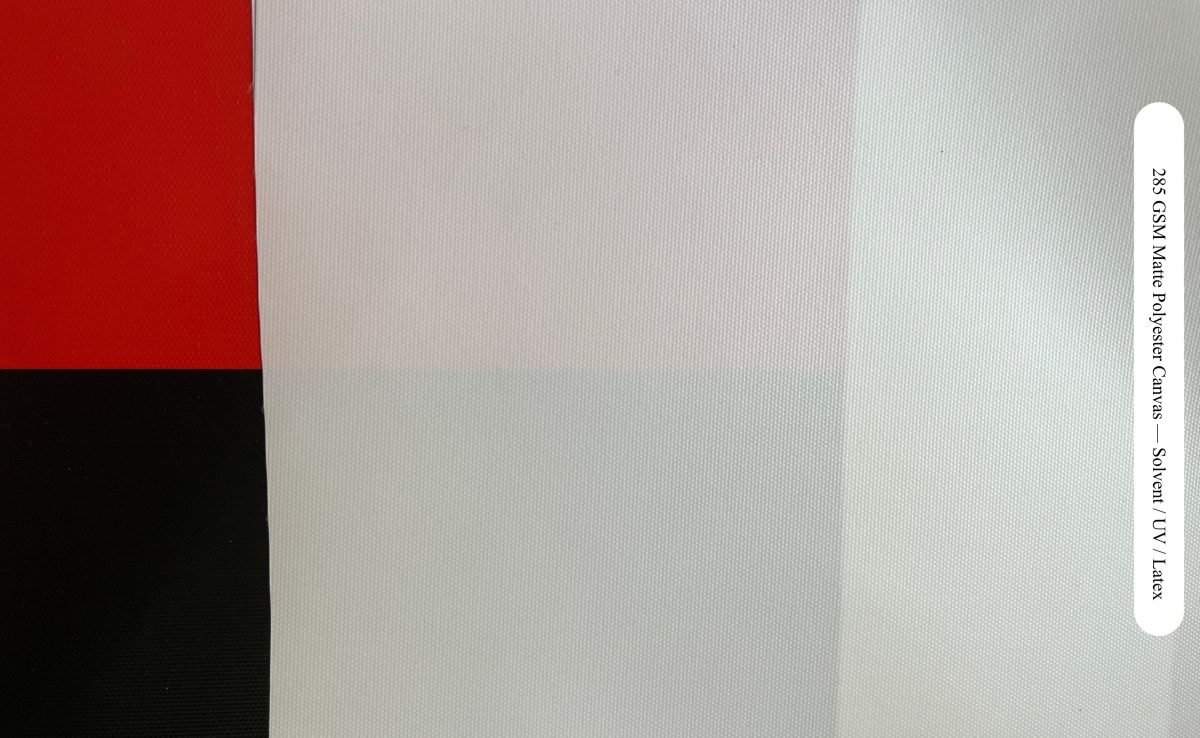
285 GSM matte polyester printable canvas under the same visual opacity comparison.
There is only a 5 GSM difference between this sample and the previous 280 GSM polyester canvas.
That small numerical difference alone tells us very little about which product should have better opacity.
Even when two products use the same general fiber type and have very similar finished GSM, differences in yarn construction, weaving, base-fabric structure and coating can affect the visible result.
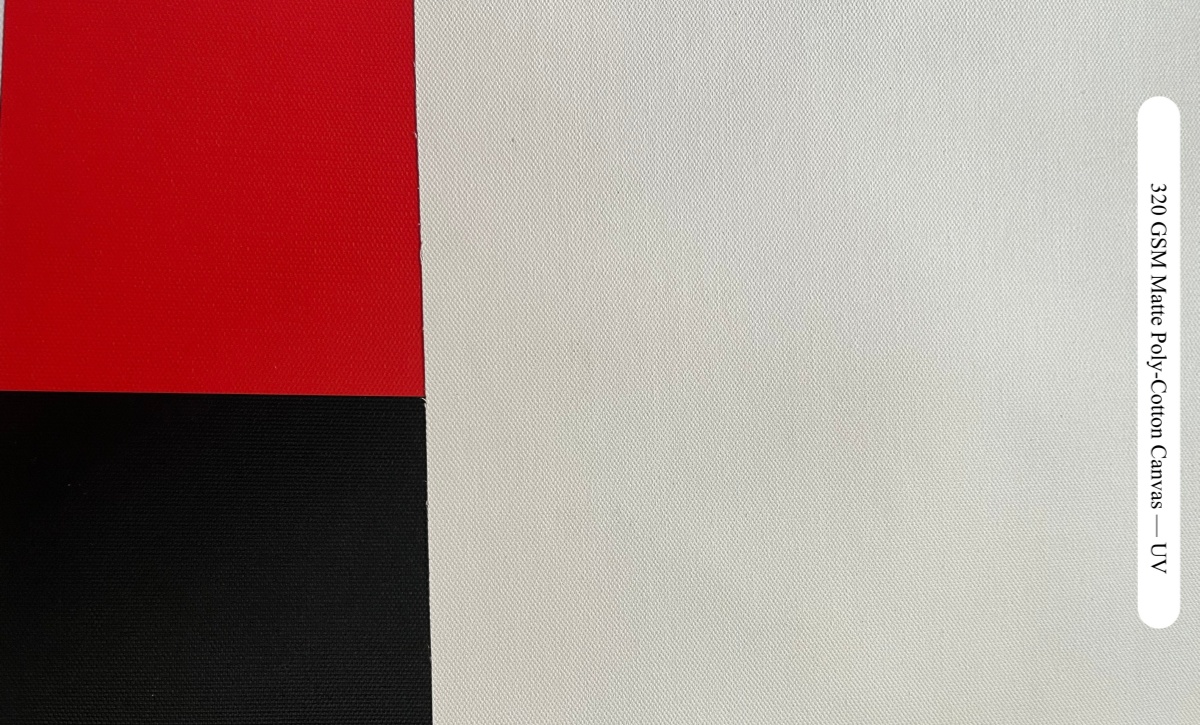
320 GSM Matte Poly-Cotton Canvas — UV
320 GSM matte poly-cotton printable canvas placed over red, white and black backgrounds for visual comparison.
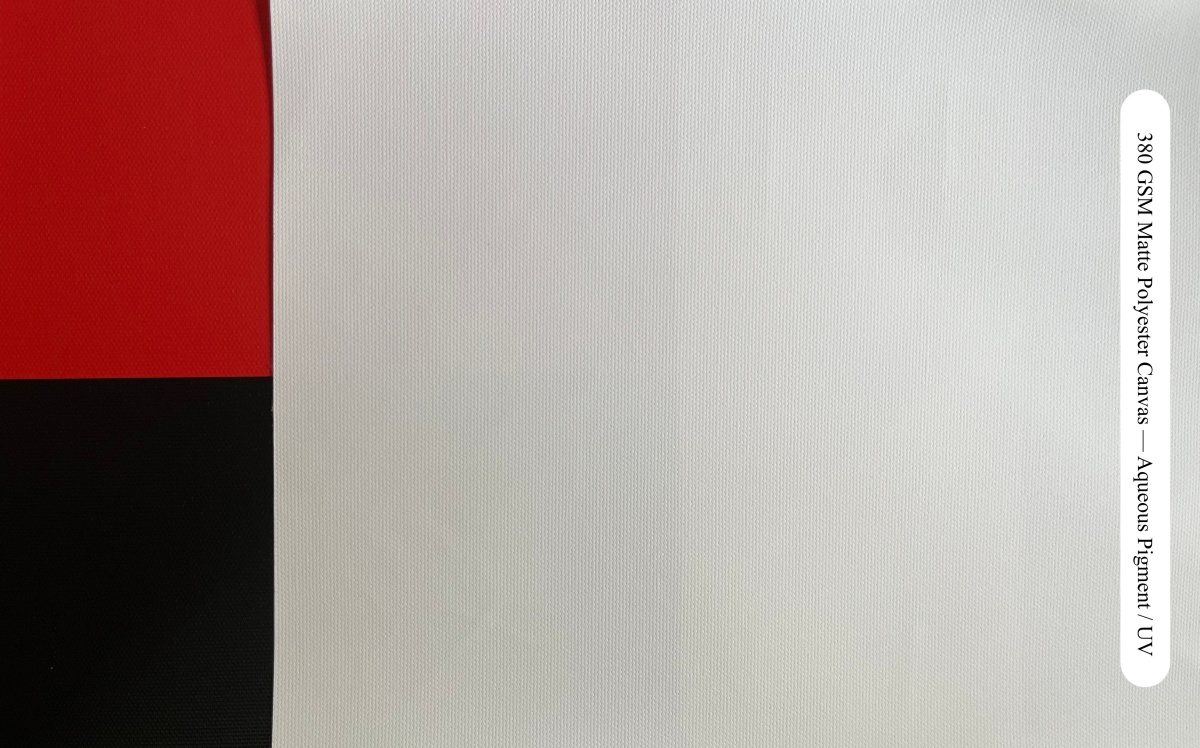
380 GSM matte polyester printable canvas shown over contrasting backgrounds for visual opacity evaluation.
This sample is particularly useful in the comparison because it returns to a polyester construction, while several neighboring heavier samples are poly-cotton.
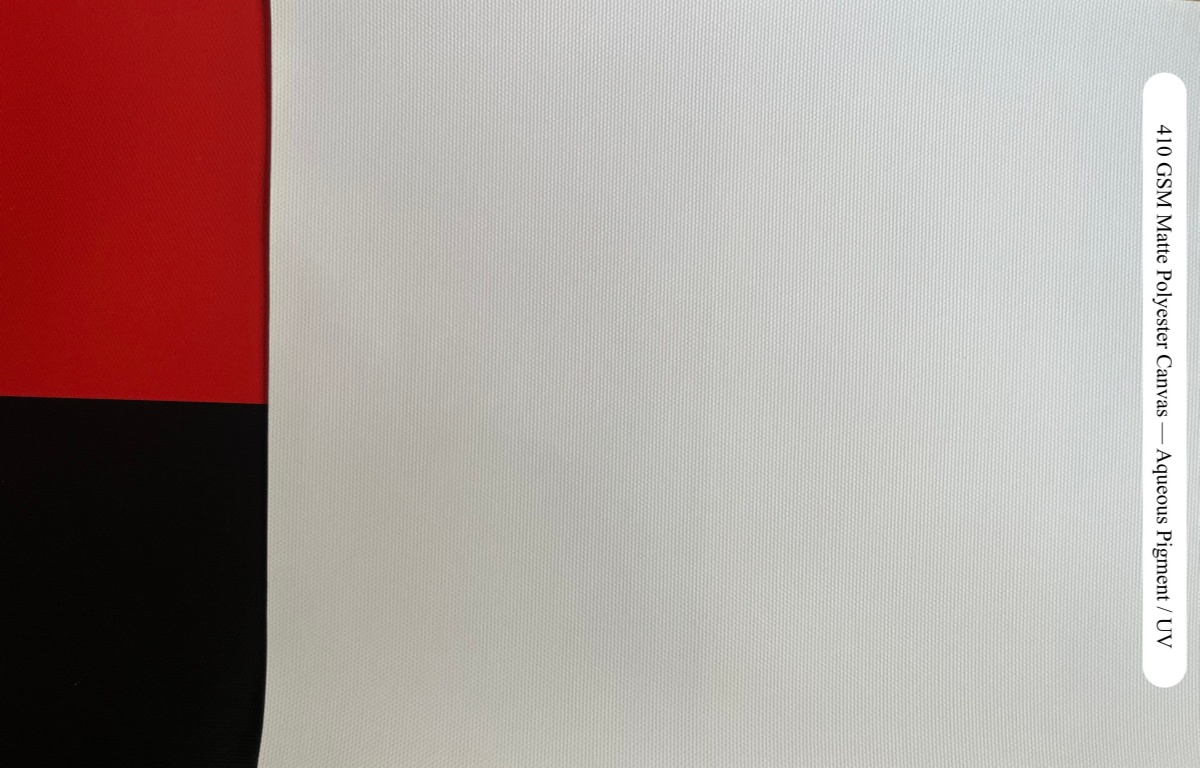
Comparing a 380 GSM polyester canvas directly with a 410 GSM or 420 GSM poly-cotton canvas by weight alone would therefore ignore an important variable: the underlying textile construction is different.
410 GSM matte poly-cotton printable canvas used for visual opacity evaluation.
420 GSM Poly-Cotton Canvas — UV
420 GSM poly-cotton printable canvas shown over red, white and black backgrounds.
Quick Comparison of the Eight Printable Canvas Samples
GSM
Material
Surface
Ink Compatibility
280 GSM
Polyester
Matte
Solvent / UV / Latex
285 GSM
Polyester
Matte
Solvent / UV / Latex
320 GSM
Poly-Cotton
Matte
UV
340 GSM
Poly-Cotton
Matte
Solvent / Latex / UV
360 GSM
Poly-Cotton
—
Aqueous Pigment / UV
380 GSM
Polyester
Matte
Aqueous Pigment / UV
410 GSM
Poly-Cotton
Matte
Aqueous Pigment / Latex
420 GSM
Poly-Cotton
—
UV
This table also makes clear why the photographs should not be treated as a controlled laboratory experiment in which GSM is the only changing variable. Material and coating systems differ across the samples.
Why GSM Alone Cannot Determine Canvas Opacity
GSM means grams per square meter. It tells us how much one square meter of the finished material weighs.
It does not tell us how that weight is distributed between the textile base and the coating system.
Base Fabric + Primer / Surface Preparation + Printable Coating = Finished Printable Canvas
Two products can therefore arrive at similar finished GSM through very different constructions.
One may use a heavier base fabric. Another may use a different yarn construction or tighter weave. Another may have a different primer or printable coating build.
As a result, canvases with similar GSM can still differ in:
Opacity
Whiteness
Texture
Fabric openness
Flexibility
Ink response
Coating behavior
Final print appearance
Yarn Construction and Weave Density Matter
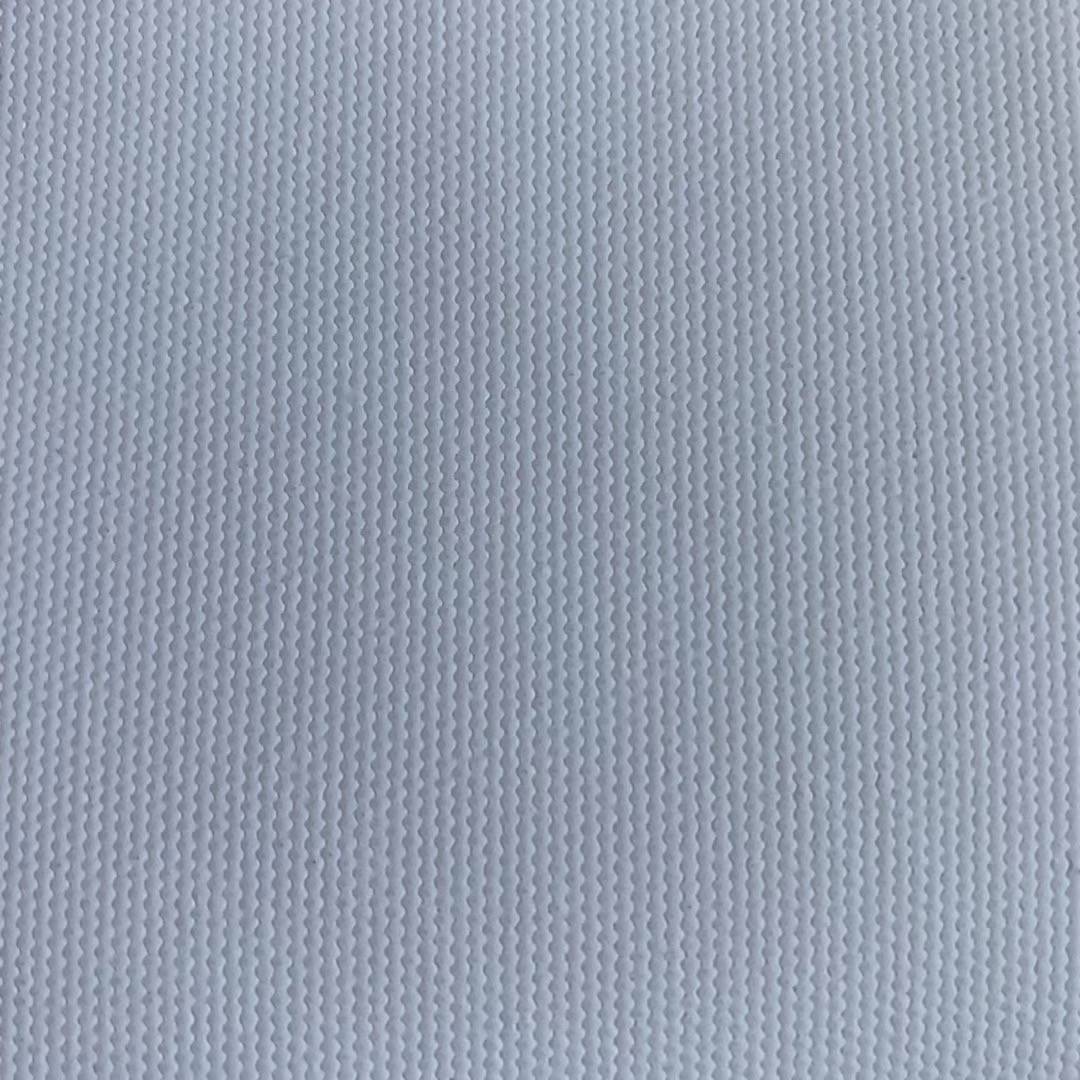
Close-up view of printable canvas surface structure and weave texture before printing.
Before any printable coating is applied, the woven base fabric already has its own physical structure.
Commercial polyester canvas, for example, may use yarn constructions such as 500D × 300D or 600D × 300D, depending on the required product construction.
But yarn specification alone is still not enough.
The density and arrangement of the warp and weft determine how open or compact the fabric structure is. If the spaces between yarns are more open, the base fabric can interact differently with light and with the background behind it than a tighter construction.
The textile structure also affects how subsequent primer and printable coating interact with the fabric.
Opacity begins with the fabric construction. It does not begin with the finished GSM number.
The Coating System Also Changes the Result
Printable canvas is not simply woven fabric with a white material applied to the surface.
The coating has to be engineered for the intended printing technology.
A canvas developed for aqueous pigment printing does not necessarily use the same coating formulation as a canvas designed for solvent, Latex or UV printing.
For some of our printable canvas constructions, the production process uses 2 primer coats + 2 top coats.
This should not be interpreted as “more coating passes always mean better canvas.” Each coating layer has a specific function.
The coating system needs to balance:
Surface coverage
Opacity
Whiteness
Ink absorption
Color density
Coating adhesion
Flexibility
Scratch resistance
Canvas texture
Overall printing performance
Opacity should be engineered, not simply added.
Increasing coating weight only to make a canvas heavier or more opaque can also change surface texture, ink absorption, flexibility, coating adhesion and production cost.
The objective is therefore not the highest possible GSM or the highest possible opacity.
The objective is the right balance between base fabric, coating system, ink technology and final application.
Opacity Is Only One Part of Printable Canvas Performance
The unprinted red, white and black comparison helps buyers observe visible show-through, but professional printable canvas should not be selected from opacity alone.
After evaluating the unprinted base material, another important step is an actual printing test.
This allows us to evaluate what happens after ink reaches the coating rather than judging only the appearance of the white unprinted canvas.
Actual Printable Canvas Printing Test
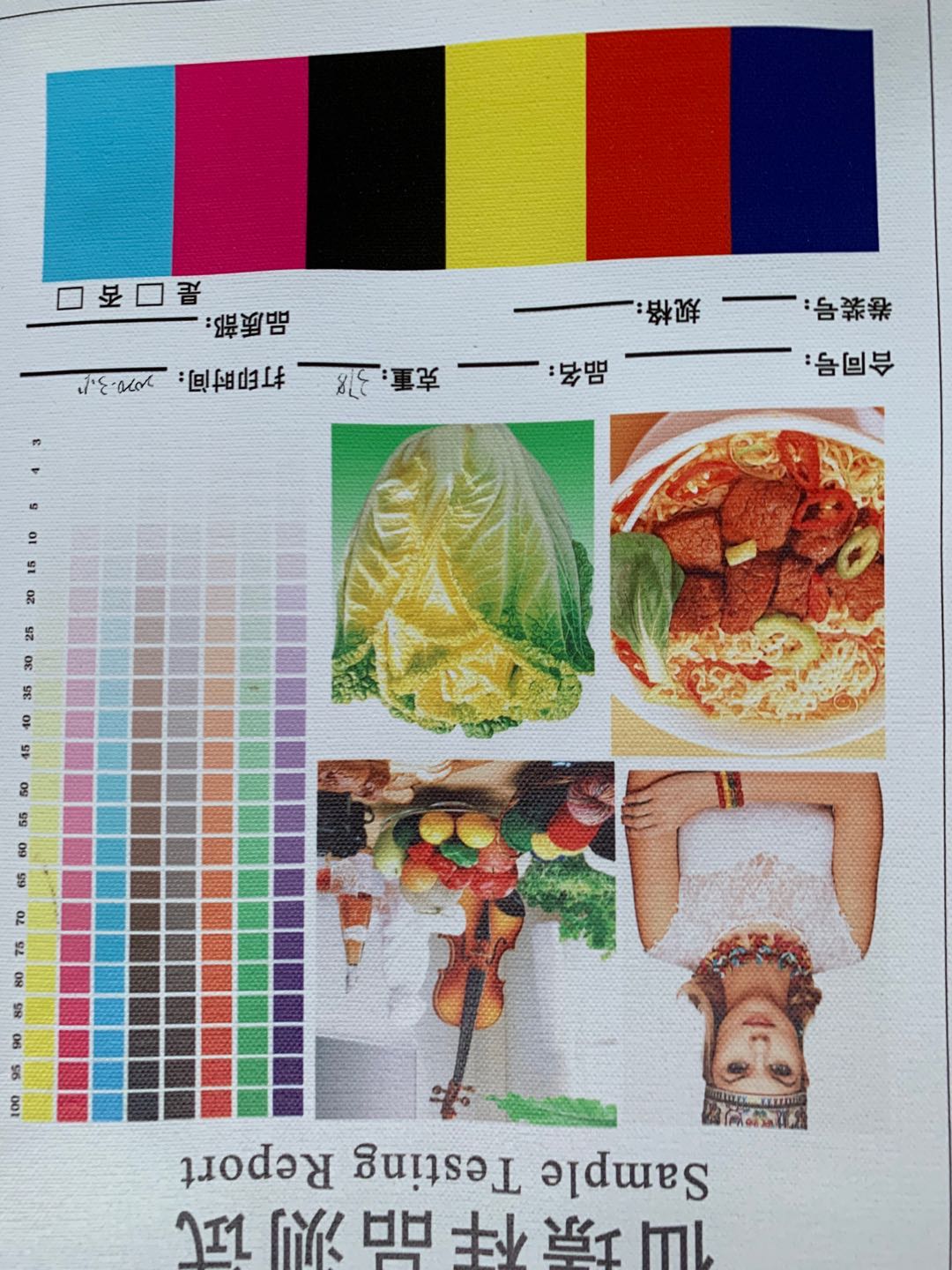
Actual printable canvas test showing solid colors, photographic images and tonal transitions.
A useful printing test should contain more than one attractive photograph. Different areas of a test image help reveal different aspects of coating and printing performance.
Our printing tests can include:
Solid colors
Dark and black areas
Photographic images
Skin tones
Fine details
Highlights and shadows
Tonal transitions
Different color-density levels
These characteristics cannot be determined from GSM or an unprinted opacity comparison alone.
Solid Colors and Black Density
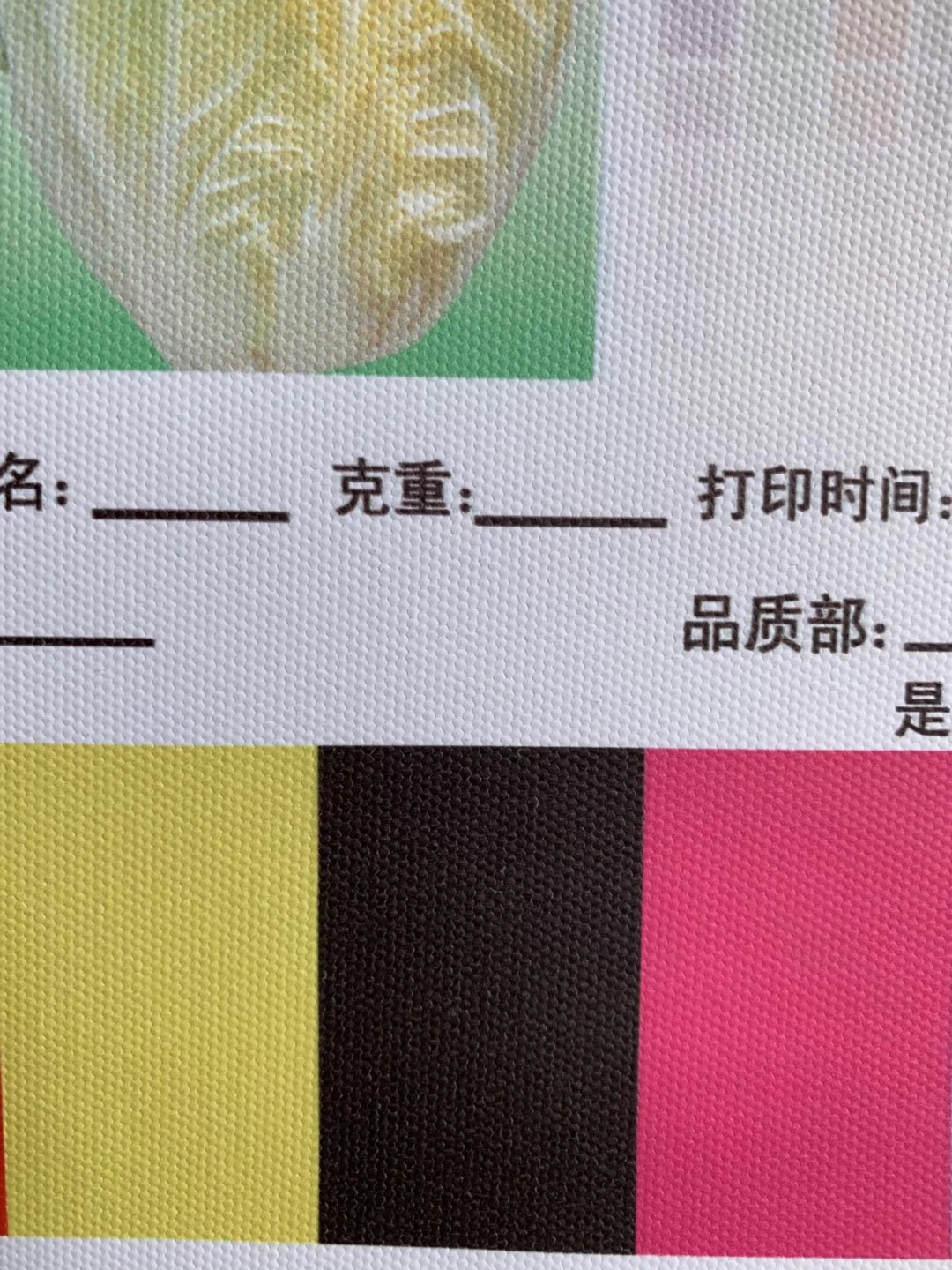
Close-up of a printed canvas test showing solid-color density and the interaction between ink and canvas texture.
Solid-color areas are particularly useful when evaluating a printable coating.
Dark areas can help reveal black density, coating uniformity, ink reception, visible texture and whether the image maintains sufficient visual depth on the woven surface.
Highly saturated colors also help us observe how the coating receives and reproduces different ink loads.
A canvas may look excellent while unprinted but behave differently once a significant amount of ink is deposited onto the surface.
This is why white-canvas appearance and actual printing performance should be evaluated separately.
Image Reproduction and Canvas Texture
Printed image test used to evaluate color reproduction, tonal detail and the interaction between the printed image and canvas texture.
Photographic images provide another level of evaluation.
They allow buyers and manufacturers to observe:
Skin-tone reproduction
Warm and cool colors
Fine image details
Highlights and shadows
Tonal transitions
Dark-area reproduction
The interaction between the printed image and physical canvas texture
The goal is not to eliminate canvas texture.
Canvas is a textile printing medium, and its woven character is part of the finished visual appearance. The challenge is to achieve a balance where the texture remains appropriate while the coating still delivers the required image quality.
Two Canvases With Similar Opacity Can Still Print Differently
This is another important point for professional buyers.
Even if two unprinted canvases appear to have similar opacity, they may still perform differently once they are put on the printer.
Printer + Ink + Print Settings + Coating + Base Fabric + Final Application
A specification sheet cannot fully show:
Ink absorption behavior
Color density
Tonal reproduction
Image sharpness
Drying behavior
Surface feel
Scratch resistance
Coating adhesion
Behavior during stretching
This is why two printable canvases with apparently similar descriptions—including similar GSM, material and surface finish—do not necessarily produce identical printing results.
Does Higher Opacity Mean Better Printable Canvas?
Not necessarily.
Opacity is important, but maximum opacity is not the universal definition of printable canvas quality.
Different customers and applications have different priorities.
A high-volume wall décor producer may place more emphasis on:
Consistent printing
Stable coating
Cost efficiency
Roll-to-roll consistency
Stretching performance
A fine-art printer may place greater emphasis on:
Surface character
Tonal reproduction
Color density
Fine detail
Image appearance
A gallery-wrap producer also needs to consider how the coated canvas behaves when it is stretched around the edges of the stretcher frame.
The best printable canvas is therefore not automatically the heaviest or the most opaque.
It is the product whose complete construction is appropriate for the intended printer, ink system, application and production requirements.
How Should Professional Buyers Compare Printable Canvas?
Instead of asking only:
“What GSM is your canvas?”
a more useful technical evaluation should consider the complete product.
Specification
What It Helps Evaluate
GSM
Finished material weight
Material
Polyester, cotton or poly-cotton construction
Yarn & Weave
Textile structure and surface character
Opacity
Visible background show-through
Whiteness
Printable surface appearance
Coating System
Ink compatibility and surface performance
Surface Finish
Matte, satin, semi-gloss or gloss
Printing Test
Color, density, detail and ink response
Stretching Test
Flexibility and coating behavior
Batch Consistency
Repeatability during commercial production
For large-volume buyers, one successful sample is not enough. Repeatability across production batches is also important.
Physical samples can then be evaluated on the actual printer before bulk production, rather than selecting a printable canvas from GSM alone.
Frequently Asked Questions About Printable Canvas Opacity
Does higher GSM mean better canvas opacity?
Not automatically. Higher GSM means a higher finished weight per square meter, but opacity also depends on fiber material, yarn construction, weave density, base fabric and coating structure. GSM should therefore be evaluated together with the complete canvas construction.
What affects printable canvas opacity?
Important factors include the base-fabric material, yarn specification, weave density, fabric construction, primer and printable coating system. The final GSM alone does not describe all of these variables.
Is canvas opacity the same as canvas whiteness?
No. Whiteness describes the visible white appearance of the printable surface, while opacity describes how effectively the canvas hides the material or color behind it. A bright white canvas is not automatically the most opaque canvas.
Is the red, white and black comparison a laboratory opacity test?
No. The photographs in this article are intended as a visual comparison of background show-through. A numerical opacity specification requires controlled instrumental measurement using an appropriate test method.
Should buyers choose printable canvas by GSM alone?
No. GSM is useful, but professional evaluation should also consider material, weave, coating, ink compatibility, surface finish, actual printing performance, stretching behavior and batch consistency.
What is the best way to test printable canvas before a bulk order?
A practical evaluation combines the technical specification with a physical sample, an actual printing test using the intended printer and ink system, and an application test such as stretching when required.