HOMEBlogStretcher Bar Profile Guide: Light Duty, Standard, Gallery Wrap & Heavy Duty Explained
Blog
Stretcher Bar Profile Guide: Light Duty, Standard, Gallery Wrap & Heavy Duty Explained
How profile size, cross-section geometry, canvas dimensions, bracing, wood quality and target market determine the right stretcher bar for professional canvas production.
When buyers compare wooden stretcher bars, one of the first questions is often: What size profile should we use?
The answer is more complicated than choosing the thickest bar available. For canvas printers, framing companies, wall-art manufacturers, artist-canvas brands and wholesale distributors, the correct stretcher-bar profile must balance structural rigidity, visible frame depth, canvas tension, timber use, finished frame size, support requirements, packing weight and target price.
Terms such as Light Duty, Standard, Medium Duty, Gallery Wrap and Heavy Duty are useful purchasing descriptions, but they are not universal engineering standards. A profile that one manufacturer calls Medium Duty may have similar outside dimensions to another supplier's Heavy Duty product.
The reason is simple: nominal width and depth do not describe the complete structure of a stretcher bar.
Different stretcher-bar profiles are designed for different structural, visual and commercial requirements. Profile selection should consider geometry, frame size, canvas tension and bracing—not depth alone.
1. Quick Answer: Which Stretcher Bar Profile Should You Choose?
A useful starting point is to divide stretcher-bar profiles by their structural and presentation direction, rather than assuming that one nominal dimension automatically belongs to one duty class.
Profile Direction
Colors Art Profile Examples
Main Objective
Typical Application Direction
Light / Slim
16×30, 17×30, 18×37, 18×40 mm
Lower weight and efficient timber use
Smaller canvas and commercial production
Standard / Commercial
29×29, 30×30, 30×40 mm*
Balance rigidity, weight and cost
General canvas production
Economy Gallery Wrap
38×28 mm
Deep visible side with controlled structural width
Photo canvas, wall art and high-volume gallery wrap
Inclined / Sloped
29×29, 37×37 Incline, 38×37 Incline
Specific working-face geometry
OEM canvas and specialized profile programs
Larger Structural
40×40, 45×40 mm*
Greater wooden section
Medium-to-large canvas applications
Large Format
50×40, 55×40 mm*
Higher structural capacity
Large and professional canvas systems
Reinforced System
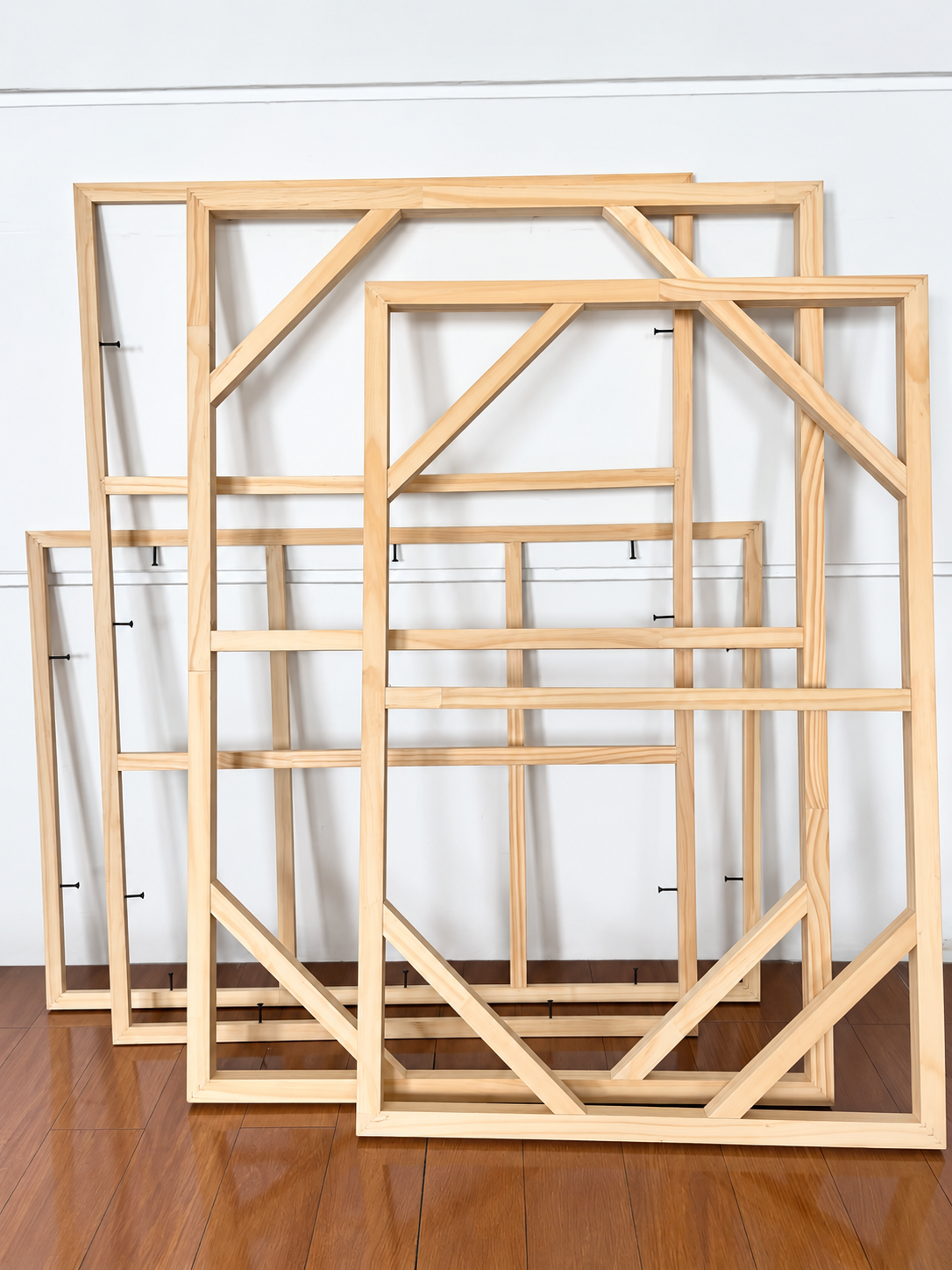
Outer profile + centre / cross / multi-bracing
Control longer unsupported spans
Large, elongated and oversized frames
*These examples describe available profile directions and should not be interpreted as a universal Colors Art duty-class standard. Final suitability depends on the actual cross-section, finished frame dimensions, canvas tension and support system.
2. Four Different Questions Buyers Should Separate
A common sourcing mistake is to combine structural strength, product quality, gallery depth and market level into one description.
They should be treated separately.
A. Structural Duty
Light → Standard / Medium → Heavy → Reinforced
This describes the structural demand placed on the frame system.
B. Market Position
Economy → Commercial → Premium → Professional
This describes the product's commercial positioning, not automatically its strength.
This mainly describes how the finished canvas looks.
D. Manufacturing Quality
Timber grade, moisture condition, straightness, machining consistency, edge geometry, joint accuracy and bracing all influence finished-frame quality.
These four dimensions can overlap, but they are not interchangeable.
A Light Duty profile can still be a premium-quality product, and a deep Gallery Wrap profile is not automatically Heavy Duty.
3. How to Read a Stretcher Bar Profile
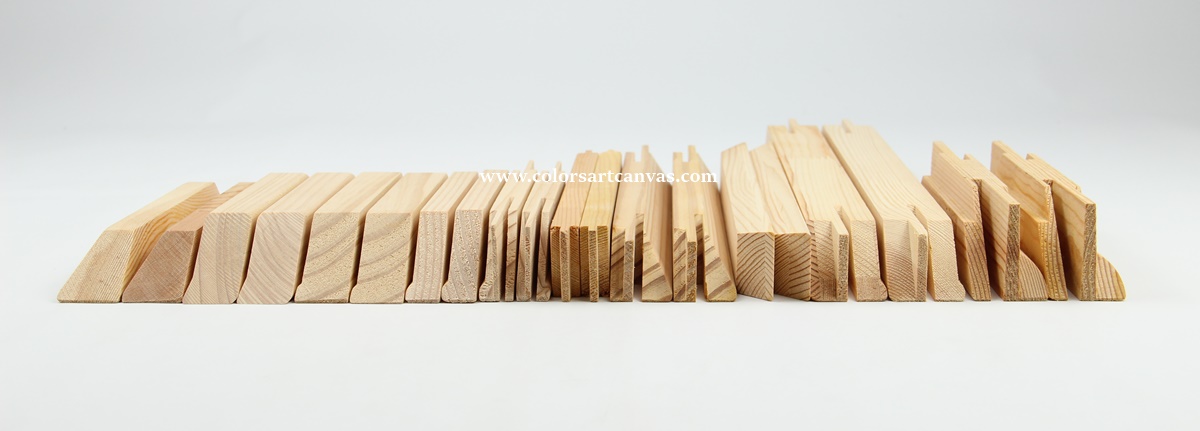
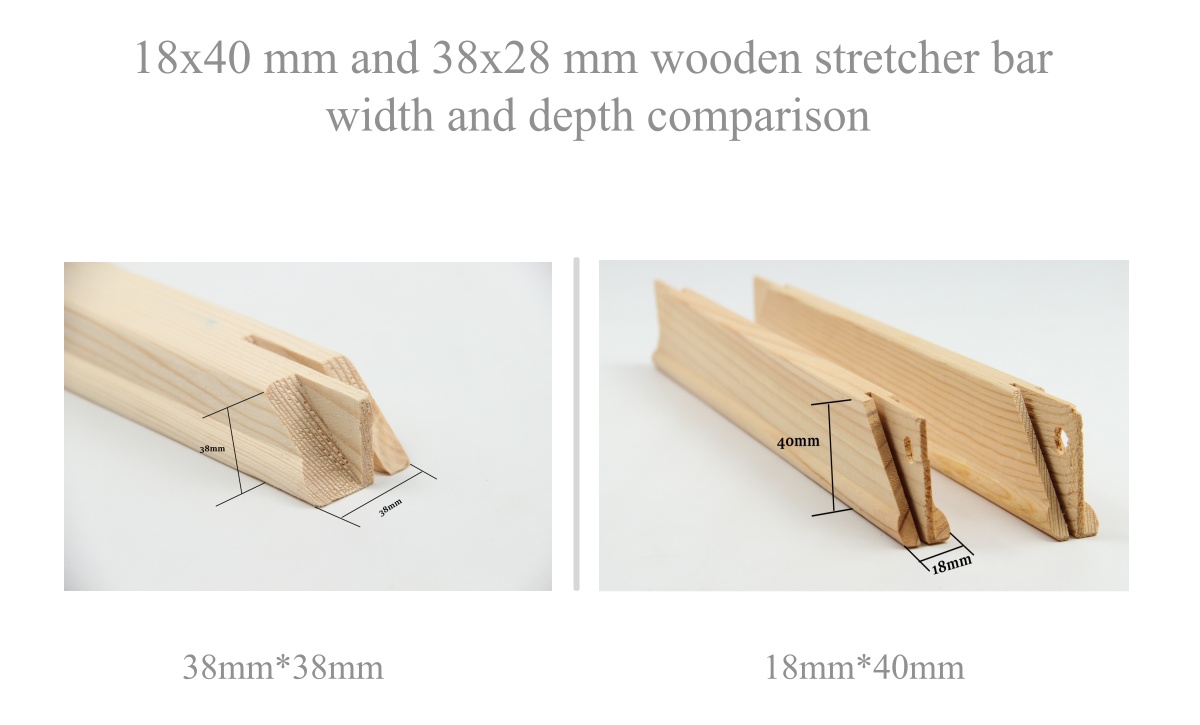
A specification such as 18×40 mm or 38×28 mm provides important dimensional information, but those two numbers do not fully define the performance of the machined wooden profile.
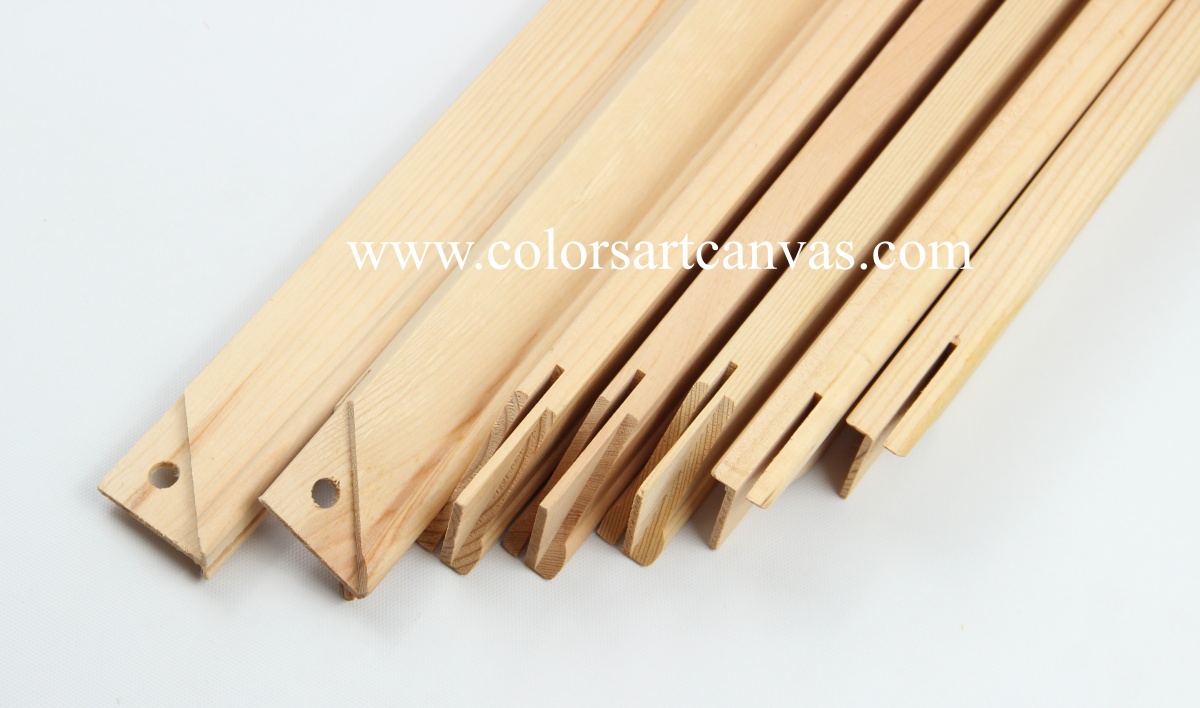
A stretcher-bar cross-section can include:
overall wall depth,
overall structural width,
a raised canvas-contact lip,
a rounded working edge,
an inclined or sloped face,
rear relief or material removal,
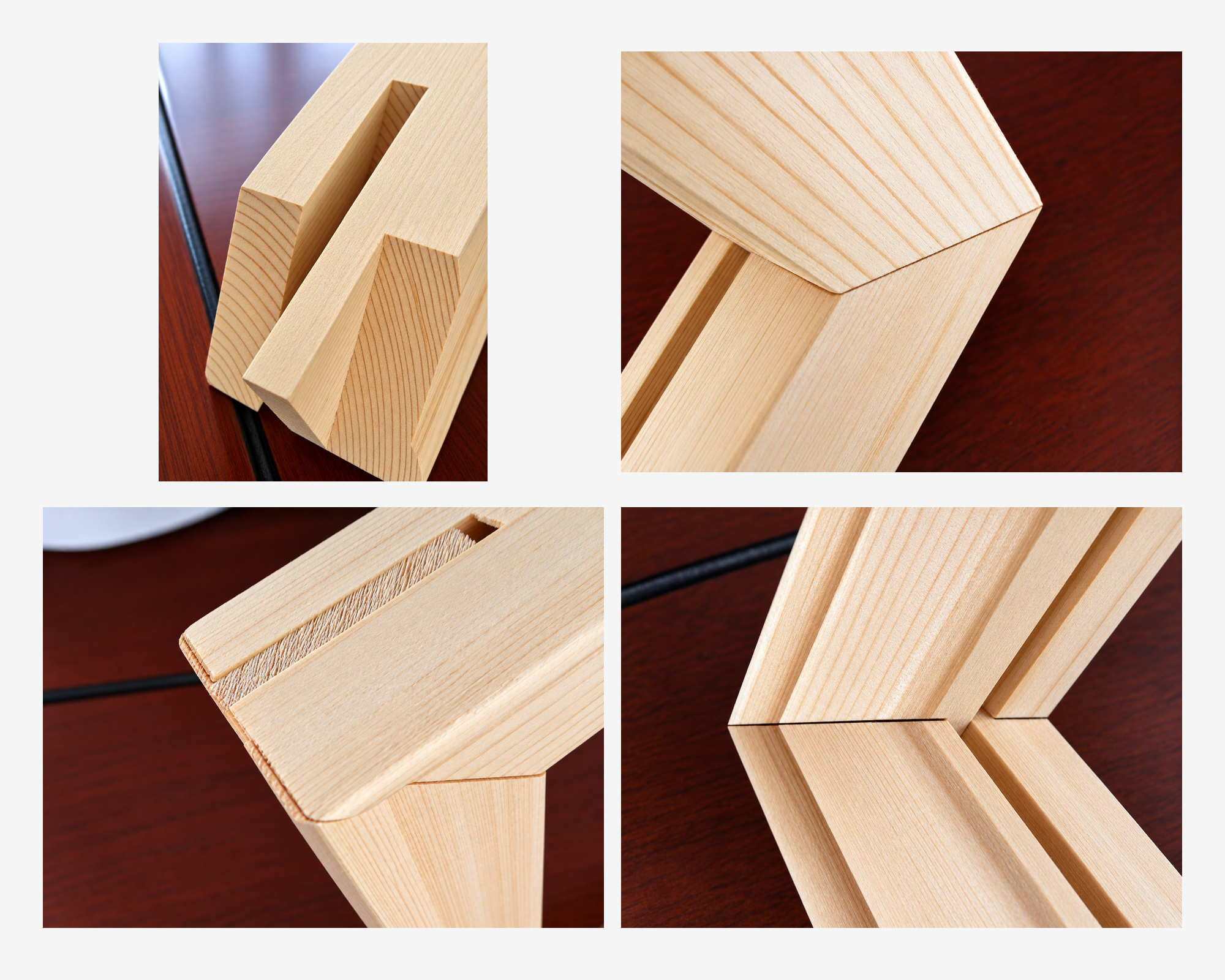
corner-joint machining,
brace or support interfaces.
Depth
Depth has a strong influence on the visible side of a finished Gallery Wrap canvas. A deeper profile generally creates a stronger three-dimensional wall presence.
Width
Width affects the amount and distribution of timber within the frame section. A wider wooden body can contribute to structural resistance, but width should still be evaluated together with the complete cross-sectional shape.
Cross-Section Geometry
Two bars with similar nominal width and depth may distribute timber differently. A square section, a sloped section and a section with significant rear relief should not be assumed to perform identically.
A shallow, wider stretcher-bar profile and a deep, narrower profile can serve very different structural and visual requirements.
Why This Matters in Purchasing
A buyer comparing quotations should therefore ask for more than:
“What is the thickness?”
A better specification asks:
What are the profile width, depth, working-edge geometry, finished frame-size range and support requirements?
4. Light and Slim Stretcher Bar Profiles
Light and slim profiles are useful when the finished canvas does not require a large structural wooden section.
Possible advantages include:
lower finished-frame weight,
efficient timber use,
smaller packing volume,
easier manual handling,
fast assembly for volume production,
lower unnecessary material cost for smaller frames.
Colors Art produces slim profile dimensions including examples such as:
16×30 mm, 17×30 mm, 18×37 mm and 18×40 mm.
Does Light Duty Mean Economy Quality?
No.
Structural duty and manufacturing quality are different concepts. A carefully machined slim profile made from properly controlled timber can be suitable for a premium small-format canvas program.
Conversely, simply increasing the dimensions of a profile cannot compensate for poor straightness, unstable timber, inaccurate joints or inconsistent machining.
Slim stretcher-bar profiles can reduce frame weight and timber use when the section is appropriate for the intended frame size, tension and support system.
5. Standard and Medium-Duty Stretcher Bar Profiles
The word Standard is frequently used in the stretcher-bar market, but it does not refer to one internationally standardized cross-section.
A manufacturer's standard profile normally represents a general-purpose design intended to balance:
rigidity + weight + timber use + production efficiency + cost.
Depending on the design, a standard or medium profile may be relatively shallow and wide, nearly square, moderately deep, rounded or inclined.
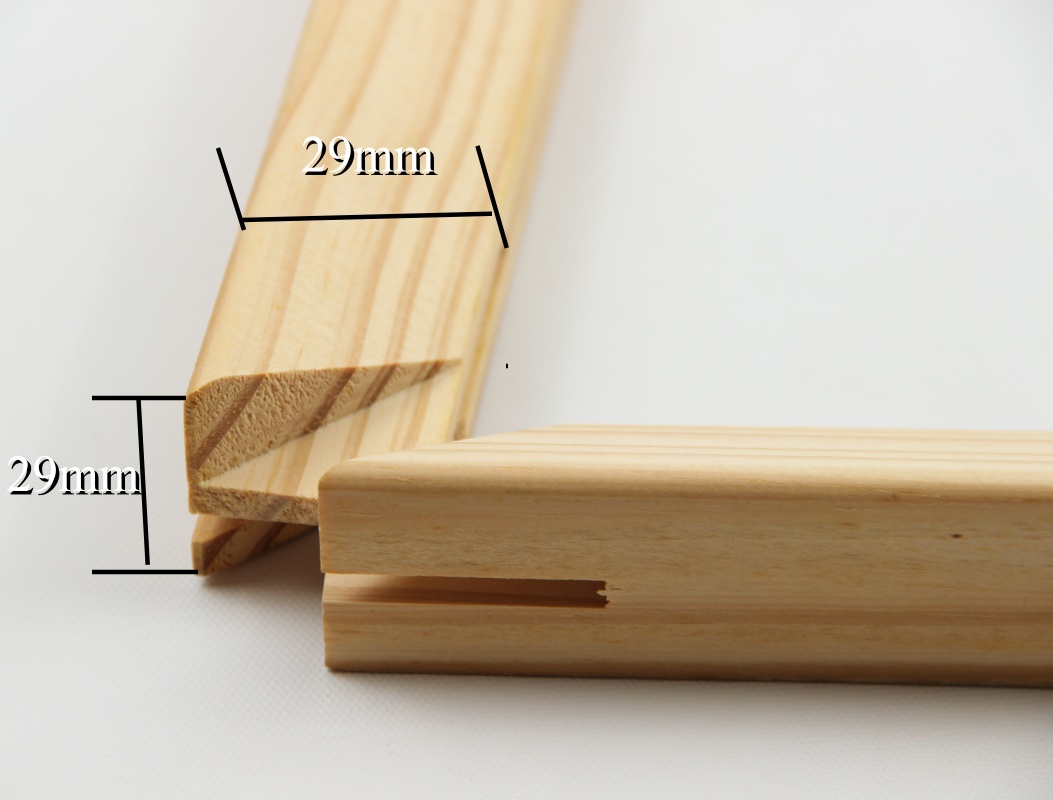
Colors Art can produce multiple commercial profile dimensions depending on the required geometry, including sizes such as 29×29 mm, 30×30 mm and 30×40 mm.
Do Not Compare Dimensions Without Comparing Geometry
A 30×30 mm profile from one supplier should not automatically be treated as structurally equivalent to every other 30×30 mm product.
The buyer should also compare:
the amount of timber removed from the rear profile,
the width and height of the raised working edge,
the radius of the canvas-contact area,
wood species and grade,
corner construction,
brace compatibility.
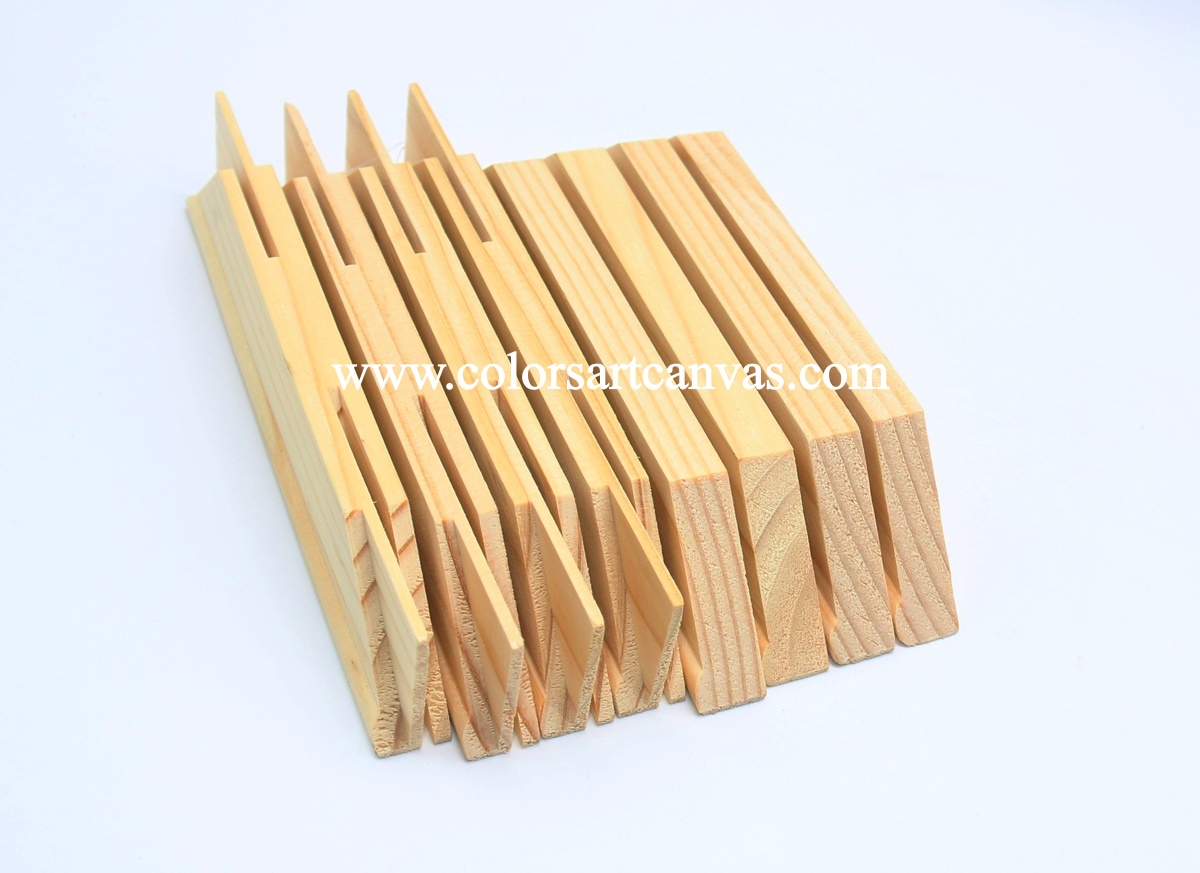
Nominal dimensions do not completely describe a stretcher bar. Profiles with similar outside dimensions may use different working-face, rear-profile and timber-distribution geometry.
6. Gallery Wrap Is a Display Style, Not Automatically a Duty Class
Gallery Wrap describes how the finished canvas is presented. The canvas extends around the visible sides of the stretcher frame and is normally secured on the back.
Because the wooden frame edge becomes part of the finished visual presentation, profile depth becomes an important design variable.
A deeper profile can provide:
a stronger three-dimensional wall presence,
a frameless contemporary appearance,
a deeper wrapped image edge,
greater visual separation from the wall.
But depth alone does not determine structural strength.
Gallery Wrap describes presentation. Heavy Duty describes structural demand.
A Gallery Wrap profile can therefore be relatively material-efficient, medium structural or genuinely heavy duty depending on its width, geometry, finished frame dimensions and support system.
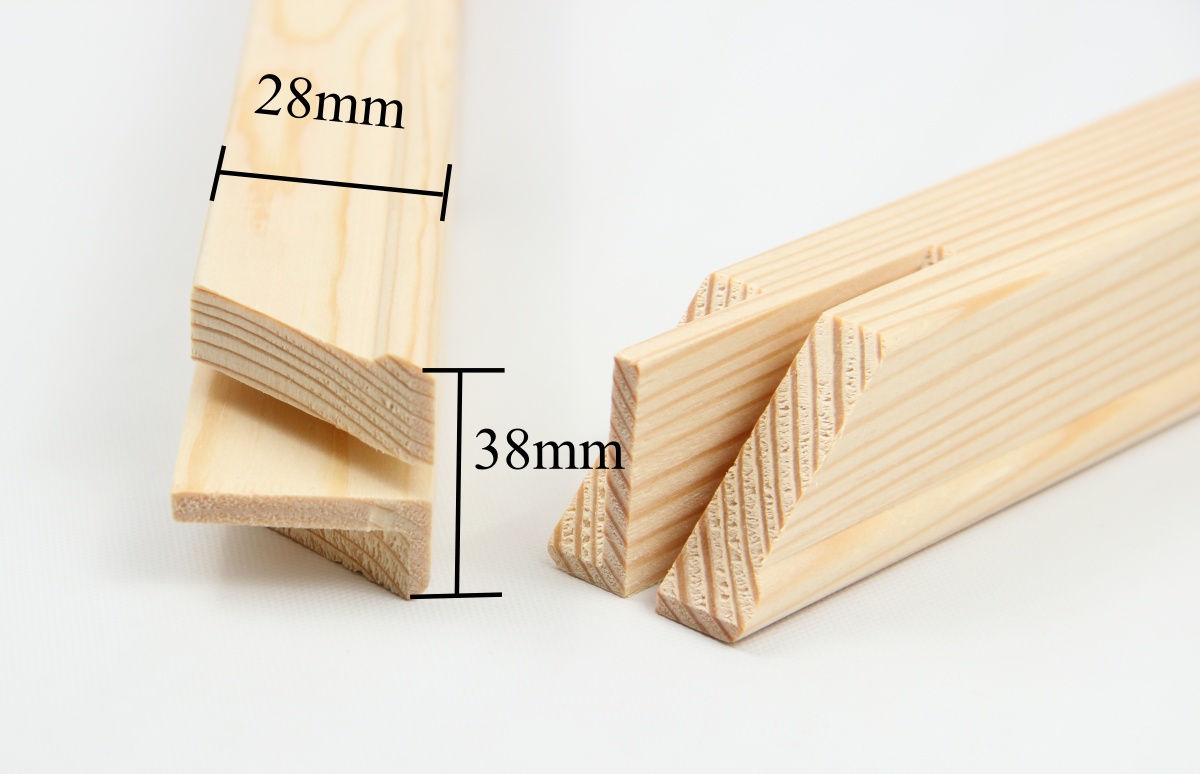
7. Colors Art 38×28 mm: A Practical Economy Gallery Wrap Example
Colors Art's 38×28 mm pine Gallery Wrap profile is a useful example of how visible depth and structural width can be optimized separately.
The profile combines:
38 mm nominal frame depth,
28 mm wood width,
pine construction,
Gallery Wrap application,
cross-bar availability,
standard or custom lengths,
OEM production options.
The 38 mm depth provides the substantial visible side expected from Gallery Wrap wall art, while the 28 mm width helps control frame weight, timber use and production cost.
Why This Matters for High-Volume Wall Art
For large-volume photo canvas and decorative wall-art production, the deepest and widest possible bar is not necessarily the most economical solution.
The objective is to achieve the required:
appearance + rigidity + production speed + acceptable cost.
The Colors Art 38×28 mm Gallery Wrap profile combines a substantial 38 mm visible frame depth with a controlled 28 mm structural width.
38×28 mm vs 38×38 mm: Nominal Rectangular Envelope
A simple outside-envelope calculation illustrates the dimensional difference:
Nominal Profile
Rectangular Envelope
38×28 mm
1,064 mm²
38×38 mm
1,444 mm²
Using only the outside rectangular envelope, 38×28 mm is approximately 26.3% smaller than 38×38 mm.
However, this is not the actual timber cross-sectional area.
Real timber consumption depends on the machined cross-section, including raised lips, slopes, grooves, rounded transitions and rear relief. Accurate timber-volume comparison should therefore use the real CAD cross-sectional area.
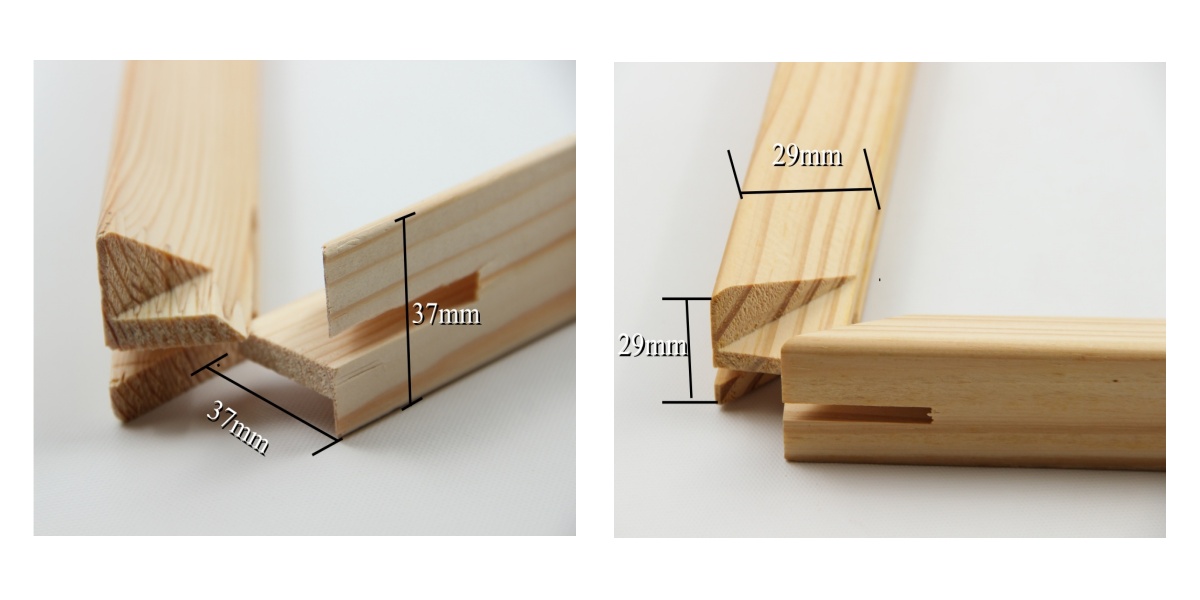
Another important reason not to classify stretcher bars from outside dimensions alone is the existence of inclined and sloped profile designs.
Colors Art produces inclined-profile families including:
29×29 mm,
37×37 mm Incline,
38×37 mm Incline.
The 29×29 mm and 37×37 mm inclined versions belong to the same profile-geometry family, with the 37×37 mm section being a proportionally larger version.
This kind of relationship is much more useful to a technical buyer than simply comparing a list of nominal dimensions.
The 29×29 mm and 37×37 mm inclined profiles share the same basic cross-section geometry family at different overall scales.
The Canvas-Contact Transition Matters
The working edge is not simply a decorative part of the moulding. It determines how the stretched canvas approaches and passes over the wooden frame.
In the 29×29 mm inclined profile family, the working transition includes a smooth radius rather than a sharp right-angle edge.
This allows the stretched canvas to transition over a rounded surface instead of being forced around an unnecessarily sharp corner.
The canvas-contact transition should be evaluated separately from overall profile size. A smooth radius avoids an unnecessarily sharp working corner.
9. Heavy-Duty and Large-Format Stretcher Bar Profiles
As finished canvas dimensions increase, the outer wooden frame must maintain its geometry over longer spans while resisting the forces created by stretching and handling.
Larger structural profiles may therefore be considered for:
large canvas prints,
professional artist canvas,
oversized wall art,
hospitality projects,
commercial interior decoration,
large OEM canvas programs.
Colors Art larger profile options include dimensions such as:
40×40 mm, 45×40 mm, 50×40 mm and 55×40 mm.
These provide larger wooden sections for applications requiring greater structural capacity. However, the nominal dimension should still not be used as the only criterion.
Heavy Duty Is a System, Not Just a Large Piece of Wood
Professional large-frame selection should consider:
actual cross-sectional geometry,
finished frame width and height,
aspect ratio,
wood species and grade,
joint construction,
canvas composition,
stretching tension,
centre or cross-bracing system.
For larger frames, the outer profile and internal support system should be evaluated together.
Larger wooden sections provide options for more structurally demanding canvas frames, but final profile selection must still consider geometry, frame size and support.
10. Centre Bars, Cross Braces and Support Systems
A common buyer question is: At what frame size must we add a cross brace?
There is no single universal answer.
Brace requirements depend on:
outer profile stiffness,
finished frame width and height,
aspect ratio,
canvas tension,
timber properties,
joint construction,
transport and use conditions.
Typical Support Directions
Support Configuration
General Application Direction
No Internal Brace
Smaller frames within the validated range of the selected outer profile
Single Centre Bar
Longer span requiring reinforcement in one primary direction
Cross Brace
Larger frames requiring reinforcement in two directions
Multiple Supporting Bars
Large, panoramic or oversized frame structures
Centre bars, cross braces and multi-brace structures should be selected together with the outer stretcher-bar profile and finished frame dimensions.
Why Aspect Ratio Matters
A 100×100 cm square frame does not behave exactly like a 50×150 cm panoramic frame.
Long narrow frames can place greater demands on one unsupported direction. Therefore, professional buyers should provide the complete finished-size program instead of asking only for a single maximum bar length.
gives the supplier much more useful structural information than simply stating: “maximum length 150 cm.”
11. Canvas Type, GSM and Stretching Tension
Heavier canvas does not automatically mean that the largest stretcher bar should be used.
GSM is useful information, but structural demand is affected by more than weight.
Buyers should also consider:
fiber composition,
fabric weave and construction,
coating or priming system,
fabric elongation,
stretching tension,
finished frame size,
manual or automated stretching method.
A relatively lightweight canvas stretched at high tension over a large frame can still create demanding structural conditions.
A heavier canvas on a smaller frame does not automatically require a Heavy Duty outer profile.
Canvas type + frame dimensions + stretching tension + outer profile + bracing should be considered together.
12. Wood Species, Grade and Manufacturing Quality
Profile dimensions tell only part of the story. The timber and machining process also influence the quality of the final frame.
Important factors include:
wood species,
density and grain condition,
wood grade,
knots and natural defects,
moisture condition,
straightness,
profile accuracy,
joint machining,
surface sanding and handling quality.
Knot-Free Wood vs Selected Wood with Knots
Different markets can require different timber grades.
A premium artist-canvas program may prefer clean knot-free pine for visual and consistency reasons.
A high-volume economy wall-art program may accept selected pine containing small, tight or sound knots when those knots do not compromise machining, straightness or the approved product standard.
That leads to another important distinction:
Wood appearance and structural performance are related quality considerations, but they are not exactly the same specification.
13. Moisture, Straightness and Dimensional Quality Control
Wood moisture content is an important specification for stretcher bars because wood can absorb and release moisture as environmental conditions change.
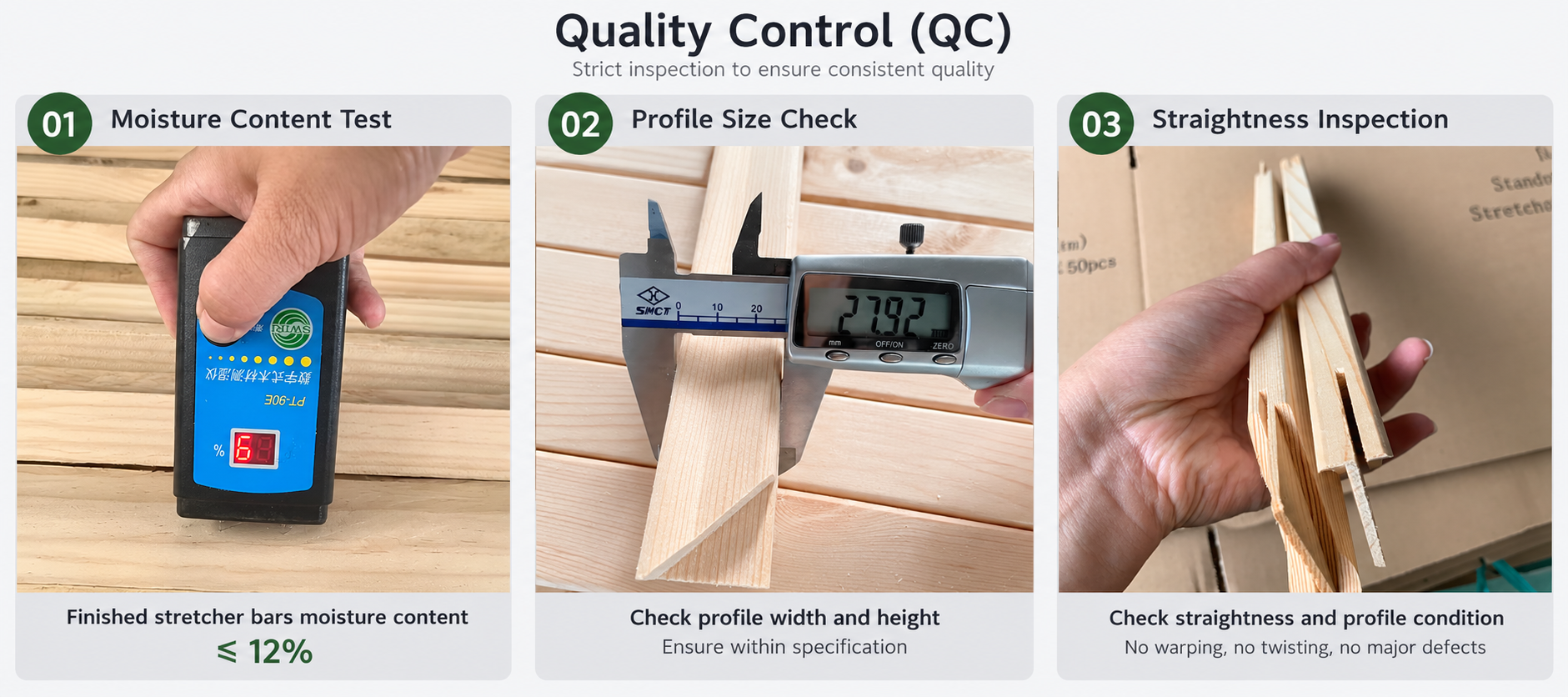
At Colors Art, finished wooden stretcher bars are required to have a moisture content of 12% or below before shipment.
However, meeting the moisture requirement alone does not automatically guarantee that every stretcher bar is acceptable.
Finished-product inspection should also consider:
straightness,
bow and twist,
profile dimensions,
finished length,
joint machining,
surface quality,
frame squareness when assembled,
brace fit where required.
The correct QC question is therefore not only:
“What is the moisture content?”
It is:
How are timber condition, moisture, straightness, dimensions and machining controlled together?
Moisture content, profile dimensions and straightness should be inspected together. Colors Art requires finished wooden stretcher bars to be at 12% moisture content or below before shipment.
14. Economy, Commercial, Premium and Professional Are Not Duty Classes
Another important sourcing mistake is assuming:
Light Duty = Economy Heavy Duty = Premium
This is not necessarily correct.
Target Market
Main Purchasing Priority
Profile Direction to Evaluate
Economy Photo Canvas
Low weight, cost and production efficiency
Light / Slim
High-Volume Wall Art
Repeatability and cost balance
Light / Standard
Economy Gallery Wrap
Deep appearance with controlled timber use
Material-efficient Gallery profile such as 38×28 mm
Mainstream Printed Canvas
Strength and commercial cost balance
Standard / Medium direction
Premium Gallery Wrap
Visible side appearance, timber and finishing consistency
Gallery profile selected according to finished size
Professional Artist Canvas
Stability and tension performance
Profile selected according to actual dimensions and canvas system
Large-Format Wall Art
Structural rigidity
Larger structural profile
Hospitality / Commercial Interiors
Repeatability and dimensional stability
Outer profile + planned support system
Oversized Canvas
Complete structural performance
Large profile + engineered bracing
A Premium Product Can Still Use a Slim Profile
A small-format professional artist canvas does not automatically need a very large Heavy Duty bar.
If the frame dimensions are moderate, a clean, straight, accurately machined, high-quality slim profile may be entirely appropriate.
An Economy Product Can Still Need a Larger Profile
Conversely, an economy large-format wall-art program may require a larger section or additional braces because structural demand is created by frame dimensions, not simply by the retail price of the finished artwork.
15. Compare Cost per Finished Frame — Not Only Price per Metre
For B2B purchasing, the lowest bar price per metre does not always create the lowest total production cost.
A more complete calculation can include:
outer stretcher-bar cost,
cross-bar or brace cost,
assembly labor,
corner-fit consistency,
reject rate,
rework,
packing volume,
shipping weight,
finished-frame claims,
production speed.
Example: Why a Wider Bar Is Not Automatically Better Value
If an unnecessarily wide profile increases timber use, packing weight and purchase price without providing meaningful benefit for the validated frame-size range, the extra section may simply add cost.
Why an Extremely Light Profile Can Also Be Expensive
On the other hand, a profile that is too light for the intended frame size may require additional braces, increase rejects or cause assembly and stability problems.
The correct objective is not the cheapest piece of wood. It is the lowest practical cost per acceptable finished frame.
16. What Information Should Be Included in a Stretcher-Bar RFQ?
A professional quotation becomes much more accurate when the supplier receives the complete production requirement.
RFQ Parameter
Example
Why It Matters
Finished frame sizes
40×60 / 60×90 / 70×100 cm
Determines span and support requirements
Profile
17×30 / 38×28 / customer drawing
Defines the starting geometry
Canvas material
Polyester / cotton / polycotton / linen
Affects stretching behaviour
Canvas weight
Actual GSM where known
Provides additional material information
Display style
Framed / Gallery Wrap
Determines visible-side requirements
Wood species
Pine / fir / specified timber
Affects sourcing and product structure
Wood grade
Knot-free / selected sound knots
Affects visual and commercial grade
Moisture requirement
Specified finished-product limit
Supports timber-condition control
Joint type
Tenoned / miter cut / long moulding
Affects assembly method
Bracing
None / centre / cross / multiple bars
Affects large-frame performance
Profile tolerance
According to approved specification
Supports repeat production
Packing
Carton / bundle / pallet / OEM
Affects handling and logistics
Quantity
Pieces / sets / metres / container
Required for production costing
Target market
Economy / commercial / premium / professional
Helps align quality and cost expectations
The more complete the RFQ, the easier it is to evaluate the actual frame system instead of simply quoting one profile by price per metre.
17. How to Approve a Stretcher-Bar Sample Before Bulk Production
A good-looking loose wooden bar should not be the only basis for sample approval.
The sample should be evaluated in the way it will actually be used.
Measure the nominal dimensions. Check profile width, depth and relevant machined features.
Compare the real cross-section. Match it with the approved drawing or physical reference sample.
Inspect straightness. Long pieces should be checked for visible bow and twist.
Check the corner joint. Assemble the real frame rather than inspecting loose bars only.
Inspect the canvas-contact edge. Check the working lip, radius and surface condition.
Measure moisture. Sample multiple pieces rather than relying on one selected reading.
Check frame squareness. Compare finished dimensions and diagonals after assembly.
Use the intended canvas. Test with the real production material and realistic stretching conditions where possible.
Test the planned bracing. Use the actual centre or cross-bar configuration required for production.
Evaluate repeatability. An approved sample is useful only if bulk production can consistently reproduce it.
Technical drawing + complete finished-size program
Frequently Asked Questions About Stretcher Bar Profiles
What size is a Light Duty stretcher bar?
There is no universal dimensional definition of a Light Duty stretcher bar. Relatively slim wooden sections are commonly used for smaller or less structurally demanding frames, but the real classification also depends on width, cross-section geometry, frame size, canvas tension and support.
Is a 38 mm deep stretcher bar automatically Heavy Duty?
No. A 38 mm depth can be used in a Gallery Wrap profile without automatically making the complete frame Heavy Duty. Structural width, cross-section geometry, finished frame size and bracing must also be considered.
Is Gallery Wrap the same as Heavy Duty?
No. Gallery Wrap primarily describes how the canvas wraps around the visible sides of the frame. Heavy Duty describes structural requirements.
Can an economy canvas use a deep stretcher-bar profile?
Yes. A profile can provide a substantial visible Gallery Wrap side while controlling structural width and timber use. The Colors Art 38×28 mm Gallery Wrap profile is one example.
Does a larger profile always mean a stronger stretcher bar?
Not necessarily. Larger outside dimensions can provide more structural potential, but actual performance also depends on the true cross-section, timber distribution, wood quality, joints and bracing.
Does heavier canvas always require Heavy Duty stretcher bars?
No. Canvas GSM is only one variable. Fabric construction, elongation, stretching tension, frame size and support must also be considered.
When should a canvas frame use a centre bar or cross brace?
There is no universal size threshold. Brace requirements depend on the outer profile, frame dimensions, aspect ratio, canvas tension and complete frame system.
Why is the rounded canvas-contact edge important?
The working edge affects the transition of the stretched canvas over the wooden frame. A smooth radius avoids forcing the canvas around an unnecessarily sharp corner.
What moisture content does Colors Art require for finished stretcher bars?
Colors Art requires finished wooden stretcher bars to have a moisture content of 12% or below before shipment. Moisture is evaluated together with straightness, dimensions, machining and other quality-control factors.
Is knot-free wood always structurally stronger?
Not automatically. Knot-free timber can be desirable for appearance and consistency, but structural suitability still depends on the complete timber grade, grain, moisture, straightness, dimensions and frame design.
Can Colors Art manufacture custom stretcher-bar profiles?
Yes. OEM profiles can be evaluated from technical drawings, physical samples, required dimensions, wood grade, finished frame sizes, joint structure, bracing and packing requirements.
Choose a Complete Canvas Frame System — Not Just a Profile Dimension
The most important lesson is that a stretcher bar should not be selected from width and depth alone.